Faulty culverts are harming or killing fish. N.S. environmentalists want that to change
CBC
A Nova Scotia man who fishes in the Minas Basin says he routinely sees the harm that faulty culverts cause fish.
In some cases, Darren Porter says, the results are deadly.
Porter, a commercial fisherman and environmentalist, points to a pair of culverts on the Halfway River near Hantsport, N.S., where strong currents during high tide propel fish through them with such force that it can maim or even kill them.
“Just imagine the fish being pulled through or shoved through that," he said. "It’s inhumane.”
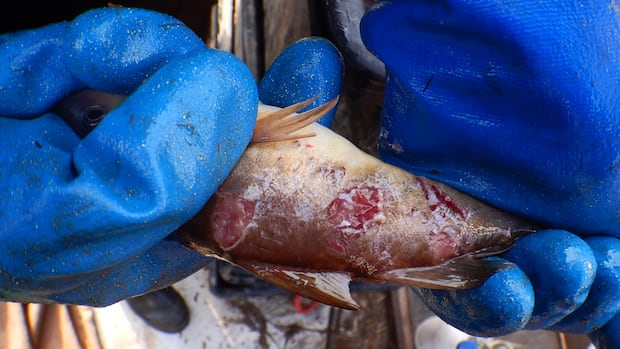
Porter has documented the injuries to fish in photographs that reveal deep wounds, hemorrhaging and even prolapse, the protrusion of internal organs due to trauma.
Faulty culverts are far from a rare problem. Thomas Sweeney, a habitat biologist with the Nova Scotia Salmon Association, says that between 50 and 60 per cent of Nova Scotia’s 31,000 water crossings — where roads cross streams or rivers — cause problems for fish passage.
A 2023 Fisheries and Oceans Canada report found similar results: between 45 and 57 per cent of culverts in four major Nova Scotia watersheds — the Annapolis, Shubenacadie, St. Mary’s and LaHave — were classified as barriers to fish.
“In many ways, it’s death by a thousand cuts. When [the fish] hit barriers, their populations are threatened across a lot of their range,” said Sweeney, adding that migratory species such as salmon are the most affected.
Problems can include culverts that are damaged, obstructed by debris or poorly designed, either not allowing sufficient water to pass or having too much water rushing through at a high velocity.
Porter wants DFO to hold culvert owners accountable by more actively enforcing the Fisheries Act, particularly Section 35 that prohibits harming or destroying fish habitat. Violating that section can lead to heavy fines and even prison time.
“As soon as you start enforcing the law, people come into compliance," he said. "Once people come into compliance, we fix the problem. It’s pretty simple. Until that happens, we’re dead in the water.”
Culvert owners can be government agencies, municipalities, industries or private landowners.
Nova Scotia’s Department of Public Works, which owns many of the province’s culverts, confirmed it does not track how many negatively impact fish passage.
“When Public Works receives an order from DFO, we make the necessary changes. We do not track the number or type of orders we receive,” a department spokesperson said in an email, declining further comment.


The federal government is putting $200 million toward a Canadian-owned launch pad to send satellites into orbit.

Paige Eaton wanted to stay open-minded about the birth plan for her first baby, so when she ended up needing an emergency C-section, the Kitchener, Ont., resident felt somewhat prepared.

This story is part of CBC Health's Second Opinion, a weekly analysis of health and medical science news emailed to subscribers on Saturday mornings. If you haven't subscribed yet, you can do that by clicking here.

Lac La Ronge Indian Band's Woodland Wellness Centre has received funding to start a mobile addictions outreach program to address the opioid and mental health crisis.

Adriana Avelina Ruíz Márquez uses fake eyelash glue to attach a tiny transmitter to the thorax, just behind the head, of the monarch butterfly.

After several delays to the mission that will take four astronauts around the moon, NASA held a press conference today announcing that Artemis II is on track to launch as early as April 1.

Snuneymuxw First Nation is calling for a temporary closure and environmental investigation of a hazardous waste services company following a January oil spill on Duke Point near Nanaimo, B.C.

In February, five people were killed in separate avalanches across B.C. and Alberta. That same month, more than a dozen people were killed in California and Utah, including a particularly deadly avalanche that claimed the lives of nine. In Europe, from Andorra to Slovakia, the season has recorded 125 deaths from avalanches so far.

Getting a proper vehicle to transport people for urgent medical care is an ongoing challenge in fly-in First Nations in northwestern Ontario.

A new supergroup of musicians from Six Nations of the Grand River and Mississaugas of the Credit First Nation have collaborated on a Robbie Robertson-inspired song they will perform at the Junos Honouring Ceremony later this month in Hamilton.

People as young as 45 should be invited to provincial and territorial programs to screen for colorectal cancer, the Canadian Cancer Society urged on Wednesday.

The Métis Nation-Saskatchewan (MN-S) has opened an office and retail space in Ottawa to create a stronger presence in the capital since removing itself from the Métis National Council in 2024.

Toronto resident Winhan Wong's lung cancer journey began in 2016, with a nagging cough that just wouldn't go away.