Farmers at the bottom of the food chain Premium
The Hindu
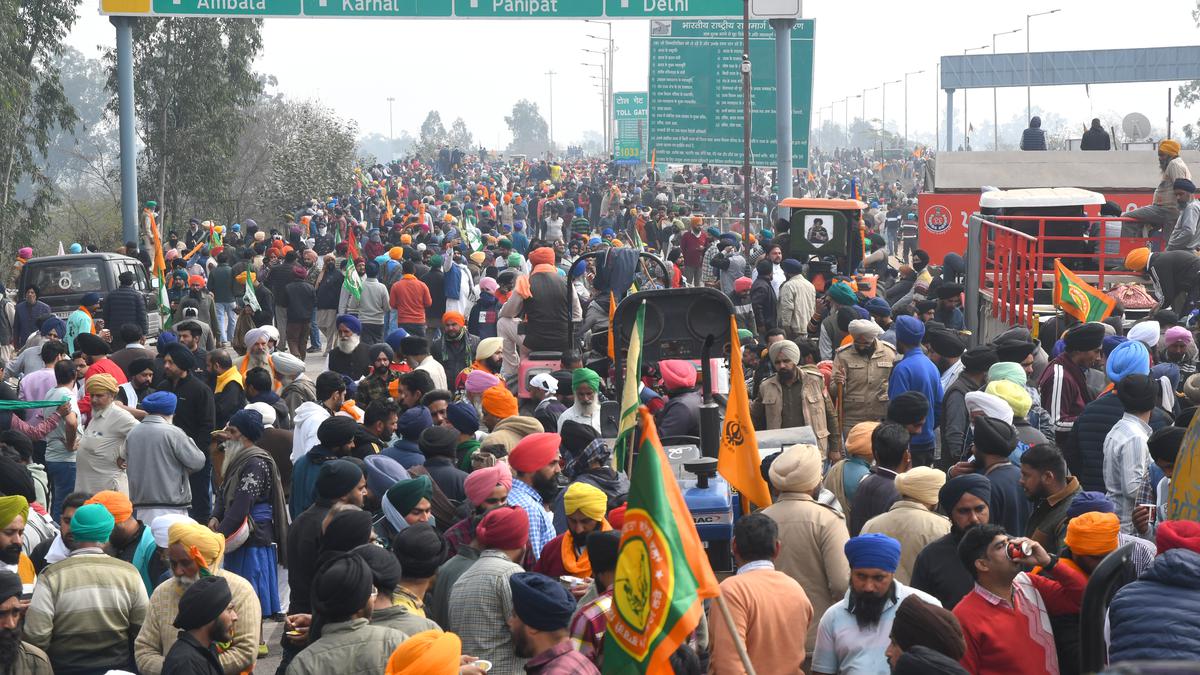
Farmers and agriculture workers protest in Delhi, demanding a legally guaranteed minimum support price and other reforms.
The scenes of farmers and agriculture workers protesting at Delhi’s borders are a throwback to 2020-21: long lines of about 1,000 trolleys attached to brightly-coloured tractors, large dekchis of sweet chai boiling on wood-fuelled stoves to serve hundreds, voices of peacefully organised dissent. In this time’s Delhi Chalo call, though, police and paramilitary forces are ‘better prepared’: on Day 1 of the protest that began on February 13, concrete barricades, 10-12 layers deep, were in place; nearly 4,500 tear gas shells were fired to disperse gatherings on the Haryana-Punjab border, most using drones; the number of Delhi Police personnel swelled to 6,000.
On February 14, the day of Basant Panchami, farmers flew kites, traditional for the first day of spring, and called for a grameen (rural) and industrial strike on February 16. Rail tracks will be blocked; so will roads, with support from truckers and transporters. Movement into and out of Delhi will be halted, even as the city is turned into a fortress citing security.
The farmers’ main demand is a legally guaranteed minimum support price (MSP), with about 12 other asks, including the banning of foreign direct investment (FDI) and corporatisation of agriculture. The protest on the Punjab-Haryana side is led by two groups: the Samyukt Kisan Morcha (SKM) formed in November 2020 in Delhi’s Gurdwara Sri Rakab Ganj Sahib, after three controversial laws farmers said heralded corporatisation was enacted in Parliament; and the SKM (Non-Political), a splinter section that has the support of about 200 organisations. The SKM is an umbrella for about 500 groups and works closely with 10 main central trade unions that collectively have a 6 crore membership.
On February 14, Shardanand Solanki, a lawyer in his 80s and the SKM’s Sonipat district leader in Haryana, addresses about 100 farmers near Bhadana village in Sonipat. There are many micro-meetings being conducted on varied issues. This one is on the laying of high-tension power cable posts in the fields. “The governments at the Centre and the State are doing this without even legally acquiring farmlands,” says Solanki.
On a stage, one of about 20 minor ones in the area bordering Delhi, he compares police action against farmers to lathi charge injuries suffered by freedom fighter Lala Lajpat Rai in 1928, during the Simon Commission visit to Lahore. He also tells listeners not to get sucked into whether the SKM or SKM-NP is leading the protest.
Solanki, a white-haired farmer sporting a blazer, says to his compatriots, “Jitna daman karega, kisan utna mazboot hoga (Repression will strengthen the farmers). He uses Rai’s famous statement about lathi blows being “like coffin nails for British imperialism”, changing it to: “Each lash that lands on farmers’ bodies will act as a nail in the coffin of the Narendra Modi government.” On February 11, the SKM had issued a press release in solidarity with farmers in the EU, where farmers are agitating. The communication urged the Central government to “learn a lesson from struggles in Europe”.
Over the last few weeks, as the fanfare around the Ram temple in Ayodhya reached a crescendo, the SKM visited about 25,000 villages with the message of “livelihood issues” over “Hindutva politics”. Several farmers’ organisations that work with the SKM-NP had or continue to have the support of the volunteer-based Rashtriya Swayamsevak Sangh (RSS).


Supreme Court affirms the public's right to critique its judgments while addressing concerns over an NCERT textbook's content.

Amit Shah reviews Manipur's security, urging the CM to tackle drug cartels and aid displaced communities after ethnic violence.

Kerala's fisherfolk urge political parties to address livelihood concerns, demanding fair pricing, rule enforcement, and better support during elections.

Moderate rainfall in Visakhapatnam brings relief but causes traffic disruptions and power outages across the city.

Shubman Gill’s Gujarat Titans banks on its tried-and-tested formula

Agriculture Ministry reviews unseasonal rains' impact, assesses farm losses, and discusses relief measures for affected farmers.

Premium petrol prices rise by ₹2 per litre, but government claims no impact on the common man amidst global oil tensions.

Kum. Veerabhadrappa’s acclaimed novel Aramane has been adapted into a television serial. Kannada channel DD Chandana (Doordarshan) has launched the serial with the same name. National Award-winning filmmaker Mansore is the director behind the project,

Diya Chitale and Manav Thakkar reach semifinals, while Yashaswini Ghorpade upsets top seed Sreeja Akula at National TT Championships.

DYFI criticizes A.P.'s job calendar for failing unemployed youth, demanding a revision to include 1 lakh posts and higher age limits.

‘Lethargic’ officials who left Chambal sanctuary to the mercy of sand miners will be held liable: SC
Supreme Court holds negligent officials accountable for enabling illegal sand mining in Chambal Sanctuary, emphasizing habitat protection laws.

Work on the Srisailam Left Bank Canal tunnel resumes after 13 months, with completion targeted by 2027-end, says Minister Reddy.

Ancient ‘Vanni’ tree at Sri Meenakshi Sundareswarar Temple tilts; steps on to restore it