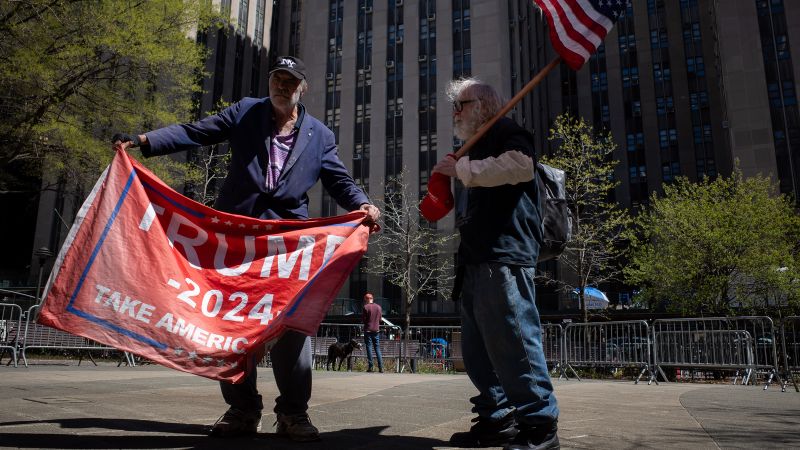
Fact check: Trump falsely claims police turned away ‘thousands’ from Manhattan courthouse and that supporters ‘can’t get near’
CNN
Former President Donald Trump is a famed exaggerator about the size of his crowds. For years, he has lied about how many supporters attended his presidential inauguration and numerous campaign rallies.
Former President Donald Trump is a famed exaggerator of the size of his crowds. For years, he has lied about how many supporters attended his presidential inauguration and numerous campaign rallies. Now he’s pushing a wildly inaccurate claim about how many supporters have attempted to show up at his first criminal trial – and he’s making additional false claims about security measures around the Manhattan courthouse, which he is baselessly blaming for keeping these supposed supporters away. After The New York Times published a story that said Trump was unhappy with the meager crowd he saw when he arrived at the courthouse for opening statements on Monday, Trump posted on social media on Tuesday to deny the story, denigrate a Times reporter and make this claim: “Thousands of people were turned away from the Courthouse in Lower Manhattan by steel stanchions and police, literally blocks from the tiny side door from where I enter and leave. It is an armed camp to keep people away.” Trump also wrote on social media on Monday that “Lower Manhattan surrounding the Courthouse, where I am heading now, is completely CLOSED DOWN.” And he told reporters inside the courthouse on Tuesday: “For blocks you can’t get near this courthouse.” Facts First: Trump’s claims are all false. The police have not turned away “thousands of people” from the courthouse during his trial; only a handful of Trump supporters have shown up to demonstrate near the building. And while there are various security measures in place in the area, including some street closures enforced by police officers and barricades, it’s not true that “for blocks you can’t get near this courthouse.” In reality, the designated protest zone for the trial is at a park directly across the street from the courthouse – and, in addition, people are permitted to drive right up to the front of the courthouse and walk into the building, which remains open to the public. If people show up early enough in the morning, they can even get into the trial courtroom itself or the overflow room that shows near-live video of the proceedings. CNN journalists reporting from the courthouse area have seen a smattering of visibly pro-Trump demonstrators present in the designated protest zone at Collect Pond Park across from the building, but nowhere even close to “thousands.” There were well under 100 visible Trump supporters gathered there at the outset of the trial in mid-April, and there have often been three or fewer there on subsequent days.


Democrats in Florida are hoping to capitalize on the party’s recent special election overperformances and come out on top Tuesday in a special state House election for a Palm Beach district that includes President Donald Trump’s Mar-a-Lago residence.

The Supreme Court on Monday appeared ready to limit mail-in ballots, a move that would reinforce the justices’ pattern of shrinking voter protections and that has, at bottom, favored Republican interests and the Trump administration.

An Air Canada plane traveling from Montreal collided with an emergency vehicle on the runway at New York City’s LaGuardia Airport in the late hours of Sunday night, killing two pilots and injuring dozens of people.

Top Senate Republicans on Capitol Hill believe their party is unified behind a plan to reopen the Department of Homeland Security. Now, they need to sell the plan to Democrats.

Markwayne Mullin will serve as Donald Trump’s next Department of Homeland Security secretary, elevating the US senator to helm the agency at the center of the president’s controversial immigration enforcement effort and an ongoing shutdown.

President Donald Trump’s sudden turnabout and, according to him, rapidly advancing peace talks made for an abrupt shift in the administration’s approach to the Iran war.

The Supreme Court’s conservative majority appeared dubious of state laws that allow the counting of mail ballots that arrive at election offices after Election Day as justices heard oral arguments in a challenge to Mississippi’s five-day grace period for mail ballots.

The chief district judge in New Jersey appointed Robert Frazer, a career prosecutor, to serve as US attorney for the state, ending for now a dispute over the legality of the office’s leadership that threatened to derail criminal investigations.

Tens of thousands of taxpayer dollars were spent on expenses for hair and makeup artists and a horse for the advertisement showcasing outgoing Department of Homeland Security Secretary Kristi Noem in front of Mount Rushmore, according to invoices seen by CNN.

President Donald Trump was presented Sunday with a potential off-ramp to the more than month-long Department of Homeland Security shutdown: fund every part of the department except enforcement operations by Immigration and Customs Enforcement, two sources familiar with the conversations told CNN.

Immigration and Customs Enforcement agents are heading to 13 airports today to help with crowd management as travelers at some airports wait in hours-long security lines amid the DHS shutdown. Follow here for the latest.

A consortium of the nation’s top architectural and historic preservation groups is targeting President Donald Trump’s plans to temporarily close and extensively renovate the Kennedy Center, filing a new lawsuit Monday that asks a federal judge to indefinitely halt the project.

ICE agents sent to airports as TSA callouts remain high; separately, two people have died after a plane collided with a fire truck at New York’s second biggest airport. Follow for live updates