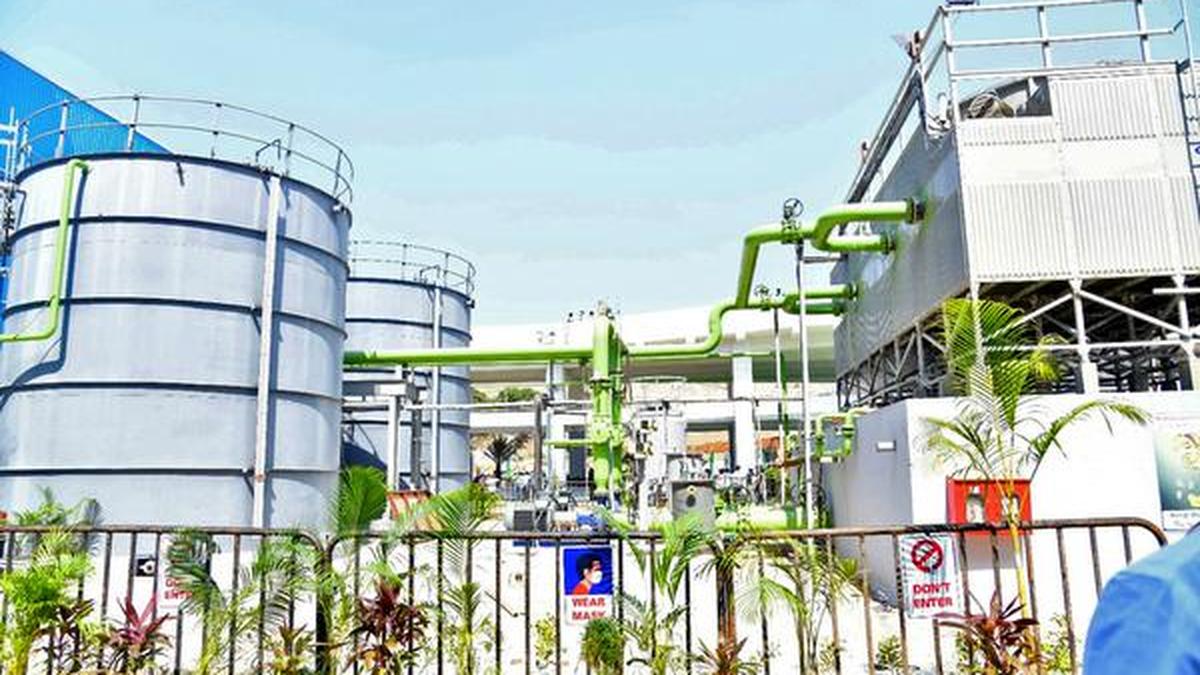
Explained | Why do so many waste-to-energy plants fail? Premium
The Hindu
Anything short of the unwavering support of a municipality, its residents, and the State, and a waste-to-energy plant will become infeasible.
The Kerala government recently announced the State’s first waste-to-energy project in Kozhikode. The planned facility is expected to be built in two years and generate about 6 MW of power.
There are around 100 waste-to-energy projects around the country but only a handful of them are operational, thanks to various production and operation challenges.
Waste-processing infrastructure is a good way to deal with the mountains of waste that Indian cities produce – but to succeed, such projects need the unwavering support of the municipality, its residents, and the State.
Waste-to-energy projects use non-recyclable dry waste to generate electricity. The process increases the State’s power generation capacity and eases the solid waste management (SWM) burden.
Generally, solid waste in India is 55-60% biodegradable organic waste, which can be converted into organic compost or biogas; 25-30% non-biodegradable dry waste; and around 15% silt, stones, and drain waste.
Of the non-biodegradable dry waste, only 2-3% – including hard plastics, metals, and e-waste – is recyclable. The remainder consists of low-grade plastic, rags, and cloth that can’t be recycled. This fraction of the non-recyclable dry waste is the most challenging portion of the present SWM system; the presence of these materials also reduces the efficiency of recycling other dry and wet waste.
Waste-to-energy plants use this portion to generate power. The waste is combusted to generate heat, which is converted into electricity.


CERN's Large Hadron Collider discovers the Xi-cc-plus particle, enhancing understanding of quantum mechanics and baryon behavior.

Vibha Batra’s latest book, Spotless (Hachette India) is a novel in verse for young adults

In its first edition, the Madras Art Salon spotlights the works of journalist and artist Narayan Lakshman at The Botanical Club, a social space in the British Deputy High Commission, Chennai

Cholesterol enhances melanoma cell invasion by making nuclei squishier, revealing a potential treatment target in cancer progression.

The designers reinterpret the Swedish artist’s symbolic forms and colour energy through contemporary resortwear silhouettes

Discover the inspiring legacy of Bibha Chowdhuri, a pioneering woman in physics and a trailblazer in STEM history.

Discover the inspiring legacy of Bibha Chowdhuri, a pioneering woman in physics and a trailblazer in STEM history.

Ashdeen’s Spring 2026 collection features saris inspired by the designer’s Parsi gara archive

Red ochre burials, ritual markings and myths across cultures show that red repeatedly marks liminal thresholds such as puberty, sacrifice and death; anthropologists argue that the colour functions as a technology of collective ritual and value, binding communities through shared symbolic acts

India approves 23 institutions for quantum labs under the National Quantum Mission, aiming to advance quantum technology and research.

India approves 23 institutions for quantum labs under the National Quantum Mission, aiming to advance quantum technology and research.

The Gaza conflict exacerbates environmental damage, emitting millions of tonnes of CO2 and threatening climate stability in West Asia.

Chefs and cookery experts share smart kitchen hacks, hybrid cooking methods and appliance tips to help households reduce LPG use without compromising on food