Explained | Why did NATO accept former Warsaw Pact states into the alliance?
The Hindu
What are the origins of NATO and why does it matter to Russia? What were the rounds of expansions carried out by NATO?
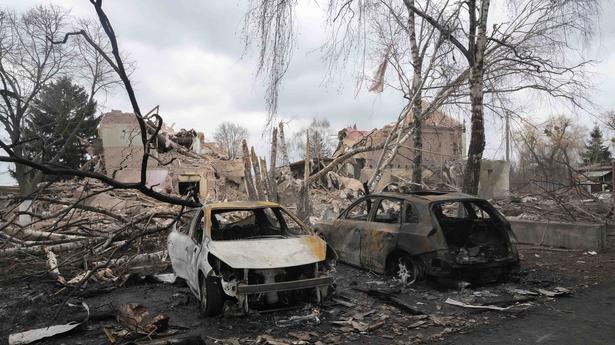
The story so far: When Russian President Vladimir Putin launched a military invasion of Ukraine on February 24, the purported reason behind this act of extraordinary territorial aggression was that the eastward expansion of the North Atlantic Treaty Organization (NATO) threatened at some undefined point in the future to allow Ukraine to join the grouping as a treaty ally and thus bring a formidable transatlantic security coalition within striking distance of Russia’s western borders — yet again. This justification offered by Russia as the reason for undertaking a ground war, including the brutal targeting with ordnance of civilian infrastructure and the expected devastation in terms of human casualty and property damage, has come under increasing scrutiny. In this context, understanding the history of NATO’s challenge to the security posture of Russia would help identify the roots of this conflict. It might also provide a clearer picture of what institutional arrangements and assurances the Kremlin could accept as sufficient to pull back its troops and weaponry and engage in dialogue with the administration of Ukrainian President Volodymyr Zelensky.
The self-declared mission of NATO when it emerged on April 4, 1949, had three prongs: “deterring Soviet expansionism, forbidding the revival of nationalist militarism in Europe through a strong North American presence on the continent, and encouraging European political integration.” Clearly the legacy of the Nazi scourge and World War II weighed heavily on the minds of the founding members of NATO. Although NATO claims that it is only “partially true” that its very creation was to counter the threat from the erstwhile Soviet Union, there was a strong emphasis on military cooperation and collective defence in its clauses. For example, Article 5 of the Treaty proclaims that “an armed attack against one or more of them… shall be considered an attack against them all” and that following such an attack, each ally would take “such action as it deems necessary, including the use of armed force” in response.
The broader context at the time was that in 1955, a time when the Cold War was gaining momentum, the Soviet Union signed up socialist republics of Central and Eastern Europe to the Warsaw Pact, including Albania (which withdrew in 1968), Bulgaria, Czechoslovakia, East Germany, Hungary, Poland, and Romania. The Pact, essentially a political-military alliance, was viewed as a direct strategic counterweight to NATO, and its focus at the time was the fact that while East Germany was still part of the Soviet occupied-territory of Germany, the Federal Republic of Germany had joined NATO by May 1955, and Moscow began to worry about the consequences of a strengthened and rearmed West Germany at its border. As a unified, multilateral, political and military alliance, the Warsaw Pact was aimed at tying Eastern European capitals more closely to Moscow, which it effectively did for several decades through the worst hostilities of the Cold War. Indeed, the Pact even gave the Soviet Union the option to contain civil uprisings and dissent across the European satellite states, including in Hungary in 1956, Czechoslovakia in 1968, and Poland in 1980-1981.
All that began to unravel by the late 1980s, when the sheer downward pressure of inevitable economic slowdown in most Eastern European Pact allies reduced the potential for military cooperation to make any real difference strategically across the region. Thus, it hardly came as a surprise in September 1990 that East Germany quit the Pact to be reunified with West Germany, and soon Czechoslovakia, Hungary, and Poland withdrew from all Warsaw Pact military exercises. The Pact was officially disbanded in early 1991 after the dissolution of the Soviet Union itself.
Even as the Soviet Union was dissolved into Russia and former Soviet republics, NATO, emboldened by circumstances and optimism that the global balance of power was tipping in its favour, embarked on a path of expansion. During the term in office of U.S. President Bill Clinton, NATO began, in successive rounds of negotiation and expansion, to pull former Warsaw Pact states into its membership. After reunification, while Germany retained membership of NATO, the Czech Republic, Hungary, and Poland joined the alliance in 1999. But it did not end there — in 2004, Bulgaria, Estonia, Latvia, Lithuania, Romania, Slovakia, Slovenia joined the treaty organisation. In 2009 Albania and Croatia signed on, in 2017 Montenegro entered the bloc and in 2020 it was North Macedonia’s turn.
In 2008, in the week leading up to NATO’s Bucharest Conference, “NATO Allies welcomed Ukraine’s and Georgia’s Euro-Atlantic aspirations for membership and agreed that these countries will become members of NATO.” They went on to announce a period of intensive engagement with both countries at a high political level to address the questions still outstanding regarding their Membership Action Plan applications.
This set off alarm bells in the Kremlin, because even the very concept of Ukraine, a nation considered to hold strong historic ties first to the Soviet Union and then Russia, was anathema. This development prompted Mr. Putin to warn erstwhile U.S. Undersecretary for Political Affairs William Burns that “no Russian leader could stand idly by in the face of steps toward NATO membership for Ukraine. That would be a hostile act toward Russia.” This was only among the more recent of a long list of actions by NATO leaders that Russia considers a political betrayal. However, it is not necessarily the case that Russia is right to believe that — and to understand this, it is important to grapple with the history of NATO expansion and its consequences.


Kim Jong Un vows to solidify North Korea's nuclear status and labels South Korea as its "most hostile" adversary.

U.S.-Israel war on Iran LIVE: Follow The Hindu for updates on the West Asia conflict on March 24, 2026

Trump claims “very good” talks with Iran, despite Tehran’s denial, as U.S. negotiators plan potential meetings in Pakistan.

Netanyahu discusses U.S.-Israeli military gains with Trump, emphasizing commitment to protect Israel's interests amid ongoing conflicts.

Pakistan reaffirms commitment to combat terrorism as Afghan ceasefire approaches end amid rising tensions and recent casualties.

Trump postpones military strikes on Iranian power plants for five days amid escalating tensions and ongoing diplomatic discussions.

Shorts News:Watch: NATO chief: 22-nation group forming to secure Strait of Hormuz

Saudi Aramco reduces crude supply to Asia for April, citing disruptions from the Iran-Israel conflict affecting trade routes.

Tencent launched a tool on Sunday to integrate its WeChat messaging platform with the OpenClaw agent

An Air Canada flight collided with a Port Authority vehicle at LaGuardia Airport, causing significant damage and police response.

Saudi Arabia and the UAE face missile attacks, with casualties reported and air defenses engaged amid escalating regional tensions.

Slovenia's parliamentary election results show a tight race between liberals and populists, signaling potential political instability ahead.

IEA chief warns of a potential energy crisis worse than the 1970s, with 11 million barrels lost daily amid regional conflicts.