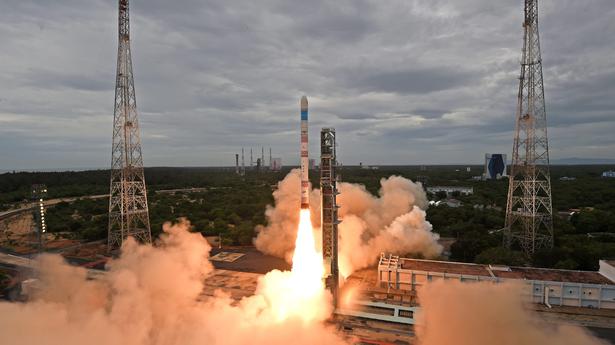
Explained | What went wrong with the ISRO launch of SSLV?
The Hindu
Why did the ISRO prefer a SSLV over the PSLV or GSLV? What was the designated function of the satellites on-board the vehicle?
The story so far: On August 7, ISRO got ready for the first developmental flight of the SSLV-D1/EOS-2 mission. The launch took place from the Satish Dhawan Space Centre at Sriharikota. The Small Satellite Launch Vehicle (SSLV) D1/EOS-2 mission, was carrying two satellites — the Earth Observation Satellite-2 (EOS-2) which weighed about 135 kg and AzadiSAT which weighed about eight kg. The mission aimed to place the EOS-2 in a circular low-Earth orbit at a height of about 350 km above the Equator and inclined at an angle of 37 degrees. The initial part of the story was successful with the launch vehicle operating smoothly. However, the mission failed to place the satellites in their required orbits, and the satellites, as they were already detached from the launch vehicle, were lost.
The purpose of this mission was to place the two satellites in circular low-Earth orbits at a height of about 350 km above the Equator. The larger one, the EOS-2 which was designed and developed by ISRO, offered advanced optical remote sensing operations. It would have operated in the infrared region and could have served many purposes, from imaging for climate studies to simply keeping an eye on Earth.
AzadiSAT, on the other hand, was a collective of 75 tiny payloads weighing around 50 grams each, which were integrated by students. It carried tiny experiments which would have measured the ionising radiation in its orbit and also a transponder which worked in the ham radio frequency to enable amateur operators to access it.
The SSLV was composed of three stages powered by solid fuels and these three performed their function as planned. However, when it came to the stage when the satellites had to be set in orbit, there was a glitch which resulted in the satellites being lost forever. With a degree of openness that is unprecedented in ISRO, it was announced that there was a malfunctioning of a sensor which resulted in placing the satellites in an elliptical orbit, rather than a circular orbit. The ellipse or oval shape of the elliptical orbit is elongated in one direction and compressed in another (the so-called major and minor axes, which are like two radii of the ellipse). The shortest height above the Earth of this oval orbit was only about 76 km.
If the closest distance to the Earth is only 76 km, as it happened this time, there is an atmospheric drag experienced by the object at that height. Thereafter, unless adequate thrust is applied to overcome the drag, it will lose height and fall towards the Earth because of gravity and may eventually burn up due to friction.
Today rocket technology has progressed to such a stage that even if the course of the rocket is altering from its planned course, there will be sensors that feed back this information to a system. This will immediately trigger a course correction which will restore the trajectory of the rocket. There are many sensors as well as a built-in redundancy. That is, even if one or two sensors fail, there will be others that take over and effect the course correction. In the present case, the announcement was that “failure of a logic to identify a sensor failure and go for a salvage action caused the deviation.” This could possibly imply that either redundancy was not built in, which is highly unlikely, or perhaps that it was built in but did not kick off due to a technical glitch.
The PSLV (Polar Satellite Launch Vehicle) and GSLV (Geosynchronous Satellite Launch Vehicle) are quite powerful and can carry huge loads. To place an Earth Orbiting Satellite in a low Earth orbit, one does not need such power horses. The SSLV can easily carry small-to-medium loads from 10 kg to 500 kg. It is less expensive. The three stages being powered by solid fuel is another advantage. Solid fuel is easier to handle, whereas handling the liquid propellants used in the PSLV and GSLV is more complex.


Harley-Davidson X440T introduces updated rider aids, refined performance and refreshed styling, offering a modern, city-focused evolution of the successful X440.

Explore how neurotechnology, including BCIs, can transform healthcare and enhance India's capabilities in addressing neurological disorders and beyond.

Explore the fascinating physics of sound waves and their enchanting presence in nature and everyday life.

Parambriyam reopens in Anna Nagar, offering a vibrant dining experience celebrating South India's rich culinary traditions and flavors.

Scientists debate mosquito origins as fossil evidence and genomic studies clash, revealing new insights into their evolutionary timeline.

From Christmas trees fashioned out of books to real spices as ornaments

Explore how DGCA's new fatigue regulations prioritize human limits to enhance aviation safety amidst recent airline disruptions.

Experts advocate for a diversified energy strategy in India to enhance reliability and support the 500 GW non-fossil capacity target.

On December 7, 1909, Belgian-American chemist Leo Baekeland’s process patent for making Bakelite was granted, two years after he had figured it out. Bakelite is the first fully synthetic plastic and its invention marked the beginning of the Age of Plastics. A.S.Ganesh tells you more about Baekeland and his Bakelite…

Explore the challenges and opportunities in enhancing India's medical research ecosystem to unlock its potential for groundbreaking discoveries.

Explore how India’s flexible workspaces are transforming into secure, intelligent environments that safeguard data and enhance employee confidence.

Discover how collaborative policies and innovative financing can unlock affordable housing in India's urban growth landscape.

“When I turned to the mirror, it caught me unguarded. The reflection was both familiar and foreign.”