Explained | What the fate of Luna 25 means for Russia Premium
The Hindu
Luna 25 failed in its mission to soft-land near the moon’s south pole, due to a technical glitch. The mission was part of Russia's attempt to demonstrate its economy's resilience and to ensure access to the moon's surface. Despite speculation, the mission was not in a race with Chandrayaan 3. Roscosmos lost contact with Luna 25 as it attempted to modify its orbit, and sanctions imposed by Western countries limited their access to satellite tracking systems.
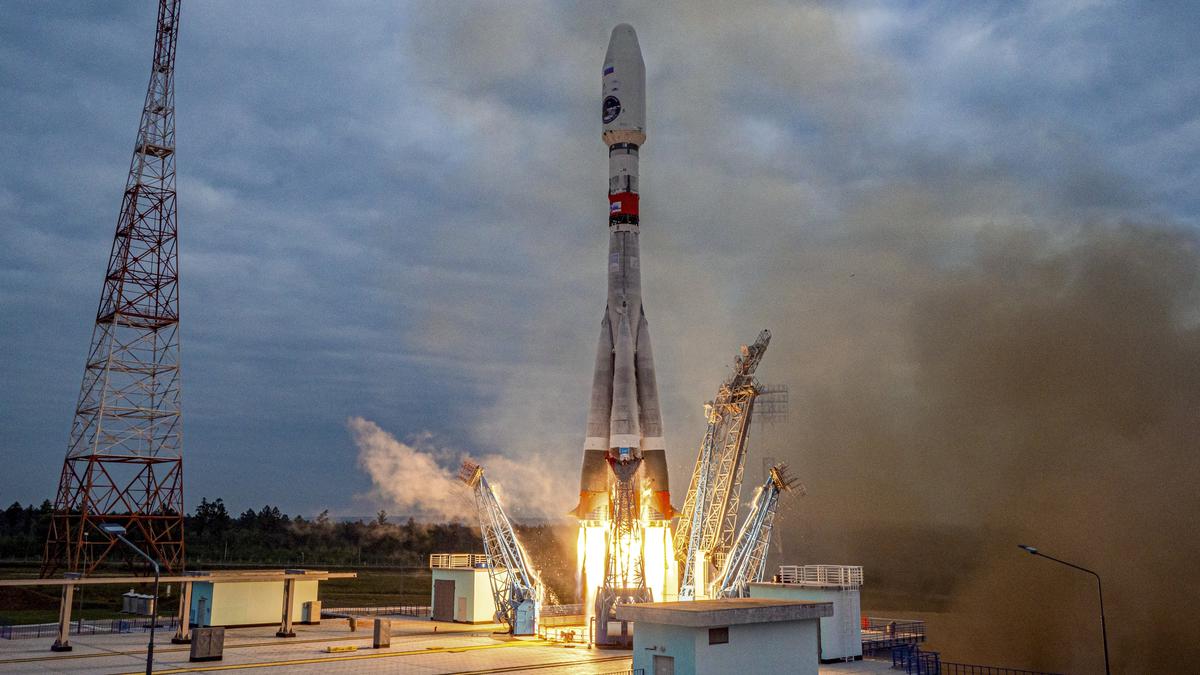
The story so far: On August 11, Roscosmos, the Russian space agency, launched its Luna 25 spacecraft onboard a Soyuz 2 rocket from the Vostochny Cosmodrome. Luna 25 consisted of a lander and its mission was to soft-land near the moon’s south pole, and there study the optical, physical, and chemical properties of moondust and moon soil, and the atmosphere.
But on August 20, Roscosmos issued a statement stating that Luna 25 had suffered a glitch and crashed on the moon’s surface the previous day, ending the mission in a failure. While the event attested to the various challenges of autonomously landing a robotic instrument on the moon, the fate of Luna 25 also speaks to more than technical issues.
The Luna 25 mission has technically been in the works for more than two decades. In the first decade or so, it was called Luna-Glob; the name was changed later to make the mission a part of the Luna series, the last edition of which, Luna 24, was launched in 1976. In its statement after Luna 25 failed, Roscosmos said one of the reasons to launch the mission was to “ensure Russia’s guaranteed access to the moon’s surface” – an allusion to the growing importance of the moon as a spaceflight destination and its importance as one of the sites of contest between the U.S. and China.
While Russia and China are together leading the International Lunar Research Station (ILRS), versus the U.S.-led Artemis Accords, Russia has not executed a successful interplanetary mission in 34 years. Some experts have also said that Russia intended Luna 25 as president Vladimir Putin’s demonstration that the country’s economy – including the spaceflight sector – haven’t buckled under the weight of international sanctions following Putin’s invasion of Ukraine in 2021.
Contrary to population perception, too many details are misaligned to expect that Luna 25 and Chandrayaan 3, or Roscosmos and the Indian Space Research Organisation (ISRO), were in a race. Both missions launched in a similar timeframe and were expected to attempt a soft-landing on the moon within days of each other.
However, these mission parameters are determined by the launch vehicle, the mass of the spacecraft, the earth-moon trajectory, and availability of sunlight at a point on the moon (to power solar panels).
In addition, while Chandrayaan 3 has been in development since 2019, Roscosmos was working on Luna 25 since the early 2010s, and couldn’t have anticipated the fate of Chandrayaan 2. Both missions also suffered unpredictable delays due to the COVID-19 pandemic.


An Air Canada flight collided with a Port Authority vehicle at LaGuardia Airport, causing significant damage and police response.

Saudi Arabia and the UAE face missile attacks, with casualties reported and air defenses engaged amid escalating regional tensions.

Slovenia's parliamentary election results show a tight race between liberals and populists, signaling potential political instability ahead.

IEA chief warns of a potential energy crisis worse than the 1970s, with 11 million barrels lost daily amid regional conflicts.

Cuba begins restoring power after a nationwide grid collapse, affecting thousands amid an ongoing energy crisis and blackouts.

The Hindu LIVE updates on March 23 2026 on Iran-Israel war. Iran faces deadline of US President Donald Trump warning to open Strait of Hormuz

Brazil's Lula condemns renewed colonialism and U.S. interference in developing nations at a summit in Colombia.

Saudi Arabia expels Iranian military staff amid escalating tensions and ongoing missile attacks during the U.S.-Israeli war on Iran.

Russia claims control of Potapivka village in Ukraine's Sumy region amid ongoing military efforts to establish a buffer zone.

Iranian missile strikes on Israeli towns cause widespread damage and injuries, marking a significant escalation in the ongoing conflict.

As Gor makes first trip as U.S. Special envoy to South Asia, Delhi watches strategic signals closely
Sergio Gor's inaugural trip as U.S. Special Envoy to South Asia signals strategic U.S. engagement amid regional tensions.

Slovenians vote in a tight election between liberal and populist candidates, impacting the country's future domestic and foreign policies.

Netanyahu asserts U.S.-Israel alliance fights Iranian threats, emphasizing global security after missile strikes on Israeli and European targets.