Explained | What is the U.N. Peacekeeping mission?
The Hindu
India has been among the largest troop-contributing countries to the U.N. peacekeeping missions.
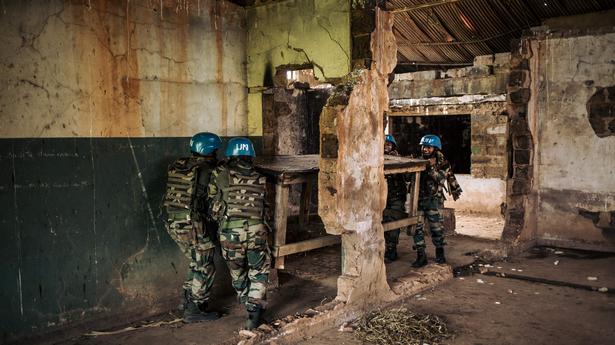
The story so far: A top United Nations (U.N.) official has lauded the Blue Helmet peacekeepers from India as well as other countries for thwarting an attack by an armed group in the Congo. Responding to a question by news agency PTI, U.N. Under-Secretary-General for Peace Operations Jean-Pierre Lacroix said that the Mouvement du 23 mars (M23) armed group has been active in the last couple of weeks in an area in eastern DR Congo.
India has been among the largest troop-contributing countries to the U.N. peacekeeping missions. As of November 2021, India is the second-highest military (1,888) and fifth-highest (139) police-contributing country to the United Nations Organisation Stabilisation Mission in the Democratic Republic of the Congo (MONUSCO).
The U.N. Peacekeeping mission is a joint effort between the Department of Peace Operations and the Department of Operational Support, and aims to assist host countries to transition from situations of conflict to peace.
The U.N. began its Peacekeeping efforts in 1948 when it deployed military observers to West Asia. The Peacekeeping mission’s role was to monitor the Armistice Agreement between Israel and its Arab neighbours.
U.N. Peacekeepers provide security as well as political and peacebuilding support to conflict-ridden countries.
The three basic principles that guide U.N.’s Peacekeeping missions are:
Blue Helmets are the military personnel of the U.N. that work alongside the U.N. Police and civilian colleagues to promote “stability, security, and peace processes”. The personnel get the name from the iconic blue helmets or berets they wear.


A federal judge blocks the Pentagon's restrictive press access policy, emphasizing the public's right to diverse information.

UK approves US strikes from British bases on Iran missile sites, while Prime Minister Keir Starmer seeks to avoid war.

Czech authorities investigate a suspected arson at a drone technology warehouse linked to anti-Israel group claims.

Ayatollah Khamenei claims Iran has struck a significant blow against enemies amid escalating tensions and ongoing conflict with Israel.

Trump labels NATO allies "cowards" for not supporting the U.S.-Israel war against Iran, criticizing their inaction amid rising oil prices.

Iran warns that global tourist sites are unsafe for Israeli and U.S. officials, while continuing missile development amid ongoing conflict.

Explore how U.S. and Israeli assassinations have transformed Iranian leaders into martyrs, reinforcing a culture of sacrifice and defiance.

Exiled Iranian writer Shahrnush Parsipur’s banned novella explores women’s freedom amid political repression and cultural patriarchy.

Sri Lanka denies U.S. warplanes access to its airport, balancing ties with the U.S. and Iran amid trade interests.

Indonesian President Prabowo Subianto condemns acid attack on activist Andrie Yunus as terrorism, pledging to pursue justice.

Norway's Crown Princess Mette-Marit regrets her friendship with Epstein, claiming she was 'manipulated and deceived' amid scandal.

A fire at a South Korean auto parts factory injures at least 50, prompting a large-scale firefighting response.

IEA suggests working from home and avoiding air travel to mitigate rising energy prices amid the U.S.-Israel conflict with Iran.