Explained | The ongoing political crisis in Iraq
The Hindu
Why are the two dominant Shia factions of Iraq up in arms against each other? What has led to the current deadlock?
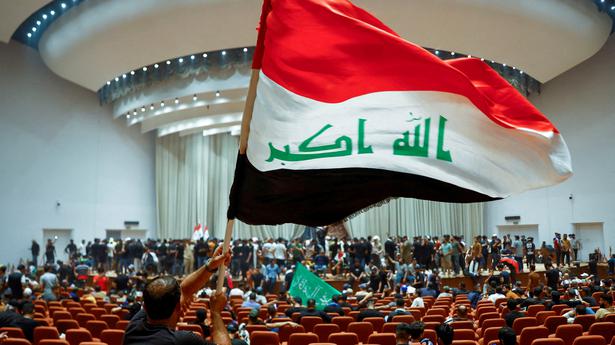
The story so far: Iraq’s political crisis took a violent turn on Monday when at least 24 people were killed and about 200 injured in clashes between the supporters of influential Shia cleric Moqtada al-Sadr and the country’s security personnel. Mr. Sadr’s supporters breached the concrete walls of Baghdad’s highly fortified Green Zone, stormed the Republican Palace of the government and fought the security personnel with mortars and grenades after Mr. Sadr announced that he was quitting politics amid a political deadlock. Iraq has failed to form a government after the October 2021 parliamentary elections in which Mr. Sadr’s bloc won the most number of seats. A bitter power struggle between the country’s dominant Shia parties have since then plunged the country into a deepening crisis, leading to the current violence.
The October elections to the Council of Representatives were considered to be a new beginning and opportunity for Iraq to form a stable, legitimate government, but what happened was just the opposite. The Sadrist Movement won 73 out of the 329 seats available, but failed to secure absolute majority. Iraq’s post-war tradition was to form national consensus governments. But Mr. Sadr wanted to form a majority government led by his bloc. He entered into a tripartite coalition, called “Save the Homeland ( Enqadh Watan)”, with Sunni and Kurdish parties — the Sunni Coalition of Sovereignty (62 seats) and the Kurdistan Democratic Party (31 seats), led by Masoud Barzani, the President of the autonomous Kurdistan region which is a U.S. ally. Together, they had absolute majority in the House. The Shia Coordination Framework, the coalition of Iran-backed Shia parties that stand opposed to Mr. Sadr, is composed of the Fatah Alliance of Hadi al-Amiri (17 seats); the State of Law Coalition of former Prime Minister Nouri al-Maliki (33 seats) and the National State Forces Alliance (4 seats), led by Ammar al-Hakim and former Prime Minister Haider al-Abadi.
The Constitution requires a new Parliament to pick a President first, who then should ask the largest parliamentary bloc to nominate someone for the post of Prime Minister. The PM nominee should then form a government and get parliamentary approval. For the Presidential election to take place, two-thirds of the representatives should be present in the House. The subsequent Presidential votes failed to go through as the quorum was not met as different blocs boycotted parliament sessions — once by the Sadrist Movement as the candidate Mr. Sadr supported, Hoshyar Zebari, was barred from running for presidency by the Supreme Court due to corruption charges, and twice by the Shia Coordination Framework, to stop Mr. Sadr’s bid to form a majority government. Therefore, without a new President, a new government could not be formed. In protest against the rival parties’ continued boycott of Parliament, Mr. Sadr, in June, asked all the 73 legislators of the Sadrist Movement to resign.
According to Iraq’s electoral laws, if a parliamentary seat becomes vacant, it will be filled by the candidate who receives the second-highest number of votes in their electoral district. The Coordination Framework took advantage of the resignation of the Sadrist lawmakers and got them replaced by those who finished second. In the new parliamentary make-up, the Coordination Framework became the largest bloc and they went ahead with plans to form their government. Mr. Sadr, now out of Parliament, called for protests in the streets.
The Coordination Framework wanted to nominate Mohammed al-Sudani for the post of Prime Minister. Mr. Sadr called on his loyal supporters, mostly working-class Shia Muslims, to apply pressure through protests. The protestors stormed the Parliament building in the Baghdad’s Green Zone several times. They demand the dissolution of Parliament, early elections and Constitutional amendments to clear blockades that stand in the way of Mr. Sadr forming a majority government. Mr. Sadr asked his supporters to continue the sit-in protests until new elections are held. The Shia Coordination Framework opponents have staged counter-protests. After Monday’s incidents, Mr. Sadr has denounced violent protests but has not walked back from his key demand of early elections. Part of the problem is the power struggle between Mr. Sadr and Mr. Maliki, the former Prime Minister who is a key leader of the Coordination Framework. The rivalry between the two goes back to 2008 when Sadrists challenged Mr. Maliki’s U.S.-backed government following which the latter ordered security personnel to quell the rebellion. Mr. Sadr has since then grown into a formidable Shia political and spiritual leader, while Mr. Maliki’s fortunes have waned.
The political paralysis in Iraq could have two possible outcomes. Firstly, as per the wishes of Mr. Sadr and his loyal followers, Parliament could be dissolved, and early elections could be called. Mr. Sadr hopes that the last election was testimony to his growing popularity and that his bloc could repeat its performance in the elections. His readiness to reach political tie-ups with the Sunnis, Kurds and left-leaning parties enhances his chances of forming a majority government, provided the political impediments are removed. The second possibility is the Shia Coordination Framework electing a new President and getting their choice, Mohammed al-Sudani, elected as the next Prime Minister of Iraq irrespective of the protests. The second possibility runs the risk of violence as was evident on Monday. Sadrists might have resigned from Parliament, but they remain a formidable street force. It would not be easy for the Framework to ignore their anger. Either way, the current crisis marks a break from Iraq’s post-war Shia consensus. If the dominant political contradiction in the elections held immediately after the U.S. invasion was between Shia and Sunni parties, now the power struggle between two Shia factions, one backed by Iran and the other relatively autonomous led by Mr. Sadr, is the main driving force of Iraqi politics.


Russia claims control of Potapivka village in Ukraine's Sumy region amid ongoing military efforts to establish a buffer zone.

Iranian missile strikes on Israeli towns cause widespread damage and injuries, marking a significant escalation in the ongoing conflict.

As Gor makes first trip as U.S. Special envoy to South Asia, Delhi watches strategic signals closely
Sergio Gor's inaugural trip as U.S. Special Envoy to South Asia signals strategic U.S. engagement amid regional tensions.

Slovenians vote in a tight election between liberal and populist candidates, impacting the country's future domestic and foreign policies.

Netanyahu asserts U.S.-Israel alliance fights Iranian threats, emphasizing global security after missile strikes on Israeli and European targets.

Israeli settlers attack Palestinian villages in the West Bank, causing injuries and destruction amid ongoing settlement expansion.

Britain asserts no evidence of Iran planning missile strikes on Europe, despite Israeli claims of missile capabilities.

UNESCO reports over half of countries have banned phones in schools due to concerns about attention, cyberbullying, and social media impact.

Analysis reveals a U.S.-operated Patriot missile likely caused a pre-dawn explosion in Bahrain, injuring numerous civilians.

Sri Lanka raises fuel prices by 25% amid ongoing West Asia conflict, impacting petrol and diesel costs significantly.

Iran strikes near Israeli nuclear research center as Trump threatens attacks on Iranian power plants
Iran's missile strikes near Israel's nuclear site escalate tensions as Trump threatens retaliation against Iranian power plants.

Saudi Arabia intercepts one of three ballistic missiles targeting Riyadh amid ongoing regional tensions and threats from Iran.

Iran's death toll exceeds 1,500 amid escalating war, with heavy airstrikes and shifting U.S. and Israel strategies reported.