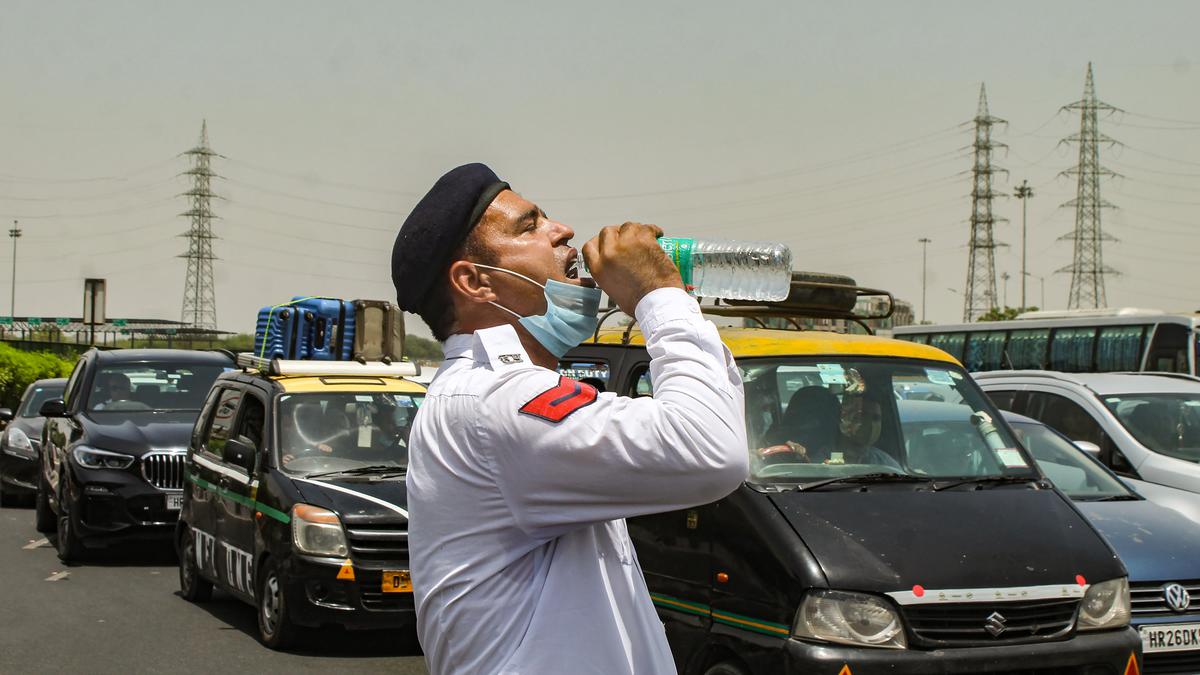
Explained | IMD is already sensing heat waves. What are they and why do they happen? Premium
The Hindu
In spring, India typically has air flowing in from the west-northwest. This direction is bad news for several reasons.
In the week of February 21, the India Meteorological Department (IMD) warned that the maximum temperatures over northwest, west, and central India would be 3-5° C higher than the long-term average.
On February 21 itself, the national capital recorded its third hottest February day (33.6° C) in more than five decades.
In the week before, the IMD had warned of heat waves in the Kutch and Konkan regions, only to withdraw them after a sea breeze came to the rescue.
If the heat waves had played out, they would have been the earliest these regions would have experienced this deadly phenomenon.
El Niño + heat waves
Irrespective of whether these are freak occurrences, heat waves are expected to become more intense, longer, and more frequent over the Indian subcontinent. According to the IMD, a region has a heat wave if its ambient temperature deviates by at least 4.5-6.4° C from the long-term average. There is also a heat wave if the maximum temperature crosses 45° C (or 37° C at a hill-station).
Spring (March-April) in 2022 in India was already a sign of things to come: the heat wave ‘season’ started early, was more intense than the long-term average, and had more waves.


Explore 2026's wallpaper trends in India, highlighting botanicals and handmade designs that enhance modern homes with nature-inspired aesthetics.

Mercedes-Benz CLA 250+ with EQ Technology review: design, performance, range and features explained. Discover how the new electric CLA combines advanced AI, long range, fast charging and futuristic styling for the next generation of luxury EVs.

AI tool for sparrow conservation

BTS’s comeback with ‘Arirang’ marks a major global music event. When does the album release, and where can you watch their concert live stream? We have all the details

The 2026 U.S. cholesterol guidelines urge starting screening and treatment at 30 to prevent cardiovascular disease effectively.

Olam Festival 2026 in Thiruvananthapuram returns March 27-29 with 120+ vendors, music, art, and cultural zones.

A few storytellers in Thiruvananthapuram share their journeys, challenges, and evolving methods on World Storytelling Day, inspiring young minds.

76-year-old Kurian Jacob from Kerala triumphs with seven medals, including five golds, at the Open Masters Games in Abu Dhabi.

Explore the nature of the human mind as an emergent property of brain activity and complex neural interactions.

CERN's Large Hadron Collider discovers the Xi-cc-plus particle, enhancing understanding of quantum mechanics and baryon behavior.

Vibha Batra’s latest book, Spotless (Hachette India) is a novel in verse for young adults

In its first edition, the Madras Art Salon spotlights the works of journalist and artist Narayan Lakshman at The Botanical Club, a social space in the British Deputy High Commission, Chennai

Cholesterol enhances melanoma cell invasion by making nuclei squishier, revealing a potential treatment target in cancer progression.