Explained | How is ‘click chemistry’ more energy efficient?
The Hindu
In what way are 2022’s Nobel laureates for Chemistry changing the agricultural, pharmaceutical and biomedical fields?
The story so far: A trio of chemists, Carolyn Bertozzi, Morten Meldal and Barry Sharpless, are this year’s Nobel laureates for Chemistry. They won it for pioneering ‘click chemistry’, which underpins green chemistry.
A big part of what chemists do is making new molecules, which is as much an art as it is science. The standard approach is to mimic nature. In the early 20th century, finding nitrogen in a form usable by plants, despite it being the most abundant element in the atmosphere, was one of the discoveries scientists were striving hard to achieve. German chemist, Fritz Haber cracked the code for ammonia, which combined nitrogen and hydrogen that plants could synthesise for nitrogen, and Carl Bosch figured out a way to produce it in massive amounts. The Haber-Bosch process is still the dominant way of producing cheap fertilizer and is at the heart of industrialised agriculture. However, this process is extremely energy intensive and polluting and the modern-day challenge is to therefore produce so-called ‘green ammonia’. This principle extends to most synthetic chemicals — where scientists try to create a natural substance, in a way that is different from the usual method which is often circuitous and creates several unwanted toxic by-products.
Editorial | A synthetic click
Shortly after winning his first Nobel Prize in 2001, Sharpless began discussing ways to synthesise chemicals that were efficient and not wasteful. To be able to create new pharmaceuticals, Sharpless argued, chemists ought to be moving away from trying to make ‘natural’ molecules and creating new ones in simpler ways that did the job. As an example, he said, it was hard to coax carbon atoms — the building blocks of organic molecules — from different molecules to link to each other. Instead, why not take smaller molecules, which already have a complete carbon frame and link them using bridges of nitrogen atoms or oxygen atoms? Sure, it wouldn’t be as elegantly constructed as the natural stuff but would be efficient, greener and useful. This Lego-block like approach to making new molecules is the essence of ‘click chemistry.’ The ‘click’ is from an analogy he drew from seatbelts clicking snugly into buckles.
For a chemical reaction to be called click chemistry, it has to occur in the presence of oxygen and in water, which is a cheap and environmentally friendly solvent. While Sharpless gave examples of existing reactions that were potentially ‘click worthy’, the actual breakthrough came in a Copenhagen laboratory.
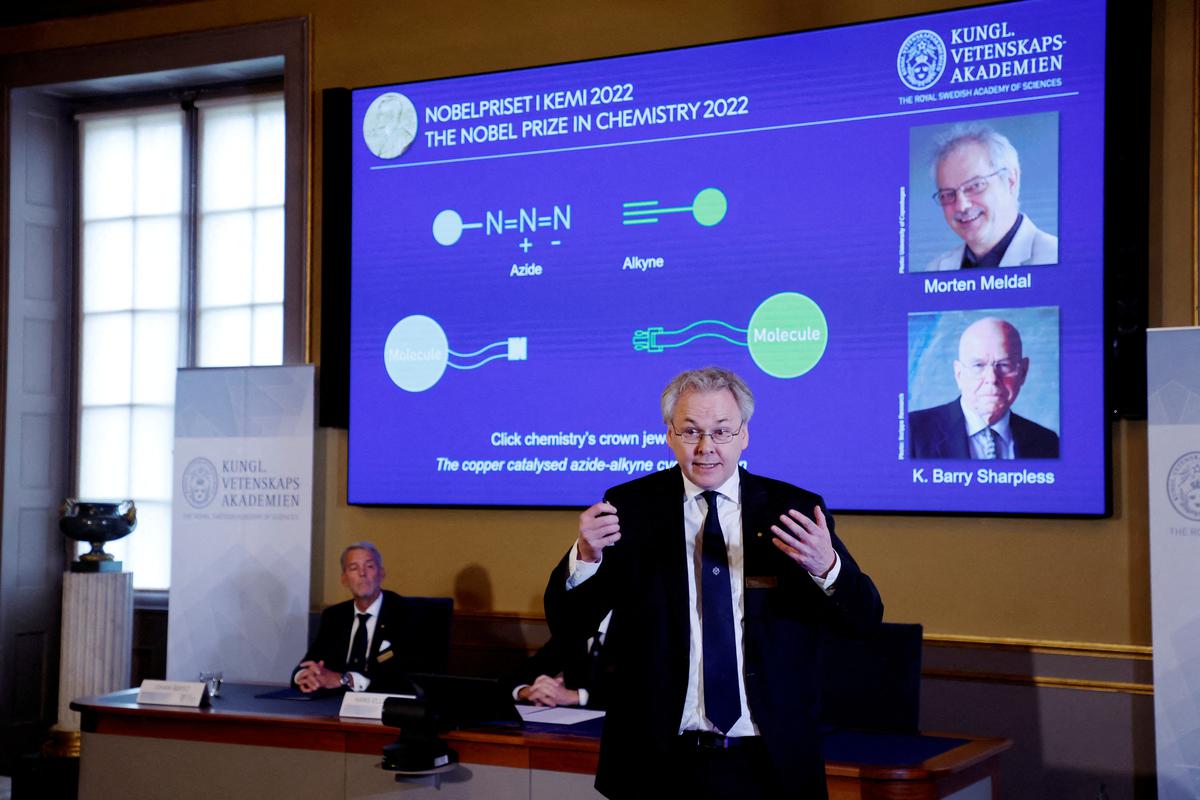
This reaction — the copper catalysed azide-alkyne cycloaddition — has now become almost synonymous with click chemistry. Azides and alkynes are different chemical groups that don’t combine naturally but can do so in the presence of copper ions. Meldal who was tinkering with some routine reactions in his Copenhagen laboratory, discovered that these two had combined to form a third kind of chemical structure called triazole. These are stable structures found in certain drugs and agricultural chemicals. Earlier attempts to make triazoles were inefficient and created undesirable by-products but copper changed the game. Sharpless and Meldal had independently discovered this out of the U.S. and Denmark respectively. Manufacturers can now add a clickable azide to a plastic or fibre and modify it to be able to conduct electricity or make them waterproof by adding an alkyne.
Click chemistry as envisaged by Meldal and Sharpless applies to the non-living world. However, Bertozzi began investigating glycans, which are complex carbohydrates that play an important role in many biological processes, such as when the immune system is activated. Bertozzi wanted to study a particular kind of glycan that attached itself to the lymph nodes but the problem was tracking its presence in the body. She figured out a way, again using an azide, to attach a fluorescent molecule onto sialic acid — a constituent of glycans. However, since copper is toxic to cells, Bertozzi used click chemistry to make a product that avoided it, paving the way for making biomolecules that can be used to track diseases and corresponding cell processes.


Discover the Minor Planet Centre, the key hub for tracking and verifying observations of small solar system bodies.

In this week's Science for All newsletter, XX explains

Test your knowledge with the quiz on Science films at the Oscars through history

Set between the Siwalik hills and the plains, Butwal offers travellers a mix of regional cuisine, pilgrimage trails to Lumbini and the comfort of Hyatt’s new hospitality landmark

Explore 2026's wallpaper trends in India, highlighting botanicals and handmade designs that enhance modern homes with nature-inspired aesthetics.

Mercedes-Benz CLA 250+ with EQ Technology review: design, performance, range and features explained. Discover how the new electric CLA combines advanced AI, long range, fast charging and futuristic styling for the next generation of luxury EVs.

AI tool for sparrow conservation

BTS’s comeback with ‘Arirang’ marks a major global music event. When does the album release, and where can you watch their concert live stream? We have all the details

The 2026 U.S. cholesterol guidelines urge starting screening and treatment at 30 to prevent cardiovascular disease effectively.

Olam Festival 2026 in Thiruvananthapuram returns March 27-29 with 120+ vendors, music, art, and cultural zones.

A few storytellers in Thiruvananthapuram share their journeys, challenges, and evolving methods on World Storytelling Day, inspiring young minds.

76-year-old Kurian Jacob from Kerala triumphs with seven medals, including five golds, at the Open Masters Games in Abu Dhabi.

Explore the nature of the human mind as an emergent property of brain activity and complex neural interactions.