Explained | Does the 2023 Thailand election result mark the start of a new era? Who will form the government? Premium
The Hindu
In Thailand, pro-democracy parties led by the maverick Move Forward Party have emerged victorious, in a historic rejection of military-backed rule. But will they get to form the government? We explore.
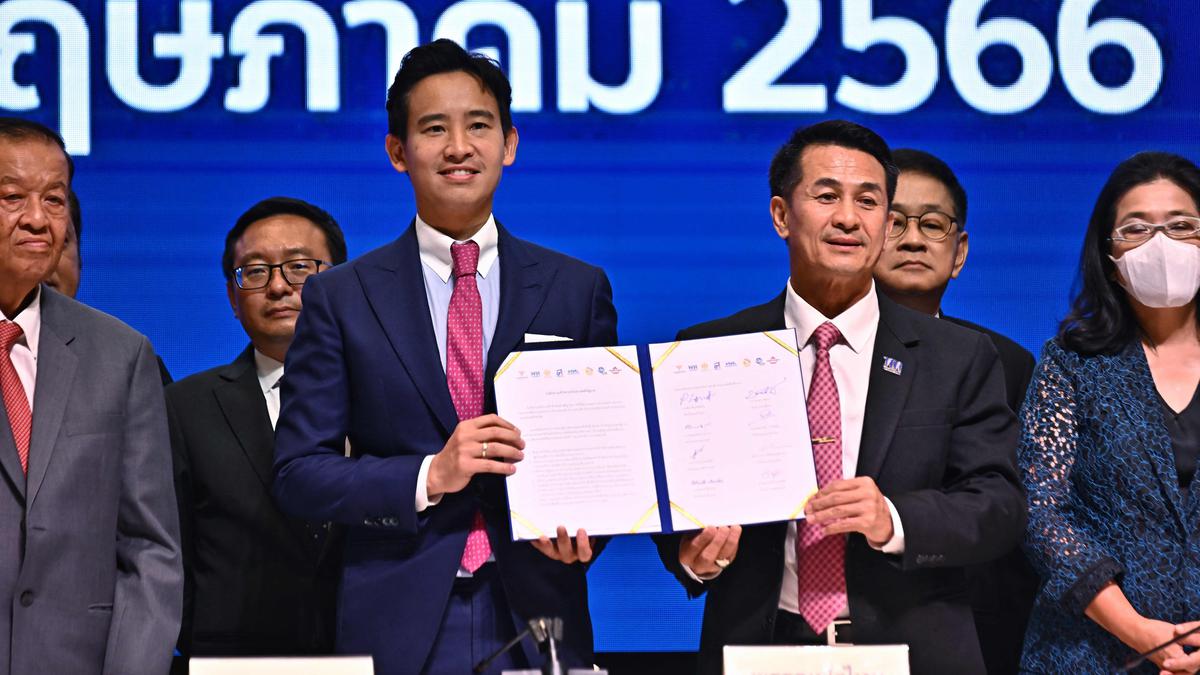
The story so far: More than a week after Thailand’s progressive Move Forward Party (MFP) and populist Pheu Thai Party claimed victory in an election that gave a thumbs-down to military-backed parties which ruled on and off for a decade, the alliance on May 22 signed an ambitious deal. The agreement aims to draft a new constitution, end mandatory military conscription and monopolies, and allow same-sex marriage, among other things.
While the youth-led MFP which bagged the most votes, campaigned on the promise to change the country’s controversial lèse-majesté (royal insult) law which prescribes heavy punishment for insulting the Thai monarchy, other allies, including its second-biggest ally Pheu Thai, may not be on board with such a move. Besides, any legislative reform will depend on who gets to form Thailand’s government — a power not automatically given to election winners owing to a constitutional tweak by the military government in 2017.
The MFP is a progressive party; an earlier version was dissolved and its leader banned from politics on what were widely seen as trumped-up charges. It emerged as the single-largest party in the May 14 poll in a surprise result, garnering 152 seats in the 500-seat House of Representatives. Its 42-year-old leader Pita Limjaroenrat capitalised on his popularity among disillusioned young voters awaiting change after eight years of a dour military-backed government. MFP is the only party promising to reform the strict lèse-majesté laws.
Mr. Limjaroenrat, seen as the Prime Ministerial candidate if the coalition led by his party forms the government, could face disqualification if the Election Commission acts on a complaint that he failed to sell shares in a media company before the campaign (a breach of rules)— the same fate that met his party’s founder in 2019.
MFP’s main ally Pheu Thai, the populist party led by the billionaire family of the self-exiled former Premier Thaksin Shinawatra, emerged as the second biggest with 141 seats. Pheu Thai drew its support from the rural and urban working class, mainly in the north and northeast regions of Thailand, considered its base built over two decades with schemes like village loans, cheap healthcare, free tablet computers for students and price support for rice farmers.
Other smaller parties in the pro-democracy alliance also managed to secure a significant share of votes. Meanwhile, this election dealt a historic blow to Thailand’s military-backed parties. The United Thai Nation Party, the recently formed party of 69-year-old former military chief and incumbent Prime Minister Prayuth Chan-o-cha only managed a disappointing 36 seats. Mr. Prayuth’s previous party, the Palang Pracharat, the biggest in the incumbent ruling coalition, also bagged just 40 seats under current leader and Mr. Prayuth’s deputy and military mentor Prawit Wongsuwan, 77.
Another party, the Bhumjaithai (meaning proud to be Thai), which has consistently won enough seats to be kingmaker, secured 71 seats, leveraging its stronghold in the lower northeast. It is led by construction mogul Anutin Charnvirakul, a deputy premier who was also the health minister at the helm of the country’s pandemic response.


Russia claims control of Potapivka village in Ukraine's Sumy region amid ongoing military efforts to establish a buffer zone.

Iranian missile strikes on Israeli towns cause widespread damage and injuries, marking a significant escalation in the ongoing conflict.

As Gor makes first trip as U.S. Special envoy to South Asia, Delhi watches strategic signals closely
Sergio Gor's inaugural trip as U.S. Special Envoy to South Asia signals strategic U.S. engagement amid regional tensions.

Slovenians vote in a tight election between liberal and populist candidates, impacting the country's future domestic and foreign policies.

Netanyahu asserts U.S.-Israel alliance fights Iranian threats, emphasizing global security after missile strikes on Israeli and European targets.

Israeli settlers attack Palestinian villages in the West Bank, causing injuries and destruction amid ongoing settlement expansion.

Britain asserts no evidence of Iran planning missile strikes on Europe, despite Israeli claims of missile capabilities.

UNESCO reports over half of countries have banned phones in schools due to concerns about attention, cyberbullying, and social media impact.

Analysis reveals a U.S.-operated Patriot missile likely caused a pre-dawn explosion in Bahrain, injuring numerous civilians.

Sri Lanka raises fuel prices by 25% amid ongoing West Asia conflict, impacting petrol and diesel costs significantly.

Iran strikes near Israeli nuclear research center as Trump threatens attacks on Iranian power plants
Iran's missile strikes near Israel's nuclear site escalate tensions as Trump threatens retaliation against Iranian power plants.

Saudi Arabia intercepts one of three ballistic missiles targeting Riyadh amid ongoing regional tensions and threats from Iran.

Iran's death toll exceeds 1,500 amid escalating war, with heavy airstrikes and shifting U.S. and Israel strategies reported.