Explained | Analysing U.S.-China bilateral ties
The Hindu
What events led to the unprecedented downturn of relations between the two countries? Is there a growing effort from both sides to reset the relationship to the pre-trade war level? Is the complex relationship between the two powers set on an irreversible trajectory of rivalry?
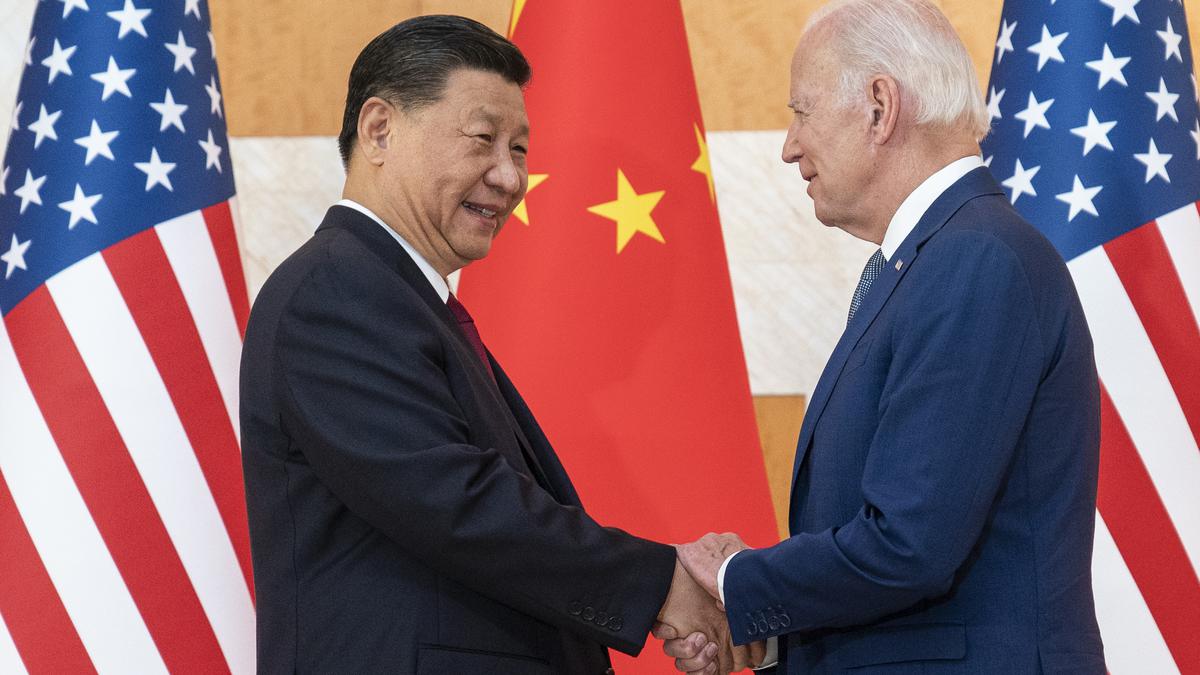
The story so far: U.S.-China relations have witnessed an unprecedented downturn in 2022. Nancy Pelosi’s historic visit to Taiwan in August has deeply upset bilateral ties. The imposition of heavy restrictions on China’s semiconductor industry by the U.S. in October has fanned the flames of rivalry further. Amid this escalation, the U.S. President Joe Biden and Chinese President Xi Jinping had their first in-person interaction on the sidelines of the G-20 summit in Bali in November, signalling a probable relaxation of the growing tensions.
The U.S. and China, ever since the establishment of diplomatic relations in the later part of the Cold War, have worked toward enmeshing their economic systems from the perspective of economic complementarity and strategic convergence. As a result, China rose to the status of the second largest economy and got itself ingrained into the global economy. This eventually translated into China’s growing economic competence as well as its rising political ambition and might. China then started to systematically undermine U.S. global dominance through military and diplomatic means. This happened at a time when there was a growing perception of U.S. decline amidst the global financial crisis and its entrenchment in the “forever wars” of Afghanistan and Iraq.
Under Xi Jinping, China’s assertiveness rose further, as its quest for primacy in the world stage became increasingly apparent. With Donald Trump’s entry into the White House, the U.S. concerns about the threat from China reached critical levels. The Trump administration took progressively confrontational steps towards China, with growing bipartisan backing. The administration’s imposition of tariffs on China’s exports turned into a “trade war” which started to reverse the trajectory of U.S.-China relations. Though Mr. Biden succeeded Mr. Trump, the policy on China did not change significantly, as the momentum for “decoupling” bilateral relations did not just continue, but kept on gathering pace. China’s crackdown in Xinjiang and Hong Kong, its “wolf warrior diplomacy” during the COVID-19 blame game, its evident support to Russia during the Ukraine crisis, and its escalating offensive posturing towards Taiwan, made it imperative for the U.S. to continue with a confrontational posture towards China.
The year 2022 witnessed the relations descend into an abysmal trajectory with the Speaker of the U.S. House of Representatives, Nancy Pelosi visiting Taiwan. The visit was extremely significant in light of sabotaging the U.S.’s stated commitment to the One China Policy as well as bolstering its commitment towards the defence of Taiwan. China expressed its exasperation through large scale military drills seemingly aimed at blockading Taiwan and signalling the U.S. of its intent to respond in kind. China has been going on an overdrive to gain technological dominance in the fourth Industrial Revolution over the U.S. In order to undercut China’s growing technological prowess, the U.S. imposed a series of restrictions on China targeting its semiconductor chip industry. With tensions reaching a peak, the G-20 summit held at Bali provided an opportunity for the leaders of both the countries to hit the pause button on the deterioration of ties.
Mr. Biden and Mr. Xi discussed outstanding matters related to U.S.-China relations for nearly three hours at Bali. There was no joint statement released after the meeting, although both sides provided their own perspectives on issues of mutual concern. Easing tensions and reopening channels of communication were agreed upon by both the leaders. The U.S. President expressed that both the countries should “manage the competition responsibly and maintain open lines of communication”, and that the U.S. is not looking for conflict with China. However, he said that the U.S. “will continue to compete vigorously” with China. Mr. Biden proposed promoting U.S.-China cooperation on the issues of climate change, global macroeconomic stability, as well as global health and food security. He also underlined the human rights concerns surrounding China’s activities in Xinjiang, Tibet and Hong Kong.
On the other hand, the Chinese President stated that the relationship should not be seen by the U.S. through the prism of “democracy versus authoritarianism”. Mr. Xi also re-emphasised Taiwan’s position as being at “the very core of China’s core interests” as well as the “the bedrock of the political foundation of China-U.S. relations”, which the U.S. needs to respect. Meanwhile, Mr. Biden reiterated that the U.S.’s commitment to the One China Policy had not changed, and that it will oppose “any unilateral changes to the status quo by either side”. This is despite Mr. Biden’s several previous statements which contradicted this stance. Mr. Xi also noted the “five noes” previously mentioned by Mr. Biden — not seek a new Cold War; not seek to change China’s system; not to revitalise its alliances against China; not to disturb the cross-Strait status quo; and not look for conflict with China. Mr. Xi stressed that both the countries needed to “explore the right way to get along”.
The recent meeting between the two heads of states certainly imply that there is a move toward bringing in more stability into bilateral relations. However, to what extent could this move be aimed at taking the relations to where it was before the trade war remains questionable. For one, China has not moved away from its path to attain its long term goal of centrality in the international system. In fact, Xi Jinping has at multiple times underlined China’s time bound aspiration to achieve such a goal through phased modernisation of the country. China’s more specific objectives like the reunification of Taiwan with the mainland has been underscored by Mr. Xi most recently in November during the 20th National Congress of the Chinese Communist Party, where he consolidated his exceptional third leadership term. Further, it has to be noted here that the “new era” of Xi Jinping is marked by China’s efforts to project rather than conceal its capabilities.


Russia claims control of Potapivka village in Ukraine's Sumy region amid ongoing military efforts to establish a buffer zone.

Iranian missile strikes on Israeli towns cause widespread damage and injuries, marking a significant escalation in the ongoing conflict.

As Gor makes first trip as U.S. Special envoy to South Asia, Delhi watches strategic signals closely
Sergio Gor's inaugural trip as U.S. Special Envoy to South Asia signals strategic U.S. engagement amid regional tensions.

Slovenians vote in a tight election between liberal and populist candidates, impacting the country's future domestic and foreign policies.

Netanyahu asserts U.S.-Israel alliance fights Iranian threats, emphasizing global security after missile strikes on Israeli and European targets.

Israeli settlers attack Palestinian villages in the West Bank, causing injuries and destruction amid ongoing settlement expansion.

Britain asserts no evidence of Iran planning missile strikes on Europe, despite Israeli claims of missile capabilities.

UNESCO reports over half of countries have banned phones in schools due to concerns about attention, cyberbullying, and social media impact.

Analysis reveals a U.S.-operated Patriot missile likely caused a pre-dawn explosion in Bahrain, injuring numerous civilians.

Sri Lanka raises fuel prices by 25% amid ongoing West Asia conflict, impacting petrol and diesel costs significantly.

Iran strikes near Israeli nuclear research center as Trump threatens attacks on Iranian power plants
Iran's missile strikes near Israel's nuclear site escalate tensions as Trump threatens retaliation against Iranian power plants.

Saudi Arabia intercepts one of three ballistic missiles targeting Riyadh amid ongoing regional tensions and threats from Iran.

Iran's death toll exceeds 1,500 amid escalating war, with heavy airstrikes and shifting U.S. and Israel strategies reported.