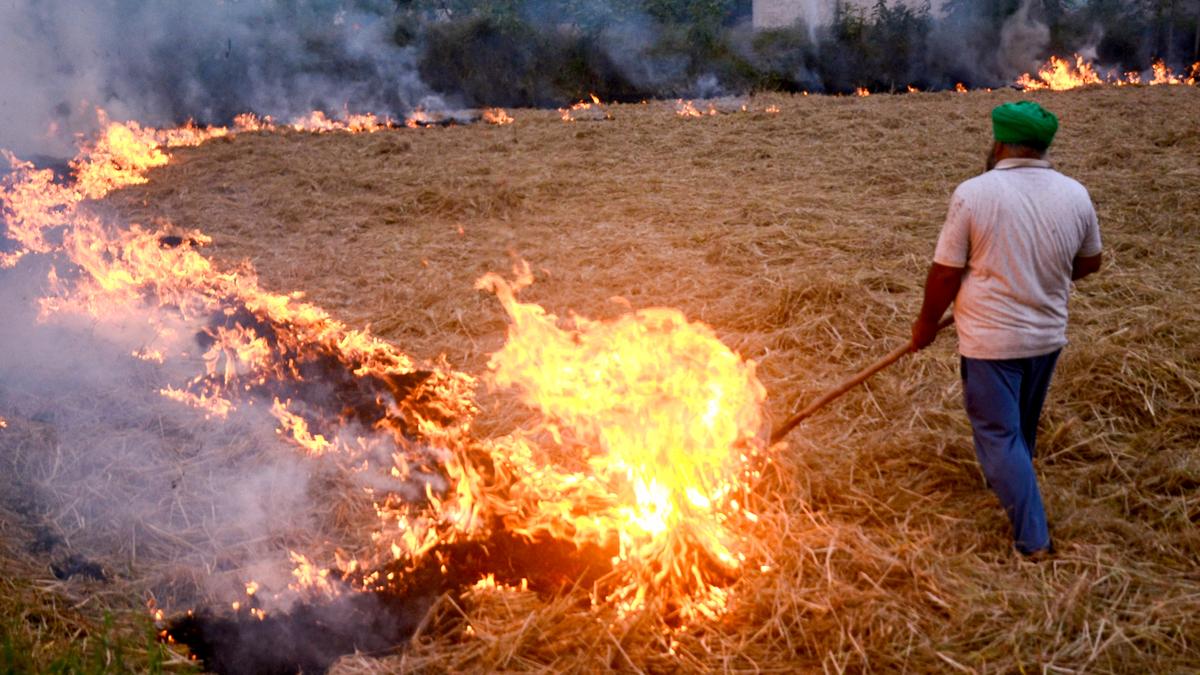
Experts call for more efficient methods of tracking farm fires; say current count may be an underestimation
The Hindu
Experts question satellite-based tracking of farm fires in Punjab, suggesting under-reporting of fires impacting air quality in Delhi.
With air quality in Delhi plummeting to hazardous levels, despite a five-year decline in the instances of stubble burning in Punjab, experts suggest that the current approach to satellite-based tracking of farm fires by government agencies may be leading to under-reporting the number of fires.
Hiren Jethva, a researcher who studies air flow in particulate matter and the role of farm fires at the Morgan State University in the U.S., has been saying in a series of posts on X since mid-October that the drop in instances of fires from Punjab may be an illusion.
The data on fire counts are from a heat-sensing instrument on two American satellites — Suomi-NPP and NOAA-20 polar-orbiting satellites. Instruments on polar-orbiting satellites typically observe a wildfire at a given location a few times a day as they orbit the Earth, pole to pole. They pass over India from 1 p.m. to 2 p.m.
The instrument on them, called the Visible Infrared Imaging Radiometer Suite (VIIRS) can sense aerosols, smoke, heat and is considered the most accurate to track wildfires across the globe. While the satellites map any particular location twice in 24 hours, they can miss fires that are set and extinguished outside of the period of tracking. Data on fire counts reported by the Punjab government and other agencies around the world are reliant on these polar-orbiting satellites.
Mr. Jethva said that data from another satellite, the GEO-KOMSAT 2A, a Korean satellite that, unlike the polar satellites, tracked the same swathe of Earth continuously, seemed to suggest that there was a spike in smoke and fires in the late afternoon in both Punjab province in Pakistan and Punjab in India. However, he hasn’t furnished the actual fire count data from the KOMSAT.
Moreover, the quantity of aerosols, or airborne pollutants, in the atmosphere hadn’t shown any measurable change despite a decline in fire counts, he posted. “(There is a) drastic downward trend in fire detection in north-west India since 2022. However, aerosol loading in atmosphere has increased or is near stable, raises suspicion that farm fires are ignited after satellite overpass time. No blame on farmers but lack of policy implementation,” he posted on October 28.
As of November 17 this year, there have been 42,314 fires reported since September 15. This is the lowest since such data was made publicly available in 2012. In 2016, 1,33,442 fires were reported during a comparable period — an all-time high, according to bulletins by the Indian Agricultural Research Institute.


The ₹88.41 crore AMRUT scheme aims to eliminate Kavali's water scarcity, transforming the town’s infrastructure and services.

A 4.1 magnitude earthquake struck Sikkim's Mangan district; no casualties or property damage reported.

Telangana government updates building rules, increasing TDR usage, allowing more floors, and easing setback regulations for developers.

The escalating Israel-Iran conflict over the South Pars gas field threatens global energy security and impacts India's energy imports.

Delhi's weather forecast: clear skies, maximum temperature around 30°C, and moderate air quality with an AQI of 154.

Union Minister Kiren Rijiju meets Tamil Nadu Bishops and pastors to discuss minority welfare and counter anti-BJP narratives.

Japan may consider minesweeping in the Strait of Hormuz post-ceasefire, says Foreign Minister Motegi, amid ongoing regional tensions.

Delhi University job fair guidelines excluding School of Open Learning students spark protests over equity and access to opportunities.

Rwanda's Fanny Utagushimaninde, at 15, becomes the youngest player to score a T20 international century.

Assembly polls 2026: Follow updates from The Hindu on the upcoming elections in five States, on March 22, 2026

Currently, only the services in the 32 series stop at the section of the road adjacent to the Broadway terminus, temporarily closed on account of reconstruction work. Small traders association tells R. Ragu that ensuring the services now accommodated at the temporary terminus at Island Grounds stop at NSC Bose road would benefit visitors to the markets in Parrys

The Hindu photo feature on Aragam which is now known as book village. Photos and text by Imran Nissar

The silent reading movement in the Mylapore-Mandaveli-RA Puram area showed up first at Nageswara Rao Park around two years ago, with modest ambitions, when Balaji launched it along with other reading enthusiasts from the region. This initiative has now moved parks, and seems to set to get entrenched in one. Due to renovation work at Nageswara Park, the reading session became irregular. With the Nageswara Rao park work gaining more surface area, it had to be shifted elsewhere. And it seems set to continue with a newly discovered green patch in RK Nagar in the Sundays to follow.