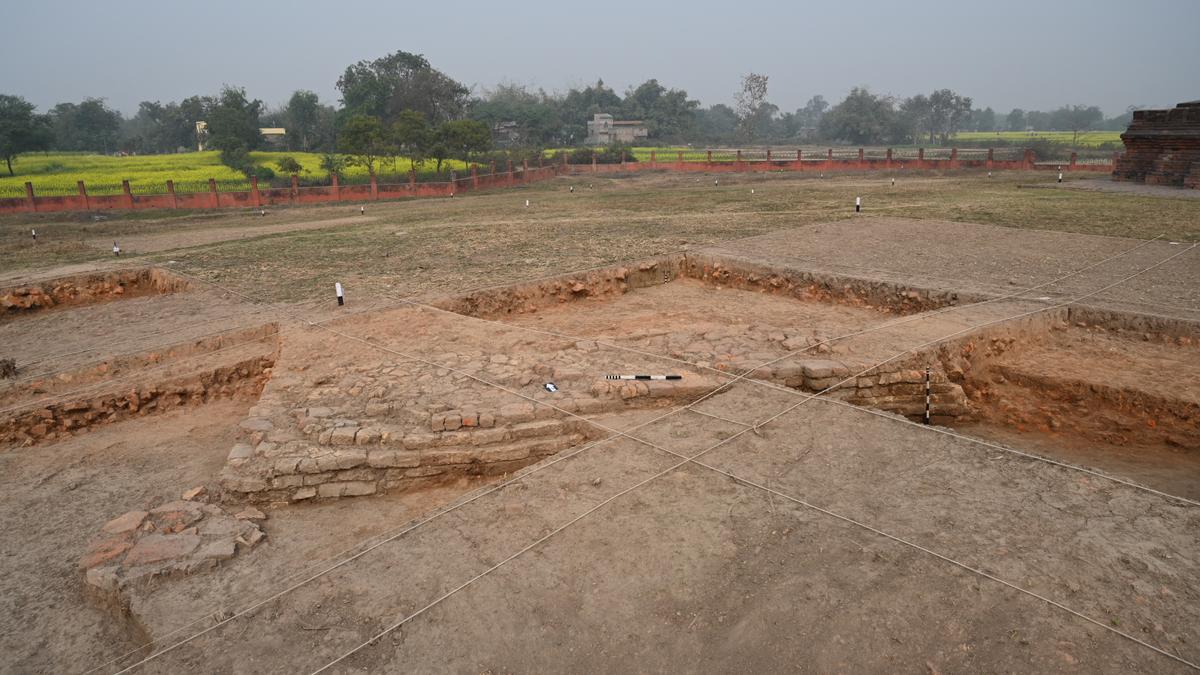
Excavations reveal Buddhist monastery complex at Bharatpur in WB
The Hindu
The site had previously been excavated in the 1970s, when a large Buddhist stupa was found, along with black and red ware pottery from the Chalcolithic Age
Recent excavations at Bharatpur in West Bengal’s Paschim Bardhaman district have revealed the presence of a Buddhist monastery. The Kolkata Circle of the Archeological Survey of India (ASI) started excavating the site in the second week of January and a structural complex of a monastery has now been partially exposed.
The site was initially excavated almost fifty years ago between 1972 and 1975 when archeologists from ASI and from Burdwan University found a Buddhist stupa at the site.
“The site lay unexcavated for almost fifty years. We were looking at the cultural sequence of the stupa from where black and red ware pottery belonging to the Chalcolithic Age was also recovered. A Buddhist stupa cannot exist in isolation, and the recent excavations have revealed the presence of an extended monastery complex,“ said Shubha Majumder, superintending archeologist of the ASI Kolkata Circle.
Mr. Majumder, who is supervising the excavations, said that archeologists working at Bharatpur will be able to ascertain more details about the monastery complex and its date of construction once the excavation progresses. “So far, we have exposed some structures which appear to be the outer wall of the monastery, containing nine layers of brick and a small circular structure, probably a stupa,” he added.
According to experts, what makes the site unique in terms of Buddhist sites in the State is the presence of a large stupa along with a monastery complex and black and red ware pottery from the Chalcolithic or Copper Age. In other sites across West Bengal, such as Karnasubarna in Murshidabad, Moghalamari in Paschim Medinipur and Jagjivanpur in Malda, archeologists have found only smaller votive stupas.
A Buddhist stupa is a commemorative monument usually housing sacred relics associated with the Buddha or other saints or priests, whereas votive stupas have similar significance but are smaller structures originating in eight cylindrical structures.
When archeologists excavated the site in the 1970s, they found black and red ware pottery, associated with the Chalcolithic Age which predates any Buddhist structures. “Excavation is likely to shed more light to understand the earliest occupation of the site and its continuity till the establishment of a Buddhist monastery,” Mr. Majumder said.


Discover how to turn creative passion into a sustainable business by mastering finance, IP, and strategic growth.

Arjun Krish and Ria Dinesh win Best Telefilm at Kerala State Television Awards for their impactful short film, F for Freedom.

redBus data reveals a significant 76% rise in solo women travelers from Karnataka since 2019, highlighting increasing independence in travel.

Air India and AI Express will operate 44 flights to West Asia amid Dubai airport restrictions on foreign carriers.

Maharashtra Assembly passes the Freedom of Religion Bill, imposing strict penalties for unlawful conversions, ensuring protection for vulnerable individuals.

Trump claims he can do “anything” with Cuba amid U.S.-Cuba talks, escalating tensions over political intervention and economic crises.

Amrutanjan owes ₹9.74 crore in rental arrears for Mylapore Kapaleeswarar Temple land, despite lacking a landlord-tenant relationship.

BJP intensifies campaign in Palakkad for the 2026 Assembly elections, targeting UDF amid scandal surrounding MLA Mamkootathil.

Jeevan Reddy leads a rally for maize farmers in Jagtial amid speculation of leaving Congress for BRS.

BJP and AINRC likely to maintain 2021 seat-sharing formula for Puducherry's 2026 Assembly elections, confirms party president.

BJP reveals 144 candidates for Bengal Assembly polls, featuring Suvendu Adhikari contesting against Mamata Banerjee in Bhabanipur.

Anna University partners with Ramco Systems to create an advanced ERP lab for enhanced industrial engineering education.

NDA announces candidates for 12 Kozhikode seats in Kerala Assembly polls 2026 as UDF and LDF ramp up campaigning.