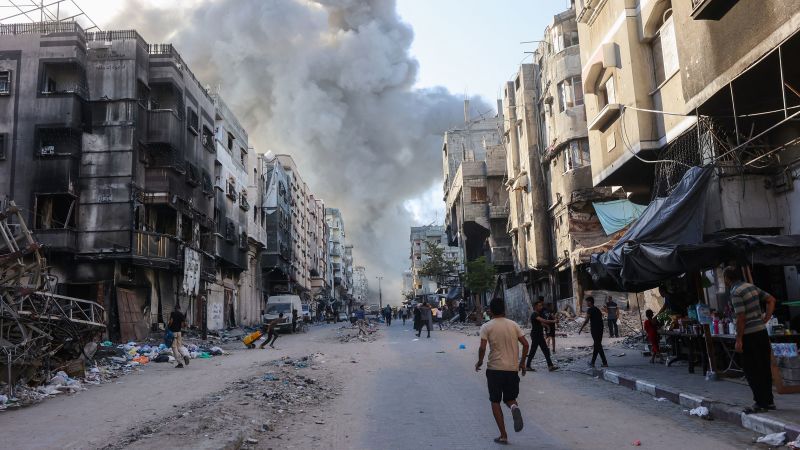
Even if a Gaza ceasefire is agreed, Israel has made clear it reserves the right to resume the war with Hamas
CNN
Months of feverish negotiations, in different cities and at multiple levels, have gotten Israel and Hamas closer to striking a ceasefire deal. But even if an agreement is reached – still far from certain – it could end up only lasting only weeks before it collapses and the war in Gaza resumes.
Months of feverish negotiations, in different cities and at multiple levels, have gotten Israel and Hamas closer to striking a ceasefire deal. But even if an agreement is reached – still far from certain – it could end up lasting only weeks before it collapses and the war in Gaza resumes. As senior negotiators prepare to meet this weekend in Cairo, there are still several sticking points in the talks over the potential three-phase agreement. But Israel has made it clear that following the initial six-week phase, a break in the fighting may be just that and it is not ready to agree to a permanent ceasefire. “I am ready to do a partial deal, it is no secret, that will bring back some of the people,” Israeli Prime Minister Benjamin Netanyahu told Israel’s Channel 14 in late June. “But we are committed to continue the war after the pause in order to achieve the goal of destroying Hamas. I will not give up on this.” There’s no indication that Israel’s position has changed and the fact this stance doesn’t violate the agreement being discussed represents a breakthrough for Israel in the negotiations. It essentially allows Israel – and Hamas – to abandon discussions after the six-week first phase and resume the war. That breakthrough was a concession by the Palestinian militant group, which has been pushing for the temporary pause to seamlessly transition to a permanent ceasefire and the war to end. The sister-in-law of a deceased Israeli hostage who met with Netanyahu this week, Riki Baruch, told CNN her takeaway from the meeting was “the prime minister’s promise to defeat Hamas, and to continue fighting until the last of the hostages returns.”


Lt. Gov. Juliana Stratton’s win in the Senate Democratic primary was also a win for Gov. JB Pritzker, while big-spending groups like AIPAC got mixed results in Tuesday’s contests.

United Farm Workers is not participating in annual celebratory events this month of its co-founder Cesar Chavez over what it calls serious allegations the union did not specify

Illinois Lt. Gov. Juliana Stratton will win the Democratic primary for an open Senate seat, CNN projects, a stunning rise for a little-known state officer now on a glide path to Washington.

President Donald Trump promised his endorsement was forthcoming in the GOP Texas Senate runoff and said he wanted whoever he didn’t pick to drop out. But now — preoccupied with the Iran war and a doomed voting bill — he’s missed a critical deadline.

The Senate has kicked off extended debate on the “SAVE America Act” — one of President Donald Trump’s top legislative priorities.

Organized crime in Latin America is proving difficult to defeat with the kind of decapitation strategy apparently favored by US President Donald Trump.

The conservative movement’s internal debate over the Iran war entered a new phase on Tuesday, with the first resignation of a prominent Trump appointee who criticized the war.

Arizona’s attorney general has filed the first-ever criminal charges in the US against a major prediction market company, accusing Kalshi of running an illegal gambling operation in violation of state law.

President Donald Trump’s brief and aggressive attempt to corral an international coalition to police the Strait of Hormuz concluded in disappointment on Tuesday.

House Oversight Chair James Comer on Tuesday issued a subpoena to Attorney General Pam Bondi to appear for a deposition on April 14 as part of the panel’s Jeffrey Epstein probe.

President Trump’s latest comments about the Iran war make him look out of the loop and unprepared.

Travelers are experiencing long security lines at a number of airports as TSA workers continue to work without pay. Follow for live updates.

A senior US intelligence official appointed by President Donald Trump abruptly announced he is stepping down from his post on Tuesday, citing misgivings about the administration’s war with Iran.