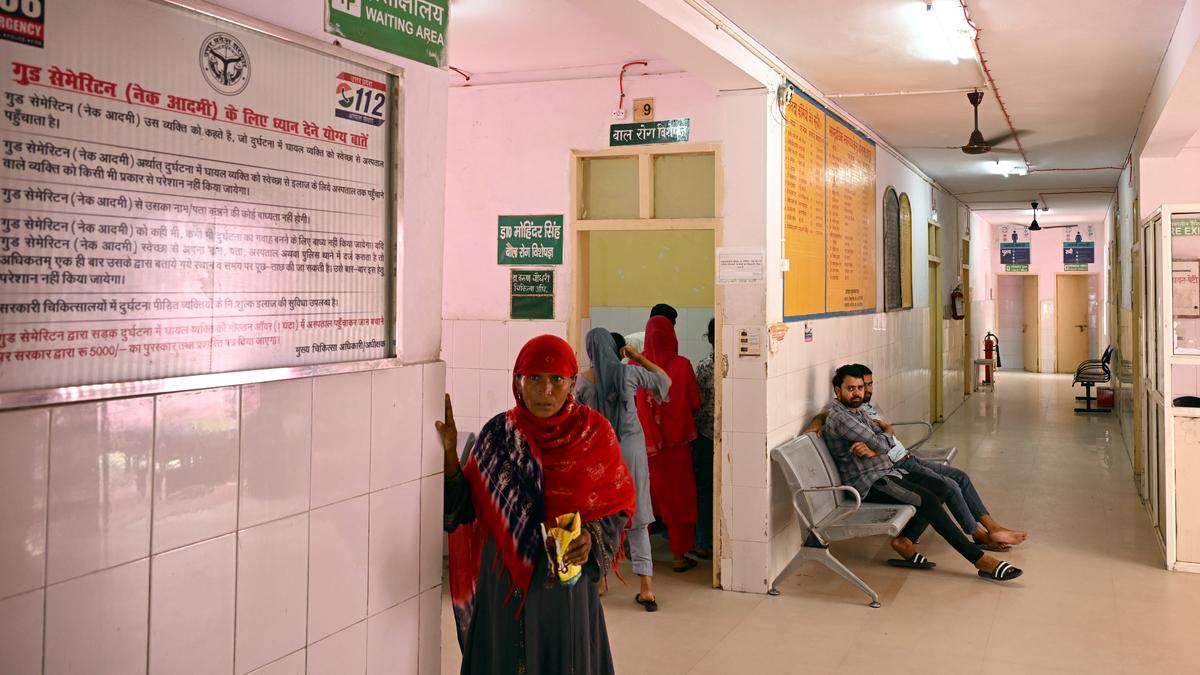
Even after Kolkata horror, State-run hospitals remain a treacherous terrain for female doctors
The Hindu
The Kolkata rape and murder has brought to light the status of workplace security for female doctors in State-run hospitals in India
Every day, Dr. Swati Sagar, a dental surgeon at a community health centre in Uttar Pradesh’s Dhaulana, makes sure she leaves work before the sun sets so she can reach her home, almost 40 km away in Noida, safe and sound.
In Dhaulana, located in Hapur district, closed shops and empty roads after 7 p.m. are a common sight. The centre itself is located on an isolated patch of land surrounded by green fields that stretch as far as the eye can see. Nobody ventures out of their homes come darkness.
“It’s an unsafe area. There’s no policeman in sight. Drunk men enter hospital premises often, even during the daytime. The guards don’t help, and there are no CCTV cameras either,” laments Dr. Sagar. She is the only female doctor at the centre.
She adds that she has been especially on edge since the Kolkata incident, wherein a second-year postgraduate trainee doctor was allegedly raped and murdered inside the State-run R.G. Kar Medical College and Hospital while she was resting in a seminar hall after a 36-hour shift.
But working in smaller towns sometimes presents an even bigger set of challenges, says Dr. Sagar.
Even at her centre, there is no space to catch a moment’s respite. “I cannot rest at all. I only have a chair that doesn’t recline. There are no attached washrooms either. Us female doctors understand why the Kolkata victim was forced to rest in a public area. Here, too, I am left with no choice but to sleep in patients’ beds, waiting rooms, or even empty halls,” she says.
Several doctors in smaller towns, including Dr. Sagar, continue to agitate for safe workplaces in their own ways — some show up to work wearing black ribbons, and others gather in communities to protest whenever they can.


The government plans to amend the FCRA, introducing new regulations for NGO asset management and accountability for key functionaries.

The draft policy for “Responsible Digital Use Among Students”, released on Monday by the Department of Health and Family Welfare, has recommended that parents set structured routines with clear screen-time rules and prioritise privacy, safety, and open conversation with children on digital well-being.

Police Observer Sushant Kumar Saxena conducts surprise inspection at Shencottai police station, reviewing warrants and security arrangements ahead of elections.

Andhra Pradesh government to launch key projects in April, focusing on industrial growth and infrastructure development, says Nara Lokesh.

Lok Sabha refers the Corporate Laws (Amendment) Bill to a JPC amid opposition concerns over CSR provisions dilution.

SHG members in Kanniyakumari use snakes and ladders to raise election awareness and boost voter turnout.

Government accelerates consultations for early implementation of the Women’s Reservation Act to ensure women’s representation in 2029 elections.

CM A. Revanth Reddy distributes ₹1 crore insurance cheques to families of deceased Electricity department employees, enhancing financial security for workers.

The Bengaluru Traffic Police (BTP) registered 634 cases of drunk driving during a week-long special enforcement drive conducted across the city between March 16 and March 22.

GHMC intensifies action against property tax defaulters, seizing properties and offering a One Time Settlement scheme for payments.

CCB arrests three drug peddlers in Mangaluru, seizing ₹2.5 lakh worth of MDMA and other valuables.

TVK's 28 candidates in Puducherry include former BJP MLAs, a sitting Independent, and a retired police IG.

BRS submits notice on private member bill to Speaker