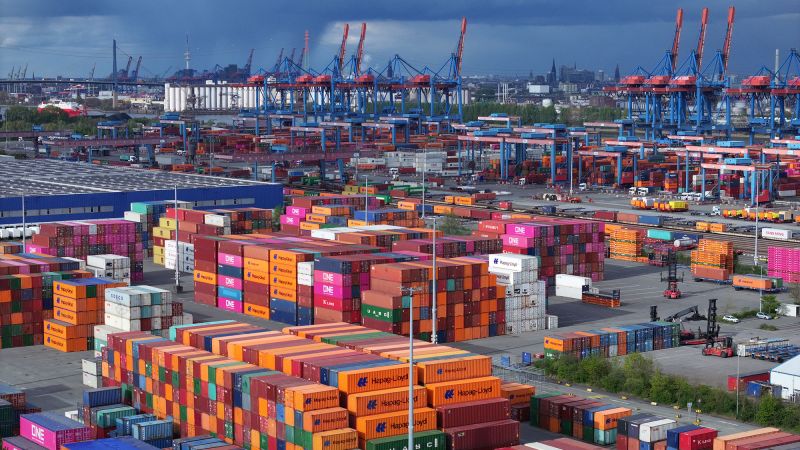
Europe saw faster economic growth early this year but Trump’s tariffs have dimmed its prospects
CNN
Europe’s economy grew more strongly in the first three months of the year, only to see hopes for an ongoing recovery quickly squelched by US President Donald Trump’s trade war.
Europe’s economy grew more strongly in the first three months of the year, only to see hopes for an ongoing recovery quickly squelched by US President Donald Trump’s trade war. Gross domestic product in the 20 countries that use the euro grew 0.4% in the first quarter, improving on 0.2% growth in the last part of 2024, according to official figures released Wednesday. But on April 2, just two days after the end of the quarter, Trump announced an onslaught of new tariffs on almost every US trading partner and hit goods imported from the European Union with a 20% tariff rate. That has led to widespread downgrading of Europe’s economic growth outlook for the year since its economy is heavily dependent on exports and the United States is its largest single export destination. Although Trump has announced a 90-day pause on what he calls his “reciprocal” tariffs — so named because they are based on how he feels other countries have been treating the US — prospects that the EU can strike a bargain to reduce the 20% figure are highly uncertain. Meanwhile, other tariffs — such as a 25% rate on steel and aluminum and on cars, both of them for all trading partners, including Europe — remain in place. The costs of tariffs are paid by the companies that import European goods such as cars and pharmaceuticals, which then have to decide whether to swallow the costs or pass them on to the consumer in the form of higher prices. As a result, indicators of business and consumer optimism in Europe have fallen. The European Commission’s economic sentiment indicator sagged to 93.6 in March, its lowest level since December. That drop in sentiment is “another illustration of how the last four weeks of tariff tensions and uncertainty have entirely wiped out the tentative return of optimism in the eurozone,” said Carsten Brzeski, global head of macroeconomics at ING bank.


Oil prices rose Sunday after President Donald Trump threatened to “obliterate” Iran’s power plants if the Strait of Hormuz is not reopened by Monday evening.

Defense Secretary Pete Hegseth has been taking steps to thwart news coverage of the Pentagon for more than a year. Now he has finally met some resistance.

Defense Secretary Pete Hegseth has been taking steps to thwart news coverage of the Pentagon for more than a year. Now he has finally met some resistance.

Gerald Rodriguez, the general manager of an NPR affiliate in rural Colorado, expected federal funding for public media to shrink. He didn’t expect it to disappear almost overnight.

The much-touted new tax breaks for tips, overtime, seniors and car loan interest have a lot of income tax filers expecting a big bump in their refunds this year – or a big cut in their tax bill.

Looking out his shop window, across the street, just to the right, Paloma Clothing co-owner Mike Roach sees one of Portland, Oregon’s, most expensive gas stations.

Oil and liquefied natural gas tankers moving through the Strait of Hormuz carry around 20% of the world’s supply. But for countries on the Persian Gulf, the waterway is more than just an energy route – it’s a lifeline for more than 100 million people.

A California jury has largely sided with Twitter shareholders who accused billionaire Elon Musk of defrauding them by intentionally driving down the social media company’s stock ahead of his $44 billion acquisition in 2022.

The war with Iran is disrupting global oil flows, damaging energy infrastructure and raising fears of prolonged conflict. But gold, usually considered a safe haven during periods of economic uncertainty, has slumped.

US stocks and bonds fell, oil prices rose and gold had its worst week in four decades as the Iran war continues to ripple through financial markets.

The White House on Friday released its long-awaited national artificial intelligence legislative framework, a move to prevent states from enacting their own laws and enforce the Trump administration’s light-touch approach to AI regulation.

“Today is a difficult day,” CBS executives wrote to staff, explaining the cuts as a tough but necessary reallocation of newsroom resources.

President Donald Trump has repeatedly promised that Americans will get larger tax refunds this year thanks to his “big, beautiful bill.”