Europe’s growth engine is sputtering. Can Germany’s economy be revived?
CNN
Germany’s economy is in a slump, battling a slew of short-term problems and structural challenges. Will it remain stuck in the slow lane or can it be revived?
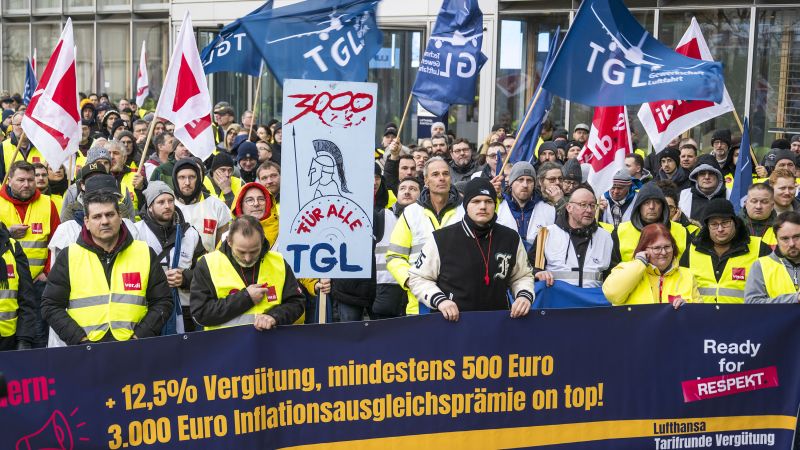
Trains canceled. Flights grounded. Highways blocked by angry farmers. The world’s fourth-largest economy has got off to a bumpy start this year. A strike by Lufthansa ground crew on Wednesday was just the latest industrial action to cause travel chaos in recent weeks, after train drivers walked off the job in January over a wage dispute and farmers blocked roads in protest against planned cuts to subsidies. Widespread walkouts in a country famed for strong legal protections for workers’ interests point to the depth of the malaise gripping Germany. Europe’s biggest economy shrank last year for the first time since the onset of the Covid-19 pandemic. And the outlook isn’t much brighter: the International Monetary Fund predicts that Germany will be the slowest-growing major economy in 2024, eking out an increase of just 0.5%. More pessimistic forecasters see an outright decline in output for the second consecutive year, as the economy grapples with an extended spell of high energy prices, steep borrowing costs and weak demand for German goods at home and abroad. The lingering impact of the energy crisis sparked by Russia’s war in Ukraine was highlighted Wednesday, with official data showing that Germany’s industrial production fell for the seventh consecutive month in December, its longest-ever slump.


Looking out his shop window, across the street, just to the right, Paloma Clothing co-owner Mike Roach sees one of Portland, Oregon’s, most expensive gas stations.

Oil and liquefied natural gas tankers moving through the Strait of Hormuz carry around 20% of the world’s supply. But for countries on the Persian Gulf, the waterway is more than just an energy route – it’s a lifeline for more than 100 million people.

A California jury has largely sided with Twitter shareholders who accused billionaire Elon Musk of defrauding them by intentionally driving down the social media company’s stock ahead of his $44 billion acquisition in 2022.

The war with Iran is disrupting global oil flows, damaging energy infrastructure and raising fears of prolonged conflict. But gold, usually considered a safe haven during periods of economic uncertainty, has slumped.

US stocks and bonds fell, oil prices rose and gold had its worst week in four decades as the Iran war continues to ripple through financial markets.

The White House on Friday released its long-awaited national artificial intelligence legislative framework, a move to prevent states from enacting their own laws and enforce the Trump administration’s light-touch approach to AI regulation.

“Today is a difficult day,” CBS executives wrote to staff, explaining the cuts as a tough but necessary reallocation of newsroom resources.

President Donald Trump has repeatedly promised that Americans will get larger tax refunds this year thanks to his “big, beautiful bill.”

President Donald Trump has repeatedly promised that Americans will get larger tax refunds this year thanks to his “big, beautiful bill.”

Oil prices edged lower on Friday after a tumultuous day that saw the international benchmark surge above $119 a barrel as the Middle East conflict deepened energy supply fears.

The war in Iran has delivered what economists call a “black swan” event — an unforeseen shock so destructive, no one is immune to it.

The war in Iran is driving up the cost of buying a home in America.

Eight state attorneys general have filed an antitrust lawsuit to block Nexstar’s pending acquisition of Tegna, which would strengthen the right-leaning Nexstar and shrink the number of station owners in the US.