Europe leading the race to regulate AI. How will the rules work?
Global News
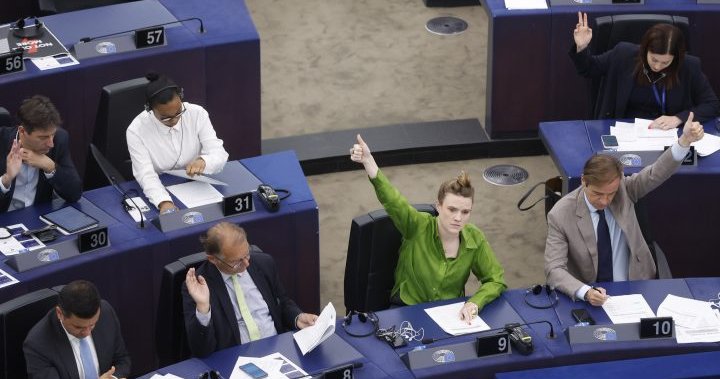
EU lawmakers agreed on Wednesday to changes in draft artificial intelligence rules proposed by the European Commission in a bid to set a global standard.
Authorities worldwide are racing to rein in artificial intelligence, including in the European Union, where groundbreaking legislation passed a key hurdle Wednesday.
EU lawmakers agreed on Wednesday to changes in draft artificial intelligence rules proposed by the European Commission in a bid to set a global standard for a technology used in everything from automated factories to bots such as ChatGPT.
The lawmakers will now have to thrash out details with European Union countries before the draft rules become legislation.
A yearslong effort by Brussels to draw up guardrails for AI has taken on more urgency as rapid advances in chatbots like ChatGPT show the benefits the emerging technology can bring – and the new perils it poses.
Here’s a look at the EU’s Artificial Intelligence Act:
The measure, first proposed in 2021, will govern any product or service that uses an artificial intelligence system. The act will classify AI systems according to four levels of risk, from minimal to unacceptable.
Riskier applications, such as for hiring or tech targeted to children, will face tougher requirements, including being more transparent and using accurate data.
Violations will draw fines of up to 30 million euros ($33 million) or 6% of a company’s annual global revenue, which in the case of tech companies like Google and Microsoft could amount to billions.


Some experts say that a cyberwar through 'proxies' may be the next stage of the Iran war, with civilian infrastructure also coming under threat.

The study is being billed by the university as "the first to study a wide range of factors which link ADHD symptoms and mental ill health symptoms over time."

The group says MAGA Energy hasn't paid its lease for three years, and therefore the company is no longer allowed on their land in Edmonton.

The analysis by the Canadian Climate Institute says oilsands producers will pay an average of about 50 cents per oil barrel, if the minimum carbon price rises to $130 per tonne.

Between November 29 and February 27, authorities recorded 406 outbreaks of bird flu in domestic birds in 32 European countries and 2,108 outbreaks in wild birds, they said.

Dr. Michael Domeier, director of the Marine Conservation Science Institute, told Global News that they tag the adult females as they are the most interesting.

Regina’s recycling contamination is currently triple the limit and city is urging resident to change sorting habits now to avoid citywide fines and higher resident fees.

The study found that higher ultra-processed food intake at age three years was associated with adverse behavioural and emotional symptoms at age five years.

Edmonton's single-use waste rules were controversial and unpopular when introduced in 2023 — but new data shows the changes are having the intended effect of reducing garbage.

Carney's speech to Australia's parliament highlighted a soon-to-launch Canadian low earth orbit satellite network that experts say could soon compete with Elon Musk's Starlink.

The Pentagon said in a statement Thursday that it has “officially informed Anthropic leadership the company and its products are deemed a supply chain risk, effective immediately.”

Opioid overdose deaths in Canada are falling, but there's growing concerns on a certain veterinary tranquilizer being cut into fentanyl and other opioids.

The product is being recalled in Alberta, British Columbia, Manitoba, Ontario, Quebec and Saskatchewan due to 'undeclared almonds' being found.