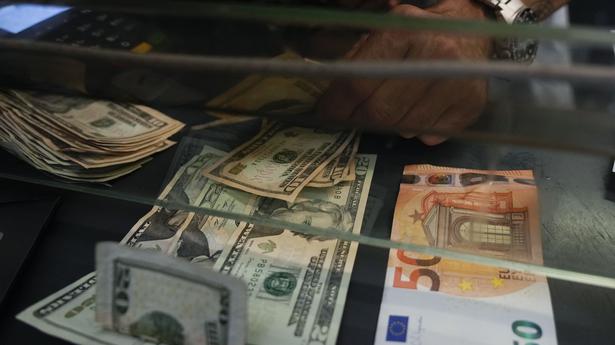
Euro falls below dollar parity for first time since 2002
The Hindu
The latest slide came after another hot set of U.S. inflation data.
The euro dropped below parity against the dollar on Wednesday for the first time in almost two decades, as a hawkish U.S. Federal Reserve and growing concern about rising recession risks in the euro area continued to batter the currency.
The latest slide came after another hot set of U.S. inflation data.
Europe's single currency started this year on a strong note given a post-pandemic economic recovery. But Russia's invasion of Ukraine, surging European gas prices and fears that Moscow could cut off supplies further has raised the spectre of recession and hurt the euro.
Heightened global uncertainty and an aggressive Fed monetary policy stance meanwhile have benefited the safe-haven dollar.
The euro tanked as much as 0.4% to a low of $0.9998 at 1245 GMT, its lowest level since December 2002. It was last down 0.1% on the day at $1.005 and has lost more than 10% so far this year.
"Gas rationing, stagflation, an expected recession, they are all good reasons to be bearish on the euro," said Stuart Cole, head macro economist at Equiti Capital in London before the euro crossed that threshold.
He add that these factors will make it harder for the European Central Bank to hike interest rates, further widening the interest-rate differential with the United States.


The rupee declines 20 paise to 93.73 against the dollar as global oil prices rise and investor uncertainty persists.

Siemens said on Monday that the Iran war has led to customers holding back on new investments as prices increase for raw materials and energy.

OpenAI said its close ties with Microsoft could be a potential risk to its business, telling investors that the software company is responsible for “a substantial portion of our financing and compute,” CNBC reported

LPG crisis: Alternative solutions are being considered, with ammonia cylinders being increasingly used for industrial applications amid delays in commercial LPG deliveries.

India monitors U.S. military pause on Iran as oil prices dip; External Affairs Minister engages with GCC nations for support.

India monitors U.S.-Iran tensions as Trump pauses attacks, leading to a significant drop in oil prices.

Union Minister Ashwini Vaishnaw launches three initiatives to enhance India's creative economy through AI training, citizen platforms, and advanced tech access.

Two Indian-flagged LPG tankers approach the Strait of Hormuz, navigating safely amidst regional tensions to reach Indian ports.

Gold and silver prices plummet over 7% due to West Asia tensions, inflation fears, and a stronger dollar.

Asian shares fall as rising oil prices and escalating Iran conflict diminish hopes for U.S. interest rate cuts.

Japan's SoftBank Group said Saturday it plans to build a huge new gas-fired power plant in the US state of Ohio

Silver prices plunge 9% to ₹2.06 lakh per kg in futures trade amid weak global cues and rising macroeconomic pressures.

OpenAI plans to nearly double its workforce to 8,000 from 4,500 by the end of 2026, the Financial Times reported on Saturday, citing two people with knowledge