Ethiopia: its past and current challenges
The Hindu
How did the east African nation transition from a monarchy to its current makeup of a ‘federated Ethiopia’? What has led to the multiple insurgencies in Tigray, the northern part of the country? How are China and India operating in the country?
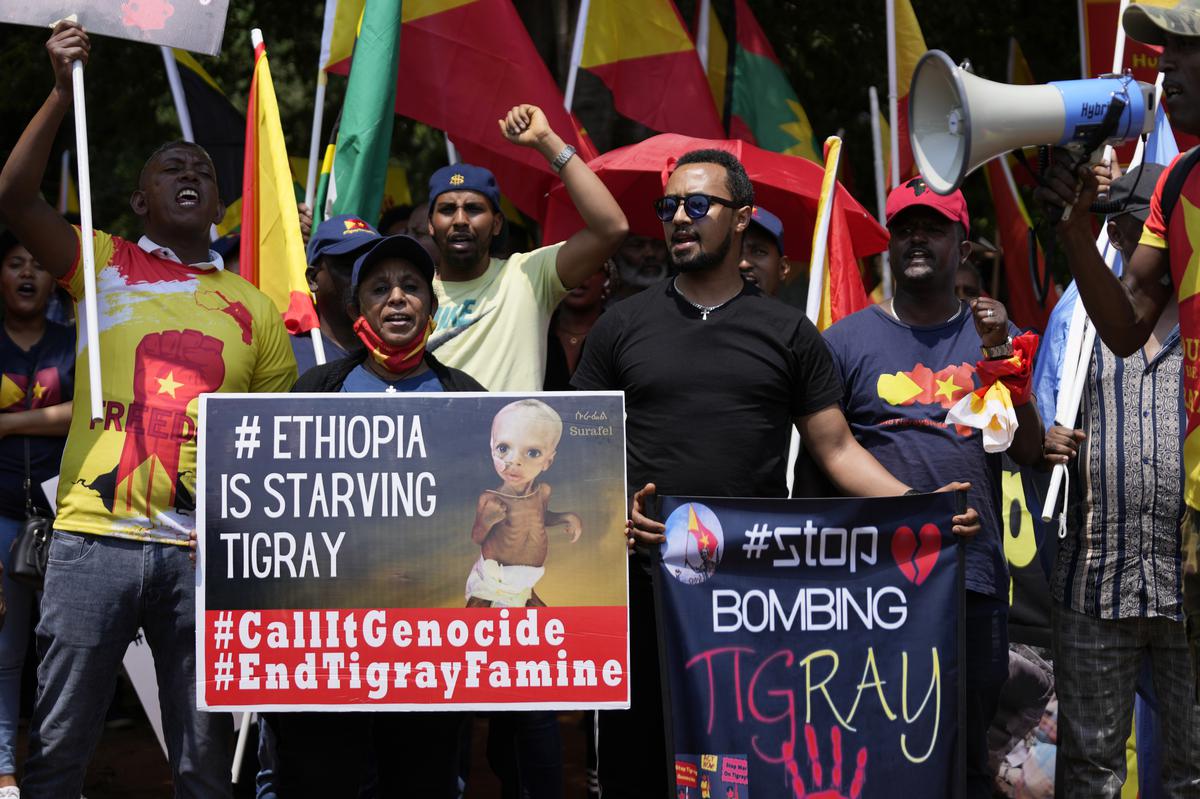
The first formal African Union-led peace talks between an Ethiopian government team and Tigray forces (since the war of 2020 with Tigray), in South Africa, scheduled from October 24, are happening at a time when Ethiopian forces and allies have made some gains in Ethiopia’s northern Tigray region. For the rest of the world, the development spells some hope of reconciliation between the federal government and Tigray which was a prominent force in the country’s ruling coalition until Ethiopia’s current leader and Nobel Peace laureate (2019) Abiy Ahmed became the Prime Minister in 2018.
The ethnic conflict, and several others preceding it, spotlight the rich, yet troubled history of Ethiopia which stands out in the African continent. From its origins in the Aksumite kingdom and a successor line of kings which eventually led to the ‘Solomonic line’, to a period of ethnic migrations marked by warfare, Ethiopia was an imperial state that gradually weakened over the course of the next two centuries with the emergence of regional and religious rivalries.
It is the next phase — what is called the modern period from around the 1850s to the present — that would help situate the conflict. Here, there was a mix of warfare and nation-building under the reigns of the emperors, notably Menelik and later Haile Selassie, to the regime of Mengistu Haile Mariam, and later the Transitional Government of Ethiopia (TGE) under soldier-politician Meles Zenawi beginning 1991. It was during the Menelik reign that Ethiopia grew in size, with his moment of glory being the defeat of an Italian invasion force that was attempting to colonise the country. The first Italo-Ethiopian war and the Battle of Adwa (1895-1896) was a watershed moment in continental history that marked the defeat of a colonial force. Menelik’s astuteness enabled the Treaty of Addis Ababa (1896), where Italy recognised the country’s absolute independence. Haile Selassie who became the emperor in 1930, ushered in a phase of modernity only to be impeded briefly by the next Italo-Ethiopian war (1935-36). Following his return from exile to Addis Ababa in 1941, he commenced military and political changes that were the catalyst for social and economic development. However, these changes triggered his unpopularity which resulted in the overthrow of the Ethiopian monarchy in 1974.
The Marxist dictatorship of Mengistu Haile Mariam that swept in resulted in the Derg unleashing a reign of terror, also known as the Ethiopian Red Terror. Agricultural productivity fell and famine followed. Even though dissent was snuffed out, the regime was up against armed insurgencies, especially in the northern part of the country, the embers of which were burning since the 1960s. A major insurgency followed in the 1970s — in Tigray, where the Meles Zenawi-led Tigray People’s Liberation Front (TPLF), rebelled against the military government and its policies. It was the backing of the then Soviet Union and allies that propped up both the armed forces and the Mengistu government, but this support began to dissipate in the 1980s, influencing the course of conflicts with the Eritreans and Tigray. Within a decade, by 1991, there was much change: a majority of Eritrea was in the hands of the Eritrean People’s Liberation Front (EPLF), while in Ethiopia it was the TPLF. The TPLF was a key constituent of the Ethiopian People’s Revolutionary Democratic Front (EPRDF) coalition. Following Mengistu’s exile in Zimbabwe (1991), the EPLF, in May, proclaimed the formation of the Provisional Government of Eritrea (PGE), while the EPRDF assumed control in Addis Ababa (capital city of Ethiopia). It needs to be mentioned that Ethiopia and Eritrea would have to maintain good ties, mainly for economic reasons.
The spectrum of political, economic, and security problems that confronted Meles Zenawi (Ethiopia) and Isaias Afwerki (Eritrea) paved the way for a strategy that essentially incorporated reconciliation and democratisation, social and economic development, and, importantly, ties with the western world.
In the interim government formation, the EPRDF chose political groups that led to the establishment of the TGE. There was an EPLF-EPRDF agreement over the use of the Aseb port linked to a referendum on Eritrean self-determination. The government was made up of the offices of the President, the Prime Minister, a multi-ethnic Council of Ministers and a Council of Representatives which was to draft a Constitution. Political representation saw the presence of the Oromos, the Tigrays and other groups. A significant aspect of the ‘National Charter’ was a recognition of ethnicity to enable local and regional governance under the umbrella of a ‘federated Ethiopia’. It was a bridge to create a viable government and allow representation to ethnic groupings. As a part of administration, the TGE came up with autonomous regions (between 10 to 12) linked to ethnic identification, and two multi-ethnic cities, one of them being Addis Ababa. The largest ethnicities, namely the Amhara, Oromo, Somali, and Tigray, had their own regions. Each region had districts or weredas, resulting in several hundred weredas across Ethiopia. The central government oversaw defence, international diplomacy, economic policy, and monetary issues, while the weredas were concerned with legislative and judicial matters. Thus, the regions created were: Afar; Amhara; Benishangul-Gumuz; Gambella; Oromia; Sidama; Somali; South West Ethiopia Peoples’ Region; Southern Nations, Nationalities, and Peoples’ Region (SNNPR); Tigray, and Addis Ababa and Dire Dawa, the cities. A 2019 referendum in the Sidama region of SNNPR resulted in a Sidama region (2020), while a South West Ethiopia Region followed in 2021. The Zenawi administration initiated a market-oriented economy which saw the appearance of private participation.
Some of the issues the TGE confronted were the addressing of human rights records and rehabilitating a vast band of ‘armed forces’ and former military personnel which resulted in clashes between government forces, former soldiers and insurgent groups. There was a refugee issue too, of a south Sudanese presence in the western Ethiopian region.


Saudi Arabia and the UAE face missile attacks, with casualties reported and air defenses engaged amid escalating regional tensions.

Slovenia's parliamentary election results show a tight race between liberals and populists, signaling potential political instability ahead.

IEA chief warns of a potential energy crisis worse than the 1970s, with 11 million barrels lost daily amid regional conflicts.

Cuba begins restoring power after a nationwide grid collapse, affecting thousands amid an ongoing energy crisis and blackouts.

The Hindu LIVE updates on March 23 2026 on Iran-Israel war. Iran faces deadline of US President Donald Trump warning to open Strait of Hormuz

Brazil's Lula condemns renewed colonialism and U.S. interference in developing nations at a summit in Colombia.

Saudi Arabia expels Iranian military staff amid escalating tensions and ongoing missile attacks during the U.S.-Israeli war on Iran.

Russia claims control of Potapivka village in Ukraine's Sumy region amid ongoing military efforts to establish a buffer zone.

Iranian missile strikes on Israeli towns cause widespread damage and injuries, marking a significant escalation in the ongoing conflict.

As Gor makes first trip as U.S. Special envoy to South Asia, Delhi watches strategic signals closely
Sergio Gor's inaugural trip as U.S. Special Envoy to South Asia signals strategic U.S. engagement amid regional tensions.

Slovenians vote in a tight election between liberal and populist candidates, impacting the country's future domestic and foreign policies.

Netanyahu asserts U.S.-Israel alliance fights Iranian threats, emphasizing global security after missile strikes on Israeli and European targets.

Israeli settlers attack Palestinian villages in the West Bank, causing injuries and destruction amid ongoing settlement expansion.