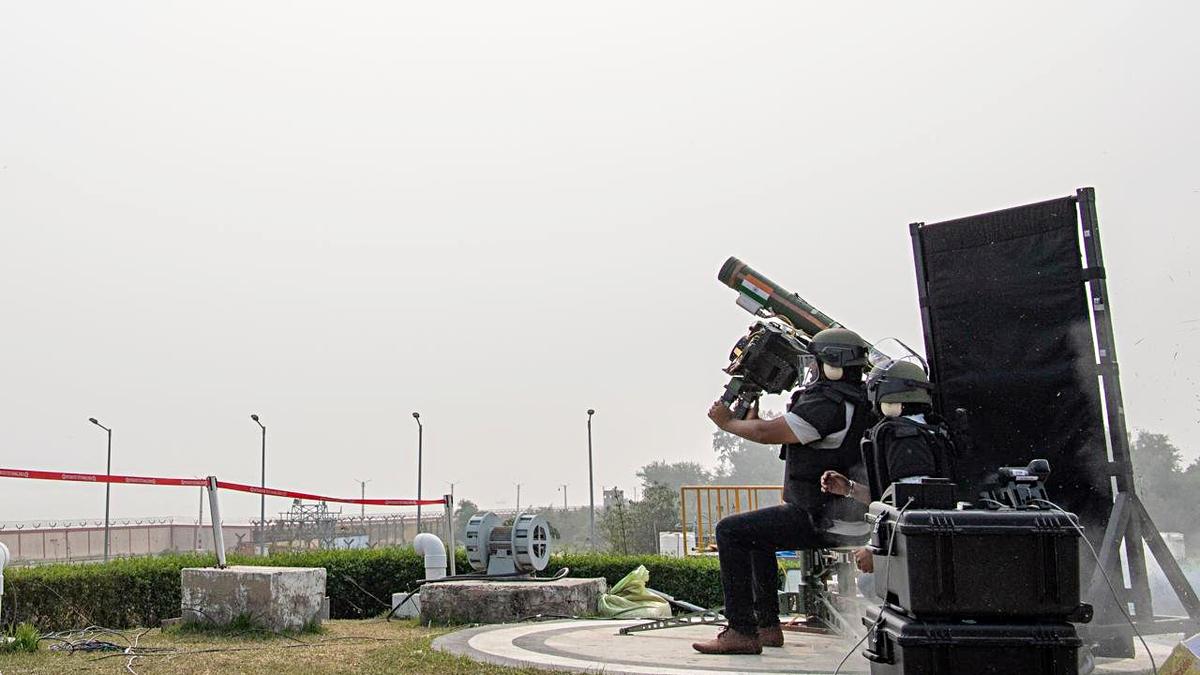
Emergency procurement to the rescue to meet Army’s requirement of very short range air defence missiles
The Hindu
Indian Army utilizes emergency procurement to acquire critical VSHORAD systems amid failed attempts, reinforcing importance in modern warfare.
The emergency route for defence procurements has once again come to the Indian Army’s rescue in its bid to buy man-portable Very Short Range Air Defence (VSHORAD) systems, as repeated attempts to acquire the critical systems have failed. Since 2020, the Army has unsuccessfully tried to close three deals for two different missile systems, constituting 88 launchers, 372 missiles and associated equipment.
A VSHORAD is the soldier’s last line of defence against enemy combat aircraft and helicopters in the multilayered air defence network, and its criticality has been reinforced in the ongoing war in Ukraine.
Under emergency procurement (EP) provisions, the armed services can procure weapons systems worth upto ₹300 crore on an urgent basis without any further clearances. Deliveries should begin in six months and end within a year of the contract date. This route has been previously used four times since 2016, with the fifth now underway. “The EP has been quite helpful in getting new equipment on a fast-track basis,” a defence source observed, adding that delivery delays have been an issue as companies have not been able to meet the stringent EP timeline.
The EP route for procurement through the Vice Chiefs emergency financial powers was sanctioned by the Defence Ministry for the first time after the 2016 Uri terror attack. Since then, there have been four rounds of such procurement: EP-1 in 2016, EP-2 after the 2019 Balakot air strike, EP-3 in 2020 after the standoff with China began, and EP-4 in 2022 to fill “critical capability voids”. EP-5 was recently sanctioned and is focussed particularly on counter-insurgency and counter-terrorist equipment, Army Chief General Upendra Dwivedi said in January.
At the height of the standoff with China in eastern Ladakh in December 2020, the Army contracted 24 Igla-S VSHORAD launchers, 216 missiles and testing equipment from Russia’s Rosoboronexport, with deliveries being completed by December 2021. Under EP-4, the Army placed a ₹260 crore order for more Igla-S, consisting of 48 launchers, 100 missiles, 48 night sights, and one missile testing station, with deliveries to begin by the end of May 2024. This order was placed to Adani Defence Systems And Technologies Limited (ADSTL), which is assembling the system in India under a technology transfer initiative.
A third deal for laser beam riding man-portable VSHORADs was announced at Aero India last month by Thales UK and Bharat Dynamics Limited (BDL), with the “initial supply” of Starstreak high velocity missiles and launchers to be delivered this year. Defence sources confirmed that the deal, under EP-4, was for 16 launchers, 56 missiles and one simulator worth just under ₹300 crore. The overall order has been delayed, two sources independently confirmed.
The fourth EP tranche was undertaken by the Army between September 2022 and 2023, with over 70 schemes concluded worth nearly ₹11,000 crore.


Papanasam dam's water level reaches 66.15 feet, with inflow at 76 cusecs and discharge at 300 cusecs.

Development without impact: Coastal residents of Kanniyakumari and Nagercoil constituencies voice discontent

Rampant encroachments in Tiruchi threaten pedestrian safety and traffic flow, undermining smart pavement initiatives and exacerbating congestion.

Discover Kerala's electoral history in 'Vottarivu,' a 201-page booklet released ahead of the 2026 Assembly elections.

Experts at a floriculture conference in Shivamogga stress the need to reduce greenhouse gas emissions and enhance soil carbon levels.

First randomisation of EVMs and VVPATs for Tiruchi and Perambalur districts completed with political party representatives present.

Puducherry elections see ongoing DMK-Congress rift over seat-sharing, leading to candidate conflicts on nomination day.

Einstein College and Sri Sarada College in Tirunelveli celebrated significant events, honoring academic excellence and cultural heritage.

Priyanka Gandhi criticises PM Modi's West Asia remarks, urging for a comprehensive Parliament discussion on the matter.

Learn who can vote by postal ballot in the upcoming Tamil Nadu Assembly election, including seniors and persons with disabilities.

Decomposed body of a missing 25-year-old man discovered in Dindigul stone quarry, prompting calls for investigation and quarry closure.

SVEEP activities launched in The Nilgiris aim to boost voter turnout at 13 polling booths with low participation rates.

Learn who can vote by postal ballot in the upcoming Tamil Nadu Assembly election, including seniors and persons with disabilities.