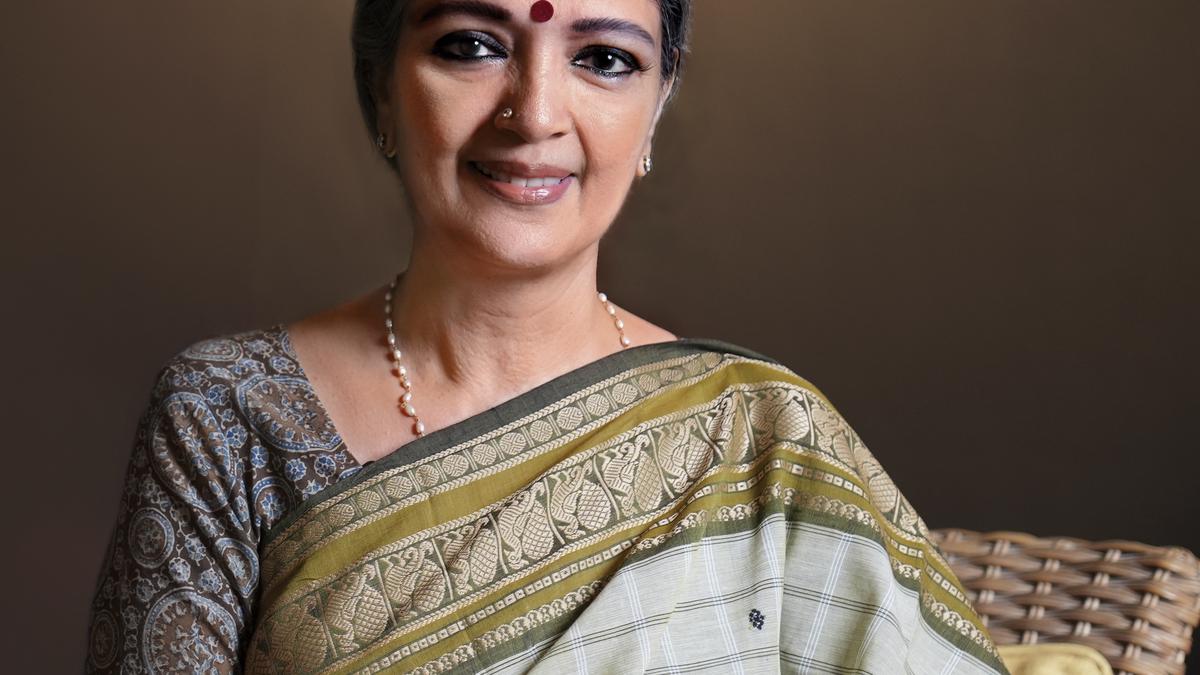
‘Embracing change is the defining quality of a good artiste,’ says Vasanthalakshmi
The Hindu
Vasanthalakshmi’s life in natya
A spotlight comes on stage, and there sits a meditative Vasanthalakshmi, ready to begin the incredibly complex Simhanandana tala. The next three avartanams of this 128-beat tala take the audience on a surreal journey with the performers.
Music and poetry has always played a significant role in Vasanthalakshmi’s life. Born in Kanigiri, Andhra Pradesh, on her maternal side, she belongs to the lineage of Vennelaganti Soorana, a royal poet of the Nellore Samsthanam. Her paternal great-grandfather was so adept at explaining the nuances of the Ramayana that the family earned the sobriquet ‘Ramayanam’.
Her mother Indira, a trained Carnatic singer and violinist, and father Prakasa Rao recognised and encouraged their daughter’s deep passion for dance and music.
Vasanthalakshmi’s journey in dance began at the age of six under the guidance of S. Bhoopal and T.V. Narasimhulu, who conducted her Bharatanatyam arangetram on October 23, 1966. Soon, guru Adyar K. Lakshman introduced her to a methodical and systematic training process, encouraging her to question and understand before accepting anything. A few years later, in 1969, Vasanthalakshmi became the partner in life and on stage to her next guru M.V. Narasimhachari.
Together, Vasanthalakshmi and Narasimhachari have enthralled audiences in India and abroad with their fine technique, challenging laya patterns, communicative abhinaya, and original choreography.
A gifted linguist, lyricist and a nattuvanar, Vasathalakshmi is known for her perfect diction of complex rhythmic syllables. She has to her credit, several sabdams, padams, varnams and mangalams. Among her critically acclaimed varnams are the one in Shanmukhapriya in khanda nadai Adi tala on Subrahmanya and the other set to Keeravani on Krishna, for which she also composed the music. She is also a proficient vainika who learnt from vidushi Kamala Aswathama.
Vasanthalakshmi’s expertise with the Simhanandana Tala Chitra Nrithyam in which the dancer draws the image of a lion with her feet has won her critical acclaim.


The actor, along with director Sushant Shah, speak about their upcoming series ‘Chiraiya’, Divya’s process of working on the dialect, Sushant’s approach to telling a story about women, and more

An independent video, ‘Feel the Spark’ by Raleigh Rajan with vocals by Ciera Dumas that celebrates Tamil literary giants, garnered 1.4 million views in less than 36 hours.

In ‘Jack Ryan: Ghost War’, John Krasinski is back as the savvy CIA analyst, diving headfirst into a high-stakes mission that unravels a deadly conspiracy and pits him against a rogue black-ops unit

Shriram Bharatiya Kala Kendra’s Shankarlal festival showcased rare ragas, radiant artistry, and inclusive performances, from Pt Madhup Mudgal’s serene morning ragas to Ramana Balachandran’s Saraswati veena.

Explore "Threads that Bind: The Kantha Project," an exhibition in Delhi reimagining kantha as a medium of repair and renewal.

Sean Penn skips the Oscars to meet Ukraine's Zelenskyy, who praises him as a "true friend" amid the war.

The teaser of Tamil star Suriya’s much-awaited film with director Venky Atluri, titled Vishwanath and Sons, was unveiled by the makers on Monday

A 'Golden' moment for a K-pop track at the Oscars.

Parvathi Nayar’s new exhibition, The Primordial, in Mumbai, traces oceans, pepper and climate change
Opened on March 12, the exhibition marks the artist’s first solo show in Mumbai in nearly two decades. Known for her intricate graphite drawings and multidisciplinary practice spanning installation, photography, video, and climate change, her artistic journey has long engaged with the themes of ecology, climate change and the natural world. In this ongoing exhibition, these strands converge through a series of works centred on water, salt, and pepper — materials that carry natural and historic weight across centuries.

Explore the highlights and key winners of the 98th Academy Awards, featuring memorable moments and historic achievements from Oscars 2026.

Spring season celebrated at Ramakrishna Mission Institute, Kolkata, with ‘Evening of Basant’

The Spirit of the Land, a solo show by artist Shivakumar Sunagar, is a vista of Nature-inspired emotions

Tal Fry is all set for an exciting new performance season