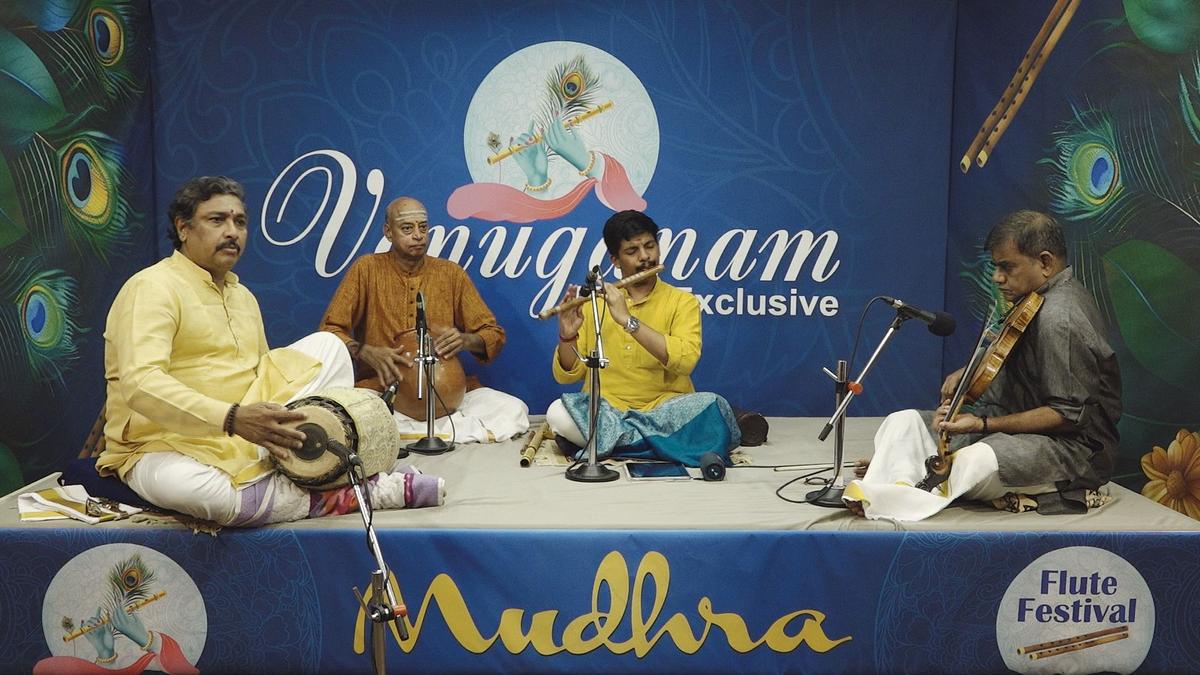
Effervescence was the defining feature of flautist Hariprasad Subramanian’s concert
The Hindu
Wind in the willows
A brief sketch Hariprasad Subramanian delivered in Surutti at the beginning reinforced the raga’s sober nature, but the young flautist followed the alapana with a varnam that brought to the fore its ebullient character. Thiruvottriyur Thyagayyar’s ‘Ento premato’ in Adi tala displayed how dynamic forays, more so along the swara sequences towards the culmination of the speedy second half, can set the tone for an energetic concert.
In fact, effervescence turned out to be the overall feature of Hariprasad’s two-hour performance at the Venuganam festival that Mudhra organised across six evenings last month. For instance, Nattai was the Kerala instrumentalist’s choice as the second piece. The inherent sprightliness in this asymmetric raga resounded further in ‘Jaya jaya (Purandaradasa), with the five-beat khanda chapu adding to the momentum.
By now Hariprasad’s grip over the woodwind was obvious: no shrill towards the top registers, never a slip down the rhythmic path. Both features not only encouraged his much-senior accompanists, but made their job easier — a hint of smile would light up the responses from M.R. Gopinath on the violin, while Sherthalai Ananthakrishnan (mridangam) and Madipakkam Murali (ghatam) were always cheerful. Hariprasad, who hails from a family of musicians near Guruvayur, is the son of nagaswaram vidwan O.K. Subramanian.
Natakapriya was the first parent scale in the presentation of eight pieces. The seven-minute alapana threw light on the kaleidoscopic nature of the tenth melakarta, which also gave Gopinath his first opportunity to show his neat artistry in response. The delineation of ‘Karuna jesi’ (of Mysore Vasudevacharya’s ‘Idi samayamu’) hinted at an upcoming swaraprastara set to Rupakam. Barring a cursory jarring, this solfa stretch bloomed as an excellent instance of individual imagination and harmonious teamwork. Nalinakanti (‘Natajana palini’ by Thanjavur Sankara Iyer) came next as just a bridge to the centrepiece.
Purvikalyani as the main highlighted Hariprasad’s finesse in assuring tonal quality to the emotive core of a raga. The alapana was refreshing even while treading the customary path, though the cooling-down was somewhat abrupt. The seasoned violinist, though not very tidy in his solo reply, offset this drawback, and joined into ‘Padmavati tamanan’. The mellowness of the melody graced each breath of the Oothukadu Venkata Subbaiyer kriti that had its final stanza branching out to niraval.
This elaborate corridor featured fair share of improvisations underscoring the happy results of any collaboration steeped in cooperation. Things progressed to the swaraprastara stage in a way that it reinforced the role of the uneven Misra chapu tala in lending the rallies a special charm. The increasing prominence of the mridangam and ghatam in the soundscape had its natural culmination in an 18-minute tani avartanam that adhered to the aesthetics of the principal composition.
The final lap comprised three pieces: Sadasiva Brahmendral’s ‘Manasa sancharare’ in Sama, ‘Bhavayami gopala balam’ (Yamuna Kalyani, Annamacharya) and a Lalgudi Jayaraman thillana in Maund. Though they came in as tukkadas, they were unhurried even while sounding vivacious.


Artist Kapila Nahender explores notions of belonging, growth and memories in her show Pockets of Resistance

BTS's comeback concert in Seoul drew over 100,000 fans, featuring their new album "ARIRANG" and a global livestream.

Prasads Multiplex Hyderabad unveiled one of India’s largest HDR cinema auditoriums, the PCX HDR by Barco

From staged funerals to rented fatherhood, Brendan Fraser turns rented intimacy into something disarmingly real in Hikari’s poignant Tokyo fable

Meet Nivrritii Mahesh, a Bharatanatyam dancer who dances with Cochlear implants

In a surprising turn of events, Urvashi theatre, one of Bengaluru’s iconic single screens, has re-opened, with the much-talked-about Dhurandhar: The Revenge running to a full house in the theatre. After the expiry of the 45-year lease, it seemed like curtains would come down on the king-size theatre but for now, it’s good news for fans.

The thrilling ‘Peaky Blinders’ finale is a farewell tour tailored for Tommy Shelby, while passing the baton to a new generation

BTS's comeback concert in Seoul drew over 100,000 fans, featuring their new album "ARIRANG" and a global livestream.

Khalid Rahman is reuniting with Malayalam superstar Mammootty after Unda (2019). The Thallumaala director has teamed up with the veteran for Mattancherry Mafia.

Bollywood actor Akshay Kumar paid tribute to the martial arts grandmaster and Hollywood’s action star, Chuck Norris, who passed away on Thursday, March 19, 2026.

Renowned Odissi dancer Madhumita Raut, aged 59, dies of cardiac arrest, leaving behind a legacy of artistic achievements.

Chuck Norris, iconic martial arts master and actor, dies at 86, leaving behind a legendary legacy and internet memes.

South African naturalist Steve Boyes speaks on ghost elephants, ancestral tracking, and Werner Herzog’s documentary exploring Angola’s elusive highland giants