Ecuador’s president invites foreign armies to fight gangs in the country
CNN
In a local radio interview earlier this month, Noboa said his government was “already in talks” to receive foreign military support.
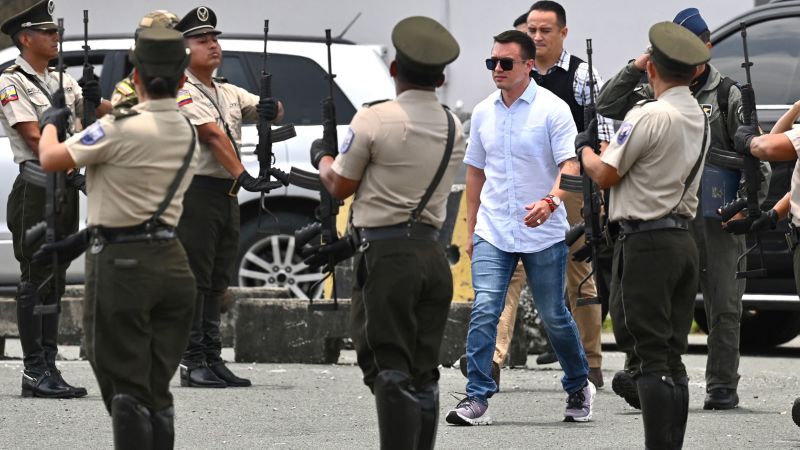
Ecuador’s President Daniel Noboa wants foreign armies to help crack down on gang violence in the country. In an interview with the BBC published Tuesday night, Noboa said he wants US, European and Brazilian armies to join his “war” on gangs, telling the broadcaster that his country needs more armed forces to fight against criminal groups. The Ecuadorean leader previously called for international forces to support the country’s effort to combat gangs. In a local radio interview earlier this month, Noboa said his government was “already in talks” to receive foreign military support for provinces like Guayas known for high crime, but did not specify which countries were involved in the talks. “We have a plan in place with our law enforcement agencies, the Ministry of the Interior, the Ministry of Defense, the Armed Forces, the Strategic Intelligence Center, and international assistance and support from special forces. That’s essential,” he told Guayaquil’s Radio City. CNN has reached out to the Pentagon and Brazil’s defense ministry on whether sending troops to Ecuador is on the table. Ecuador has been hit by waves of gang violence - often linked to the drug trade - prompting the government to take a series of extraordinary measures, including a nationwide crackdown last year, preemptive pardons for law enforcement officers battling the gangs, and states of emergency.


The search for missing 84-year-old Nancy Guthrie, mother of “Today” show host Savannah Guthrie, has stretched into another anguished week, with mounting pressure on investigators and a family grappling with uncertainty.

Cuba’s Ministry of Energy announced Saturday evening that entire island has suffered another electrical blackout, leaving more than 10 million people without power.

Iran’s attempt to strike a US-UK base over 2,000 miles (over 3,000 kilometers) off its coast has renewed questions about Tehran’s military capabilities and how far its missiles can reach.

For years, President Donald Trump has offered crass and insensitive comments about people who died – especially his foes. That reached a new level on Saturday.

Robert Mueller, the former FBI director who led the historic probe into alleged collusion between Donald Trump’s 2016 campaign and the Russian government, has died. He was 81.

Marlon Batres is not OK. The assistant principal says he is in constant fear for his students, staff and even himself after federal agents swarmed the streets.

To hear some prominent MAGA voices tell it, the marathon Senate debate over the “SAVE America Act” is an existential one for the Republican Party. But the urgency to pass the legislation is not felt by Americans more widely.

In the days after winning the Democratic nomination for Senate, Illinois Lt. Gov. Juliana Stratton spoke to the two women with whom she could make history next year.

This month, terrorist suspects in the alleged bomb-throwing in New York City and the synagogue attack in Michigan visited Phantom Fireworks stores shortly beforehand.

In near-daily briefings with top military officials at the White House, President Donald Trump has reviewed options that include sending American troops into Iran.

With his Atlantic City casinos in duress in the 1990s, Donald Trump saw a potential lifeline in sports betting and aggressively campaigned to legalize it in New Jersey. But when state powerbrokers shut him down, Trump vowed that he’d eventually find a way to win.

Unpaid Transportation Security Administration workers are struggling to stay afloat – and on the job – amid a partial government shutdown that has frustrated travelers inching through security lines that stretch for hours, with wait times only expected to worsen this weekend.

As Havana calls on Cuban exiles to invest in the island, many in the United States are rejecting the offer outright, viewing it as a desperate move by a government under mounting pressure.