Ecuador president’s war on crime gets a boost with early referendum results and gang member’s arrest
CNN
The government looks on track to win support for its key security proposals, while police say they have arrested a notorious alleged gang leader.
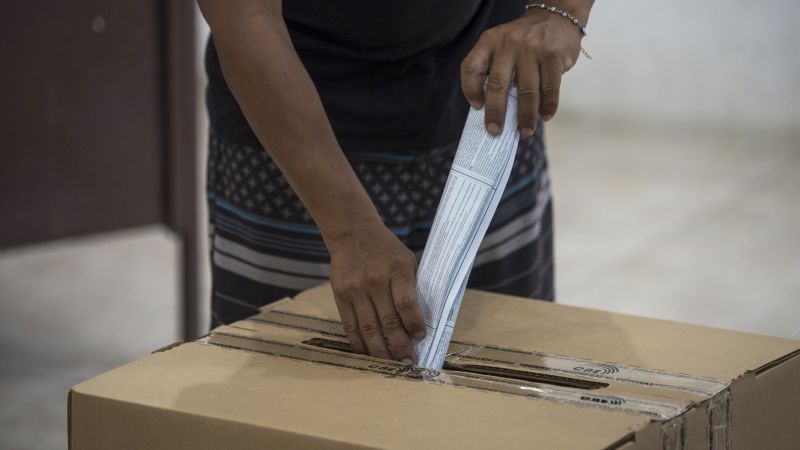
Early results from Ecuador’s referendum suggest President Daniel Noboa has won public backing for security measures aimed at boosting his war on crime. His government looks on track to win support for nine of the 11 proposals it put forward in Sunday’s vote, including for four of its key security measures, according to data from the National Electoral Council (CNE). And the good news for Noboa was compounded Monday when police announced they had arrested a notorious alleged gang leader. Early results from the referendum suggest 72% of the public approve of allowing the military to patrol with police to combat organized crime (something that can presently only happen under a state of emergency) and 65% back allowing the extradition of Ecuadorians under certain conditions (among them, guarantees of humane treatment and no use of the death penalty). Both those proposals would require modifying Ecuador’s Constitution, which currently forbids the extradition of Ecuadorians under any circumstances. If the final results of the vote continue to show public backing for these measures, they will go into effect as soon as they are published in the official registry. It is unclear exactly when this would happen. Two other security-related proposals – harsher prison sentences for some violent crimes and the establishment of a permanent armed forces presence in prisons to prevent weapons smuggling – also look on track to receive wide approval margins. These two proposals would not require changing the Constitution and will need the agreement of the National Assembly before they can go into effect.


President Donald Trump is reshaping a Colorado Republican primary by offering one of the candidates a role in his administration and returning his endorsement to the incumbent, whom he called a “RINO” just last month.

More than a month into the Department of Homeland Security shutdown, lawmakers on Capitol Hill are reckoning with their own travel privileges amid anxieties the funding crunch could exacerbate issues at already understaffed airports around the country.

TV host and comedian Bill Maher has been chosen to receive the prestigious Mark Twain Prize for American Humor, two sources close to the Kennedy Center told CNN.

Conventional wisdom has set in that President Donald Trump’s base is sticking with him on the Iran war, but he has alienated significant portions of his voters — and risks alienating more.

US officials are furiously trying to avert a potential monthslong closure of the Strait of Hormuz, privately acknowledging that reopening the key waterway is a problem without a clear solution and dependent at least in part on what lengths President Donald Trump is willing to go to force the Iranian regime’s hand, multiple administration and intelligence officials tell CNN.

The chief executive of Live Nation testified Thursday that it was “disgusting” that a top ticketing employee talked about “robbing fans blind” in internal messages.

Supreme Court revives First Amendment lawsuit from street preacher who called concertgoers ‘sissies’
The Supreme Court on Friday revived a First Amendment lawsuit from a street preacher who used a loudspeaker to call people “whores,” “Jezebels” and “sissies” as they tried to enter an amphitheater to attend concerts in a suburban Mississippi community.

As millions of Americans braced for a series of brutal storms this winter, the senior official in charge of the federal government’s disaster response had been on the job only a few weeks — and had previously claimed on podcasts that he once teleported to a Waffle House.

Air travelers across the US continue to face travel headaches as Transportation Security Administration workers go without full pay. Find the latest live updates here.

Veterans’ advocates are raising concerns that a new agreement between the departments of Veterans Affairs and Justice could take away veterans’ autonomy over their health care decisions and deter them from seeking care, particularly those facing homelessness.

Admirers of Cesar Chavez and public officials are scrambling to respond to claims about the man who has been honored with holidays, statues and school names in communities around the country.

The co-founder of Super Micro Computer and two others were charged with diverting $2.5 billion worth of servers with Nvidia’s artificial intelligence chips to China, in violation of US laws barring exports to that country without a license.

The Treasury Department will begin to manage federal student loans in default, taking on a key function of the Education Department as the Trump administration further pushes to dismantle it.