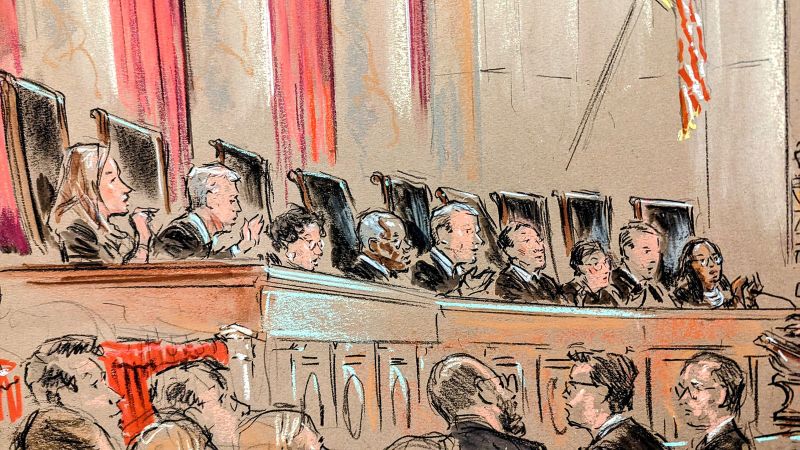
Early divisions signal bitter internal conflicts as Supreme Court turns toward final decisions
CNN
From a blockbuster Second Amendment decision to a more technical case about retaliatory arrests, sharp disagreements have emerged on the Supreme Court over the reasoning of recent rulings – divisions that could signal an especially fiery end to the current term.
From a blockbuster Second Amendment decision to a more technical case about retaliatory arrests, sharp disagreements have emerged on the Supreme Court over the reasoning of recent rulings – divisions that could signal an especially fiery end to the current term. Even as the court is sometimes finding wider-than-expected majorities for relatively limited outcomes, the nine justices are regularly in conflict over the meaning of decisions. The quarreling over doctrine and rationale may partly explain why so many major cases remain before the court’s term is expected to end as soon as Friday. That dynamic was particularly notable last week in a blockbuster decision on guns, which drew eight justices into the majority but five separate concurrences bickering over the court’s methodology. A number of lower-profile cases have also sparked deep doctrinal divisions, even when the final vote count is lopsided. “It does seem, at least anecdotally, unusual to have this many separate opinions in cases with relatively lower stakes,” said Steve Vladeck, CNN Supreme Court analyst and professor at the University of Texas School of Law. “Only the justices know why, but it certainly at least suggests that the court is having trouble reaching consensus, even in contexts in which historically it was better able to do so.” In an important ruling last week dealing with a Trump-era repatriation tax, several justices dinged the majority for not answering the question the court initially agreed to resolve. Meanwhile, in a decision about a former city councilwoman who claimed she was wrongly arrested, Justice Brett Kavanaugh appeared to be so exasperated that he wrote the judicial equivalent of a shrug emoji into a concurrence. “We are where we are,” Kavanaugh wrote, adding that the court’s decision to grant the case seemed, in retrospect, “ill-advised.”


The Department of Homeland Security on Monday said it would invest $115 million in counter-drone technologies to secure the World Cup and events marking 250 years of American independence.

Democrats are getting the news they’d been hoping for out of Alaska, with former US Rep. Mary Peltola launching a Senate campaign on Monday morning.

When the Supreme Court, led by Justice Neil Gorsuch, ruled in 2020 that federal law protected transgender workers from discrimination, the justices appeared to launch a new era of rights for a historically shunned group.

Cuba’s leader has pushed back on US President Donald Trump’s demand that the Caribbean nation “make a deal” with Washington, as Trump said Havana would be cut off from the Venezuelan oil and money that it’s relied on for decades.

Hundreds of Border Patrol officers are mobilizing to bolster the president’s crackdown on immigration in snowy Minneapolis, Homeland Security Secretary Kristi Noem said Sunday, as tensions between federal law enforcement and local counterparts flare after an ICE-involved shooting last week left a mother of three dead.

A suspect has been arrested after a fire tore through Beth Israel, the only synagogue in Jackson, Mississippi, on Saturday, leaving the congregation forced to rebuild from the ashes — again.

The Smithsonian has taken down details about President Donald Trump’s impeachments from an exhibition at the National Portrait Gallery,

President Donald Trump is weighing a series of potential military options in Iran following deadly protests in the country, two US officials told CNN, as he considers following through on his recent threats to strike the country should they use lethal force against the Iranian people.

Nationwide outcry over the killing of a Minneapolis woman by an Immigration and Customs Enforcement agent spilled into the streets of cities across the US on Saturday, with protesters demanding the removal of federal immigration authorities from their communities and justice for the slain Renee Good.

Since early December the US Coast Guard and other military branches have boarded and taken control of five oil ships that had previously been sanctioned, all either accused of being in the process of transporting Venezuelan oil or on their way to take on oil that has been subject to US sanctions since President Donald Trump began a pressure campaign against the leadership of the country during his first term.

This high school sophomore is aiming for a Supreme Court upset in transgender sports case

A Virginia man accused of plotting with his family’s au pair to kill his wife and another man, who had been lured to the home via a sexual fetish website, is set to face trial this week.

Miami’s exile politics forged Marco Rubio’s worldview. Now they’re shaping Trump’s foreign policy.