Early assessments raise questions over whether US destroyed bulk of enriched Iranian nuclear material
CNN
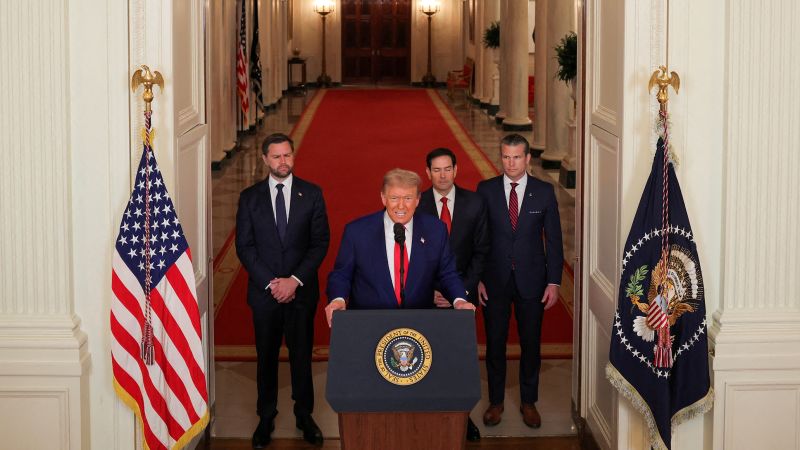
President Donald Trump declared that Iran’s nuclear enrichment facilities were “completely and totally obliterated” following this weekend’s air strikes, but the US appears to have held back its most powerful bombs against one of the three facilities included in the operation, raising questions about whether it finished the job.
President Donald Trump declared that Iran’s nuclear enrichment facilities were “completely and totally obliterated” following this weekend’s air strikes, but the US appears to have held back its most powerful bombs against one of the three facilities included in the operation, raising questions about whether it finished the job. In Isfahan, where nearly 60% of Iran’s stockpile of already-enriched nuclear material is believed to be stored underground, according to a US official, a US submarine hit the site with Tomahawk cruise missiles, Chairman of the Joint Chiefs Gen. Dan Caine said Sunday. But unlike the other two Iranian facilities targeted in the operation, B-2 bombers did not drop massive “bunker-buster” bombs on the Isfahan facility, multiple sources told CNN. The damage to the facility appears to be restricted to aboveground structures, according to Jeffrey Lewis, a weapons expert and professor at the Middlebury Institute of International Studies who has closely reviewed commercial satellite imagery of the strike sites. Even if the US was successful in destroying Iran’s facility at Fordow — another underground site that housed centrifuges needed to enrich uranium, which the US hit with 12 bunker busters — the obvious survival of Isfahan has raised questions about whether Trump achieved his stated goal of “a stop to the nuclear threat posed by the world’s No. 1 state sponsor of terror.” “This is an incomplete strike,” Lewis said. “If this is all there is, here’s what left: the entire stockpile of 60% uranium, which was stored at Isfahan in tunnels that are untouched.” A satellite image taken by Airbus shows significant damage to the Isfahan site and signs that the underground portion of the facility was hit, according to the Institute for Science and International Security, which analyzed the image. But there are layers of tunnels at the facility, so it’s unclear how far the damage goes.


US officials are furiously trying to avert a potential monthslong closure of the Strait of Hormuz, privately acknowledging that reopening the key waterway is a problem without a clear solution and dependent at least in part on what lengths President Donald Trump is willing to go to force the Iranian regime’s hand, multiple administration and intelligence officials tell CNN.

The chief executive of Live Nation testified Thursday that it was “disgusting” that a top ticketing employee talked about “robbing fans blind” in internal messages.

Supreme Court revives First Amendment lawsuit from street preacher who called concertgoers ‘sissies’
The Supreme Court on Friday revived a First Amendment lawsuit from a street preacher who used a loudspeaker to call people “whores,” “Jezebels” and “sissies” as they tried to enter an amphitheater to attend concerts in a suburban Mississippi community.

As millions of Americans braced for a series of brutal storms this winter, the senior official in charge of the federal government’s disaster response had been on the job only a few weeks — and had previously claimed on podcasts that he once teleported to a Waffle House.

Air travelers across the US continue to face travel headaches as Transportation Security Administration workers go without full pay. Find the latest live updates here.

Veterans’ advocates are raising concerns that a new agreement between the departments of Veterans Affairs and Justice could take away veterans’ autonomy over their health care decisions and deter them from seeking care, particularly those facing homelessness.

Admirers of Cesar Chavez and public officials are scrambling to respond to claims about the man who has been honored with holidays, statues and school names in communities around the country.

The co-founder of Super Micro Computer and two others were charged with diverting $2.5 billion worth of servers with Nvidia’s artificial intelligence chips to China, in violation of US laws barring exports to that country without a license.

The Treasury Department will begin to manage federal student loans in default, taking on a key function of the Education Department as the Trump administration further pushes to dismantle it.

The Justice Department on Thursday seized several websites it says were used by Iran as part of “psychological operations” targeting perceived advisories and spreading terrorist propaganda.

Sen. Thom Tillis on Thursday blasted talk of ending the Senate filibuster to pass the “SAVE America Act” as a “foolish and lazy idea” and warned his party that pushing the president’s priority through the so-called talking filibuster would hand control to Democrats.

On two major occasions, the Trump administration has gestured at Israel being mostly responsible for major inflection points in the Iran war — even though the evidence on both counts isn’t totally clear.

Conservative hardliners who supported subpoenaing Attorney General Pam Bondi in the House Oversight Committee’s Jeffrey Epstein probe are now indicating that they are open to changing their position after Bondi met with the panel for a briefing that turned contentious with Democrats.