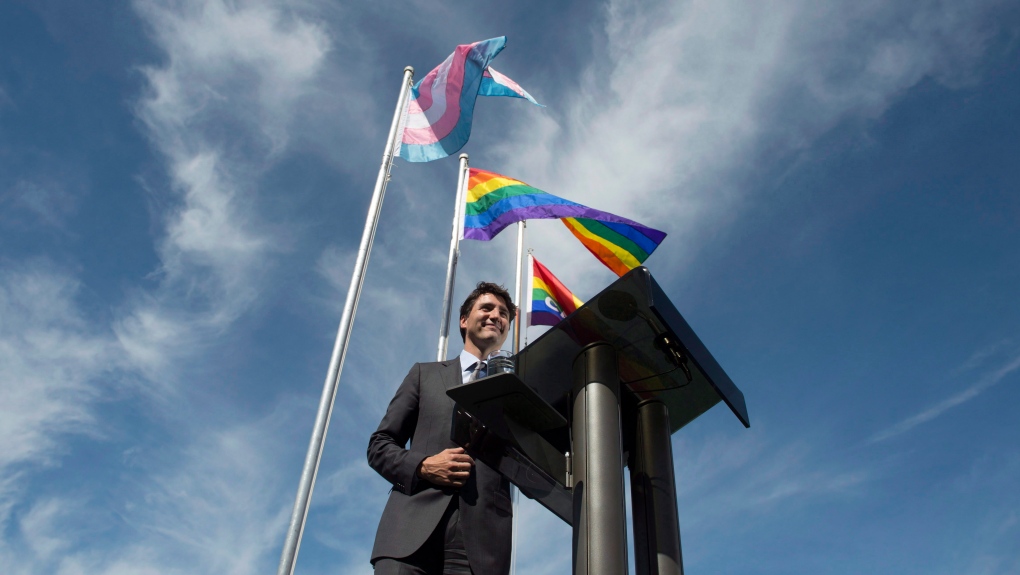
E-petition calls for Canada to allow trans people to claim asylum; but right 'already established'
CTV
More than 130,000 people have signed an e-petition calling on Canada to give transgender and non-binary people fleeing harmful laws in their home countries the right to claim asylum, but that's already possible in this country. Advocates say the popularity of the proposal shows politicians that Canadians want the government to affirm its welcoming position.
More than 130,000 people have signed an e-petition calling on Canada to give transgender and non-binary people fleeing harmful laws in their home countries the right to claim asylum, but that's already possible in this country.
The online petition asking the federal government to take action launched in January has been recently gaining traction on social media, seeing tens of thousands of Canadians, as well as celebrities, sharing the petition and calls to go sign it.
"We, the undersigned, residents of Canada, call upon the House of Commons to extend to transgender and nonbinary people the right to claim asylum in Canada by reason of eliminationist laws in their home countries, whatever country that may be," reads the e-petition.
Despite the e-petition asking for Canada to allow asylum claims on grounds that are already established, it's currently garnered the most signatures by far of any current petitions on the House of Commons' site, from all provinces and territories.
It was initiated by Ontario woman and trans advocate Caitlin Glasson. In an interview with CTV News Kitchener in February, she said she picked an e-petition "as a means of directly approaching the government with something I feel is urgent and important."
The e-petition points to recent laws and proposed policy changes in the United States and United Kingdom seeking to weaken protections for trans and non-binary people, in making the case for allowing asylum claims from countries that have historically been considered "safe."
An immigration lawyer with expertise in LGBTQ2S+ cases told CTVNews.ca however, that LGBTQ2S+ people already are able to qualify as refugees by citing a risk of persecution—including in relation to discriminatory laws in their home country—based on their sexual orientation or gender identity.


From doctors to nurse practitioners, health-care professionals are flocking to British Columbia by the hundreds in response to a campaign aiming to recruit Americans, according to Premier David Eby.

According to the Saskatchewan Ministry of Highways, a semi truck carrying an excavator heading south on Highway 39 hit an overpass on the Trans-Canada Highway east of Moose Jaw on Monday - marking the third incident in as many weeks.

Saskatoon’s public school division says it’s tightening safety measures following the arson attack at Evan Hardy Collegiate.

A B.C. man has been fined $5,000 and banned from hunting for a year after pleading guilty to discharging a firearm in a no shooting area, according to provincial conservation officers.

A school division has cancelled bus services in several regions due to what it’s calling a fluid weather system that’s making road conditions increasingly difficult to predict.

Edmonton’s police chief Warren Driechel says he stands by his trip to Israel following calls for his resignation.

Calgary police say three teenagers are facing charges after a stabbing that took place in a northeast CTrain station last weekend.

A B.C. nurse has been suspended for three weeks over a variety of “practice and conduct issues,” according to the college that regulates the profession in the province.

A London man convicted of criminal negligence causing death in connection with a November 2020 collision will remain out on bail, but faces significantly stricter conditions, a judge ruled Tuesday afternoon.

The family of a young woman killed in a hit-and-run in Cape Breton over the weekend are speaking out as police in the area continue to try to track down the driver.

Three Toronto police officers accused of colluding to lie during the first-degree murder trial of a man charged with killing their colleague have been cleared of misconduct following a probe by the Ontario Provincial Police.

French Foreign Minister Jean-Noel Barrot is openly mulling the idea of Canada seeking membership in the European Union.

Several people are facing charges after a multi-jurisdictional police investigation that resulted in the seizure of more than $842,000 of illegal drugs.