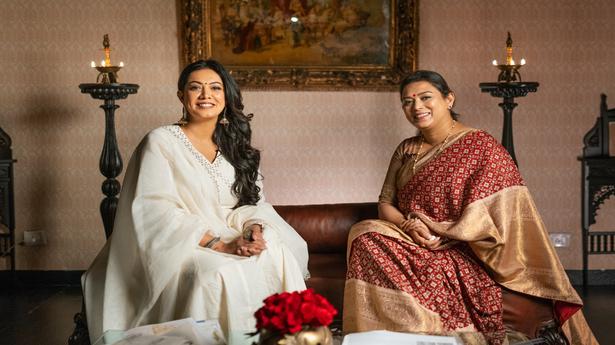
Dressing up the characters of ‘Ponniyin Selvan’: How Eka Lakhani and Pratiksha Prashant cracked it
The Hindu
Ruby-encrusted gold jewellery to handwoven cotton and silks, armours to tiger motifs, costume designer Eka Lakhani and jewellery designer Pratiksha Prashant disclose what it took to dress up the characters of ‘Ponniyin Selvan’
The face-off between Chola princess Kundavai (Trisha Krishnan) and Nandini (Aishwarya Rai), the queen of Pazhuvur, is expected to be one of the many pivotal moments of Mani Ratnam’s Ponniyin Selvan -1, which releases on September 30. The promotional images of this face-off feature the actors dressed to perfection. This was among the toughest portions to design and style, say the film’s costume designer Eka Lakhani and jewellery designer-stylist Pratiksha Prashant of Kishandas & Co. “Nandini and Kundavai try to outshine each other; it was both challenging and fabulous for us to work with the two actors,” says Eka, when we meet for an interview in Hyderabad.
For Mumbai-based Eka and Hyderabad-based Pratiksha, walking into the world of Ponniyin Selvan, the film adaptation of Kalki’s period novel of the same name, was a one-off experience. Production house Madras Talkies gave them ample research material, which was prepared in consultation with historians. The designers added to this research to use period-appropriate jewellery and clothing for the film.
The first step was to not be overwhelmed by the expectations that come with adapting an eponymous book that every other Tamil household treasures: “Everyone has their own imagination of the characters,” says Eka. The design team made sketches of each character, and the old drawings by artist Maniam for the weekly magazine Kalki were among the reference points. Eka points out that while these drawings portray the royal characters during their public appearances, they had to imagine how Kundavai, Nandini or Vanathy would look in their private chambers.
Eka and Pratiksha say while it was easy to sketch Kundavai with her elaborate hairdo or Nandini with her Aandal-inspired hairdo, the challenge was to make it work for the actors. Several look tests followed and measurements were taken before finalising the size of the hair bun and the angle. The hair accessories posed a challenge: “Earrings and necklaces were the easy part. Figuring out whether, say, a 11-inch or 13-inch hair accessory can adorn the elaborate hairstyles took some time. The drawings featured the women wearing both flowers and hair jewellery but this was tough to do in reality. The flowers would mask the jewels,” says Pratiksha.
The jewellery for the royal characters was designed in gold; and silver and other metals were used for other characters. Nearly 50 kaarigars were involved in making the jewellery. Pratiksha’s husband Prashant and brother-in-law Nithin of Kishandas jewellers oversaw the designing while she took charge of the styling.
As advised by the director, Eka visited temples in and around Thanjavur to observe the sculptures, and talk to weavers. “A lot of available research dates back to the 12th century. We had to figure out what would be suitable for events that happen from the 9th to the 12th centuries,” she says.
Cotton, muslin and mulmul were the primary woven fabrics of the region. Trade brought in silks. Taking a cue from some of the temple sculptures, zari was used for the Chola royal characters but Eka’s team kept embellishments like embroidery to a bare minimum. “We used the beaten pita work to make it look subdued.”


Atul Kumar shares his experience staging Tom Stoppard's radio play 'Darkside' after the playwright waived royalties for the production.

Anchored by a phlegmatic Nawazuddin Siddiqui, director Honey Trehan crafts a mystery that intertwines crime and social commentary. Though uneven in pacing, the film deftly examines the intersection of entitlement and morality in society

Singer Tanvi Shah returns to music with 'Baala Kaale', a Sinhalese song that marks a quiet, hopeful comeback.

The makers of the Sivakarthikeyan-starrer Parasakthi have unveiled a grand exhibition at Valluvar Kottam in Chennai that displays the many period sets that were created for the film

The trailer of Vir Das' Happy Patel Khatarnak Jasoos, backed by Aamir Khan and also starring Imran Khan, was unveiled

Filmmaker Prakash Veer just pulled off a major feat with the release of ‘The Devil’, his action-thriller featuring superstar Darshan, all while the actor was dealing with some serious legal drama

Dhurandhar exemplifies government-embedded filmmaking, blending patriotism with a one-dimensional portrayal of Pakistan in contemporary cinema.

Solve The Hindu Sunday crossword no. 35 with intriguing clues across and down for a fun challenge!

In its 10th edition Serendipity Arts Festival foregrounds food-themed projects and commentaries on surveillance, migration, ecology and erasure

Test your crossword knowledge with intriguing trivia and puzzles inspired by their rich history and clever wordplay.

A vacuum cleaner haunted by a ghost is the kind of one-liner which can draw in a festival audience looking for a little light-hearted fun to fill the time slots available between the “heavier” films which require much closer attention. A useful ghost, the debut feature of Thai filmmaker Ratchapoom Boonbunchachoke being screened in the world cinema category at the 30th International Film Festival of Kerala (IFFK), even appears so in the initial hour. Until, the film becomes something more, with strong undercurrents of Thailand’s contemporary political history.

Kochi News:Watch: Kochi-Muziris Biennale 2025 opens across 22 venues

Sustainability is not an add-on, but stamped firmly into the process: every piece is biodegradable, waste-free and unembellished, free from glitter or beads. “Products should be sustainable and biodegradable so that our planet is not harmed,” says Anu Elizabeth Alexander, a student of Sishya, Adyar. At a recent exhibition, the stars she made sold the fastest, followed by the small diamonds. “I would like people to know about the process, how it is created, and that it is sustainable,” says Anu. Infanta Leon from Kotturpuram developed an interest in crochet as a teenager. It was a hobbyhorse that evolved into a steed that would help her embark on a journey of identity-shaping creative engagement. She started making Christmas-themed decor two years ago, spurred by a desire to craft safe, eco-friendly toys for children. “With a toddler at home, and my elder child sensitive to synthetic materials, I wanted to create items that were gentle, durable and tactile,” she explains. Her earliest creations were small amigurumi toys which gradually evolved into ornaments that could adorn Christmas trees with warmth and charm.