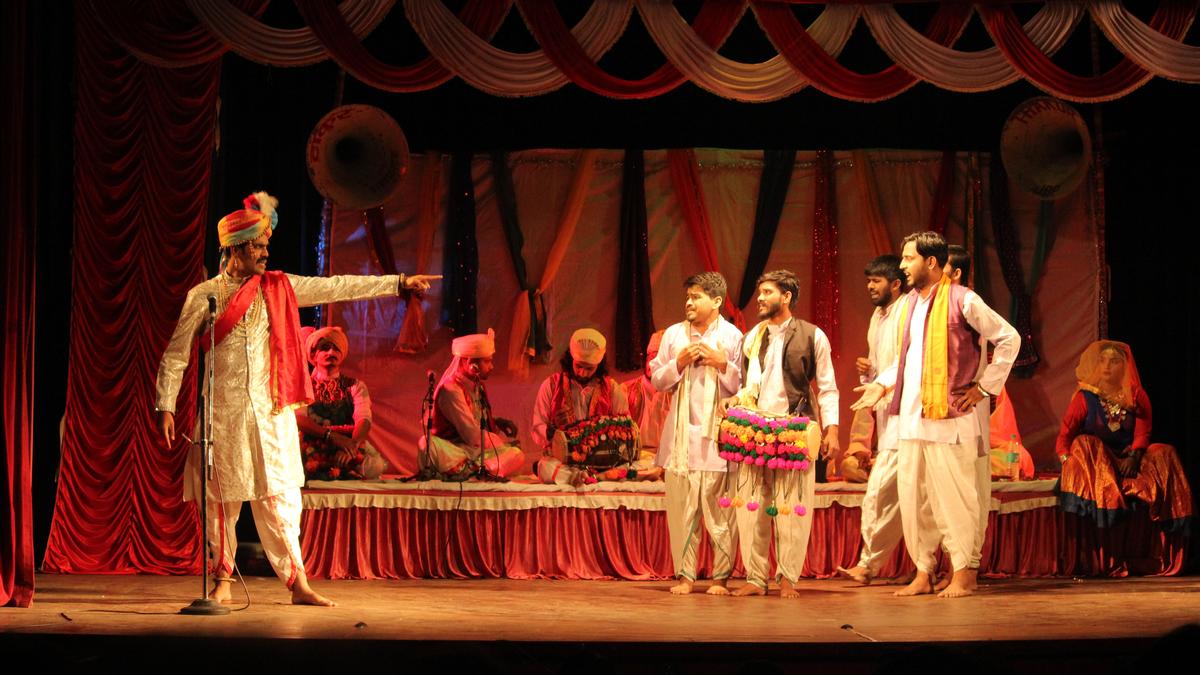
Drama at high noon | Review of The Comeback by Annie Zaidi
The Hindu
Annie Zaidi's novel "The Comeback" explores friendship and self-realization in the world of performing arts with depth and irony.
Many novelists have explored the interplay between the performing arts and life to illuminate their themes. A recent example that comes to mind is Irish author Anne Enright’s 2020 novel Actress, which is set against the world of theatre and film and delves into a fraught mother-daughter relationship. Annie Zaidi’s The Comeback uses the same world to explore ideas of friendship and self-realisation.
The narrator of Zaidi’s novel is an actor who has changed his name from Jaun Kazim to John K. to gain wider acceptance, a decision that reflects his self-interested approach to navigating the world. After years of auditioning for meaty roles in Mumbai, he strikes gold when a producer listens to his narration of an audiobook and selects him for the central role in the film version.
John is from the town of Baansa, located “north of Lucknow but south of Bareilly”. It was while he was in college here that he was bitten by the acting bug, and his talent was spotted and shaped by Asghar, a close friend and theatre group leader. “His was the hand that had picked up a rock”, John acknowledges, “and polished it into a gemstone”.
Now, however, John is on the cusp of success while Asghar works as a bank employee. After an ill-judged interview with a film publication in which the actor reveals details of their misdemeanours during a college exam, Asghar is fired from his job, much to John’s chagrin.
Asghar retreats to his mother’s house in Baansa with his wife and children to lick his wounds and plan for his future. Holding John responsible for his fate, he refuses to return calls and messages. The rift between the friends grows by the day, even as John devotes himself to signing contracts and “making the most of my moment”.
This, then, is the slim novel’s central predicament, related in a manner that is both economical and absorbing. It contains more than a few touches of broad irony, especially when it comes to the business of art and the way eastern and western dramatic traditions are appropriated by the cognoscenti.
In his late 30s, and with his career now on the skids, John becomes obsessed with finding out what Asghar is up to. When he learns that his old friend is returning to the stage, it feels like “a needle-stab in my heart”. Consumed by envy, he tries his best to be cast in the upcoming production.


The Railway Ministry has decided to regularise the services of Surat-Mangaluru Junction-Surat bi-weekly Special Express along with nine other special trains.

Training held for zonal election officers in Thoothukudi

Defence Minister highlights BRO's vital role in enhancing border infrastructure, national security, and socio-economic growth in India.

Andhra University celebrates its 91st and 92nd convocations, honoring graduates and distinguished personalities for their contributions and achievements.

Coimbatore students receive earthen bowls to provide water for birds, promoting conservation on World Sparrow Day.

Residents of Hosahundi village in Kasaba hobli of Mysuru taluk have opposed the proposed construction of a flyover at Devalapura Cross on National Highway 275-K (Outer Ring Road), urging the authorities to drop the project and adopt alternative measures to improve road safety.

A brain-dead head constable’s family consented to organ donation under the Jeevandan programme, giving two patients a new lease of life through kidney transplants.

A-G informs Madras High Court no govt. sanction needed for FIR in K.N. Nehru's cash-for-jobs scam case.

President of Karnataka Beary Sahitya Academy U. H. Umar on Wednesday appealed to Madhu Bangarappa, Minister for School Education and Literacy to introduce Beary as the third optional language from Class 6 from the academic year 2026-27.

Karnataka Dalit Sangharsha Samiti (DSS) has urged the State government to begin the process of filling up 56,432 posts only after rectifying the mistakes in fixing the roster and implementing the internal reservation among Scheduled Castes.

Rebel nominations in Karaikal expose tensions within electoral alliances, risking voter fragmentation ahead of the Puducherry Assembly elections.

CCPA prohibits restaurants and hotels from imposing unfair LPG charges, labeling them as unjustified and against consumer protection guidelines.

Andhra Pradesh receives ₹19.47 crore for 44 handloom clusters, benefiting over 10,000 weavers under the National Handloom Development Programme.