Doveton’s unique Christmas tree
The Hindu
It is Yule tide and as artificial trees are being brought to life through decorations, take a look at a real tree on the campus of Doveton Girls Higher Secondary School in Vepery that was given a fresh start through artificial support systems
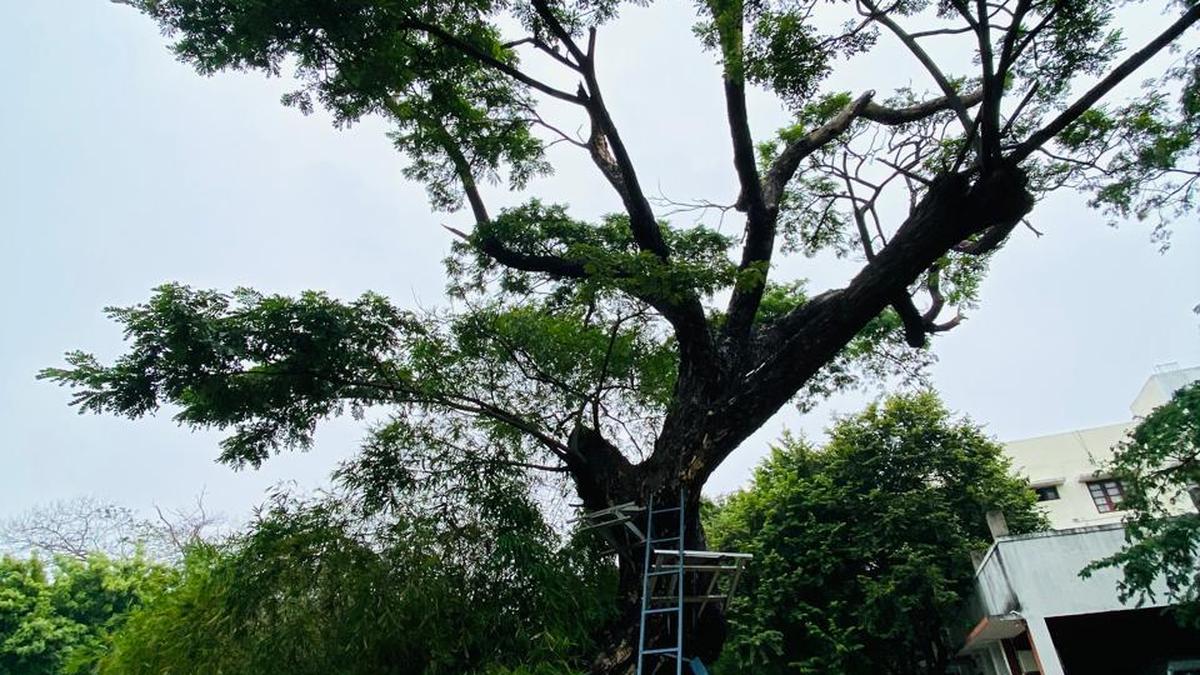
The once-majestic rain tree at Doveton Girls Higher Secondary School in Vepery began to be unsteady on its feet, a weakness that went unnoticed until the day it slumped. The school helped it back on its ageing feet, providing it with “crutches” to enable it to complete the rest of its life journey. Eight years later, it stands steady on its assisted feet, the props — a combination of metal and concrete — firmly in place.
Reflecting on the effort to save the tree, H.E. Wilkins, chairman, Doveton Group of Schools, remarks, “If someone is 80 years old and unwell, you do not just let them go — you provide care and support. This tree deserved the same.”
When the tree slumped, they could have sent it packing without a twinge of guilt, their act justified by a factor other than age. Rain trees (Albizia saman) are “alien” in this land, their roots made for elsewhere, specifically central and southern America. Though introduced, they have blended into the landscape. Traipse down TTK Road, and you would run into humongous rain trees from one end to the other. This rain tree at Doveton has blended into its specific environment, proudly brandishing a character of its own.
It is a magnet for rose-ringed parakeets, and so the tree, lovingly christened The Parrotage by Wilkins, became the focus of a collective effort to restore its vitality, when it slumped that fateful day, eight years ago. Pooling together five lakh rupees, the school devised an innovative plan to rejuvenate the ageing tree. Iron girders were installed to cradle its weakened frame, anchored securely by a sturdy concrete base. With this care and determination, the school ensured that the tree would continue to stand on the campus, offering a home for its feathered friends, particularly the rose-ringed parakeets.
This rain tree now may be a shadow of its original glory, some of its branches resembling a statement abandoned mid-sentence; and some others, gnarled in a manner that reminds one of a tedious, circular argument that implodes on itself. Amputated and wrinkled and shorn of thick foliage, certainly, but what matters is this tree still hums with life, hosting scores of vibrant parakeets that chatter, whistle and nurture their young within the hollows at the ends of “amputated” branches. To ensure their comfort, the school placed a water pot and food tray near the tree, welcoming these winged visitors and reinforcing the bond between nature and the campus community. A pictorial nameboard proudly crowns the tree, announcing its identity as The Parrotage to all who pass by.
Though these birds are parakeets, Wilkins decided to give this tree this nomenclature — The Parrotage — because it evokes the idea of a parsonage, symbolising care.
The children at the school have formed a deep connection with the tree, often spending time observing the behaviour of its avian residents. One memorable incident, told and retold by Wilkins a zillion times, involved a cat attempting to climb the tree in pursuit of an egg nestled in a hollow. Alerted by the parakeet’s frantic squawks, the flock quickly rallied, pecking at the intruder till it retreated. This remarkable display of unity and instinct left a lasting impression on everyone who witnessed it, offering a brief but significant lesson in the wonders of nature.


Anuradha Jonnalagadda took over as in-charge Vice-Chancellor of the University of Hyderabad, focusing on continuity during the transition.

Telangana government awaits committee report on TGSRTC staff absorption, with decisions to be made at an appropriate time.

Telangana's revised pay scale implementation for employees will take timer. The tenure of Pay Revision Commission extended. Govt likely to take decision on reccomendation based on its report.

Vizianagaram's SP A.R. Damodar highlights 20 accident-prone areas and urges drivers to prioritize safety with helmets and seat belts.

Kerala HC stays disqualification of SNDP Yogam leaders, reversing a single judge's order regarding financial and regulatory compliance issues.

Karnataka announces daily supply of 10,000 LPG cylinders to hotels, easing the commercial shortage for the hospitality industry.

Malayalam superstar Mohanlal will be reuniting with filmmaker Priyadarshan, it was announced recently. It will mark the 100th film of Priyadarshan and is backed by Mohanlal’s longtime collaborator, Antony Perumbavoor

Gautham Vasudev Menon loses Madras High Court appeal, ordered to pay ₹4.25 crore to R.S. Infotainment with interest.

AIADMK faces its toughest challenge in 53 years as it prepares for the crucial 2026 T.N. Assembly elections.

Lakmé Fashion Week x FDCI 2026 in Mumbai: What worked and what didn’t

Telangana CM announces underpass beneath Begumpet Airport runway to alleviate traffic congestion in Hyderabad.

Congress leader Ramesh Chennithala claims an alliance between Pinarayi Vijayan, Modi, and Shah aims to undermine UDF in Kerala elections.

CCB arrests Bengaluru couple for running a fake government job scam, cheating over 100 victims out of crores.