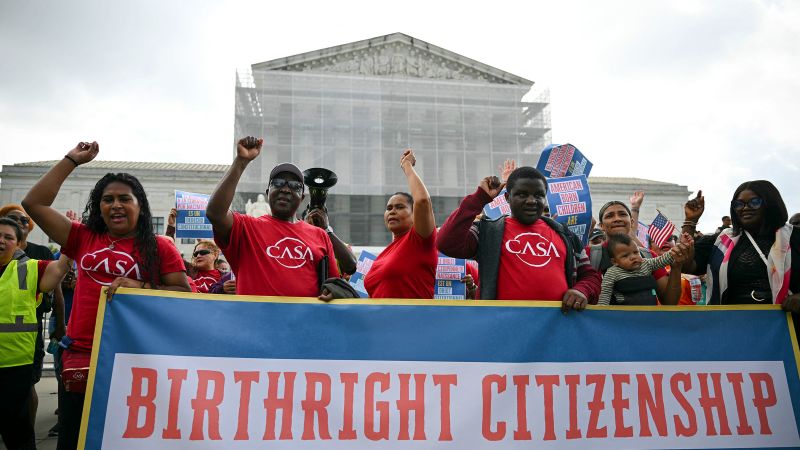
DOJ presses federal appeals court to reverse ruling blocking Trump’s effort to end birthright citizenship
CNN
The Justice Department on Wednesday pressed a federal appeals court to reverse a judge’s ruling that blocked nationwide President Donald Trump’s effort to end birthright citizenship.
The Justice Department on Wednesday pressed a federal appeals court to reverse a judge’s ruling that blocked nationwide President Donald Trump’s effort to end birthright citizenship. The hearing before a three-judge panel of the 9th US Circuit Court of Appeals represents the first time one of the nation’s intermediate courts has heard oral arguments over the constitutionality of the controversial policy, which was blocked by several courts earlier this year before it could take effect. The hourlong hearing unfolded at a courthouse in Seattle comes as the Supreme Court is considering whether it should modify the lower-court injunctions so that Trump can begin partially enforcing the policy while the legal challenges are resolved. “Our position is very firmly grounded in text, history and precedent. But I do want to be clear that the 14th Amendment Citizenship Clause sets a floor for birthright citizenship and not a ceiling, so there’s nothing in our position that would prevent Congress – if it saw fit and on the terms it saw fit – from granting citizenship to the children of foreigners who are in the country temporarily or unlawfully,” DOJ attorney Eric Dean McArthur told the court. Some of the discussion on Wednesday concerned whether the appeals court should also narrow the reach of the ruling issued in February by US District Judge John Coughenour, with McArthur struggling to answer some questions about how the policy would apply to certain groups of immigrants – like asylum seekers – because officials haven’t been able to craft guidance implementing Trump’s executive order due to the series of court orders. “One of the problems with the injunction is that it enjoined the government from even explaining how this order would be implemented,” McArthur said at one point. “So, how the executive order, if and when it is allowed to take effect, would apply to various categories like asylees, like refugees, is not clear at this point.”


President Donald Trump has said ICE agents will head to US airports tomorrow amid a partial government shutdown. Follow for live updates

Cuba is working to restore the electricity supply after another island-wide blackout left more than 10 million people without power.

President Donald Trump said Sunday border czar Tom Homan will be in charge of deploying Immigration and Customs Enforcement agents to airports on Monday, with Homan telling CNN the agents will help with security at entrances and exits to ease the Transportation Security Administration’s workload.

Donald Trump wants us to believe that a deal with Cuba is close at hand. After this past week, I am not so sure.

President Donald Trump has said ICE agents will head to US airports tomorrow amid a partial government shutdown. Follow for live updates

President Donald Trump said Sunday border czar Tom Homan will be in charge of deploying Immigration and Customs Enforcement agents to airports on Monday, with Homan telling CNN the agents will assist with security at entrances and exits to ease TSA workload amid a partial government shutdown.

Janet Mills and her allies are counting on a gender gap to narrow Platner’s wide lead ahead of the June 9 primary to decide who will face incumbent Republican Sen. Susan Collins. They are betting that the unfiltered style that has brought Platner widespread attention as someone who could help Democrats reach young men will backfire with women.

Why do people “pledge allegiance” to a “state” that is no longer a state? And what spurs someone to not just attack innocent people, but to then make a statement of loyalty while doing so?

A Supreme Court case examining state deadlines for election ballots sent in the mail is just the tip of the spear in President Donald Trump’s war on mail-in voting.

As a shrinking number of Transportation Security Administration agents work to keep hourslong security lines moving despite not being paid, President Donald Trump stepped into the fray Saturday, announcing he will send Immigration and Customs Enforcement officers to airports by Monday if Congress doesn’t agree to a plan to end the partial government shutdown.

Donald Trump wants us to believe that a deal with Cuba is close at hand. After this past week, I am not so sure.

The search for missing 84-year-old Nancy Guthrie, mother of “Today” show host Savannah Guthrie, has stretched into another anguished week, with mounting pressure on investigators and a family grappling with uncertainty.

Cuba’s Ministry of Energy announced Saturday evening that entire island has suffered another electrical blackout, leaving more than 10 million people without power.