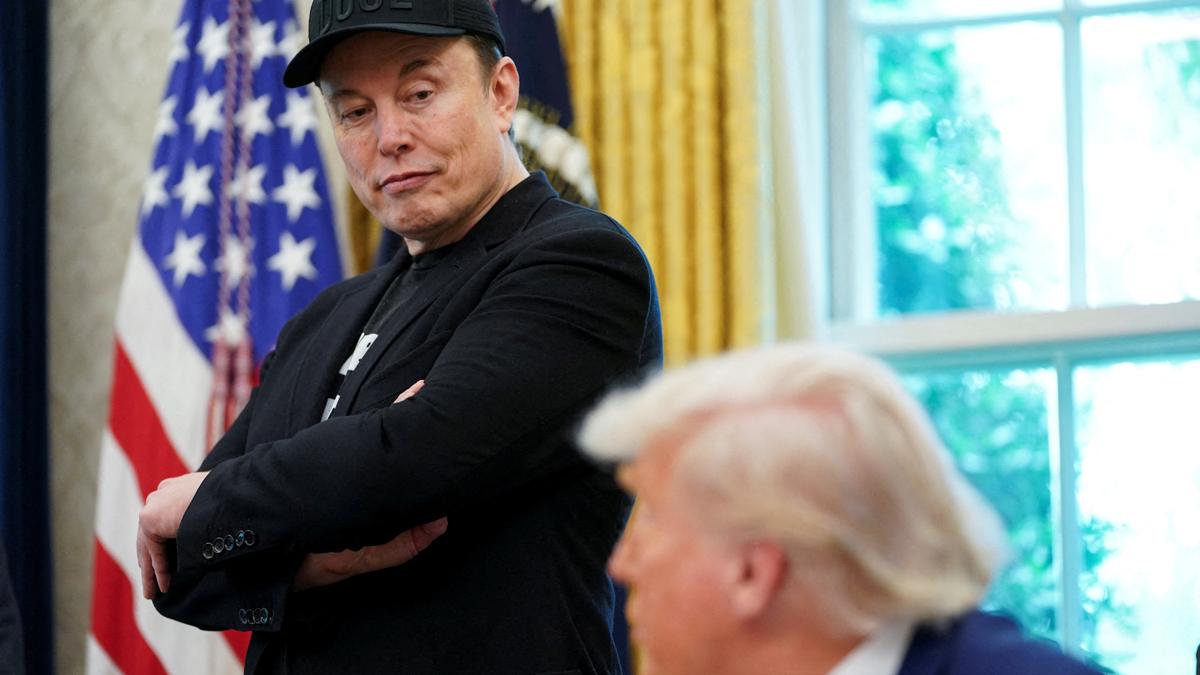
Does escalating spat with Trump pose regulatory threat for Musk businesses?
The Hindu
Regulators target Elon Musk's businesses amid political fallout with Trump, impacting Tesla, SpaceX, Neuralink, and more.
The risk U.S. transportation, environmental, communications and other regulators will take aim at Elon Musk's many businesses became a real threat after the billionaire's deep political ties with President Donald Trump disintegrated on Thursday (June 5, 2025).
Below is a list of U.S. regulators who oversee Mr. Musk's companies, including automaker Tesla, rocket and satellite company SpaceX, brain implant company Neuralink, social media platform X and construction firm The Boring Company.
The Federal Communications Commission in April voted to open a review of the decades-old spectrum sharing regime between satellite systems sought by SpaceX. SpaceX wants access to new spectrum from the FCC in the coming years to speed deployment of satellite-based internet service.
The review by the U.S. telecom regulator aims to allow a greater and more intensive use of spectrum for space activities. Existing reductions approved in the 1990s limit power usage that prevent better coverage from SpaceX's Starlink and other systems.
The FDA oversees the clinical trials for Neuralink, Mr. Musk's brain implant company, deciding whether such trials can take place and whether Neuralink can eventually sell its device to consumers. The agency already approved such trials in the U.S. Neuralink has also been pursuing clinical trials outside the U.S, including in Canada. The FDA had initially rejected Neuralink's request to start clinical trials, citing safety risks, Reuters reported in 2023. The agency has since given the startup approval to do clinical trials, which are ongoing.
SpaceX faces environmental regulations from the EPA, which oversees the company's wastewater discharges at its operating site in Texas. The company's operations are also subject to environmental reviews under the National Environmental Policy Act, with several agencies including the Fish and Wildlife Service required to analyze the impact of the company's rocket launches and landings on land, water and wildlife.
Tesla faces ongoing oversight from U.S. auto safety investigators about the safety of its vehicles especially when using advanced driver assistance systems. Last month, the National Highway Traffic Safety Administration asked Tesla to answer questions on its plans to launch a paid robotaxi service in Austin, Texas, in June, in order to assess how the electric vehicle maker's cars with full self-driving technology will perform in poor weather.


GCCs keep India’s tech job market alive, even as IT services industry embarks on a hiring moratorium
Global Capability Centres, offshore subsidiaries set up by multinational corporations, mostly known by an acronym GCCs, are now the primary engine sustaining India’s tech job market, contrasting sharply with the hiring slowdown witnessed by large firms in the country.

India’s manufacturing sector underperforms compared to China and South Korea, partly due to public sector wages that raise costs and reduce competitiveness.

Non-Resident Indians (NRIs) from the Gulf Cooperation Council (GCC) region, once prominent investors in the Indian equity market are seen shying away due to rupee depreciation and have moved to global funds, said a top financial services executive.

Mobile phones are increasingly migrating to smaller chips that are more energy efficient and powerful supported by specialised Neural Processing Units (NPUs) to accelerate AI workloads directly on devices, said Anku Jain, India Managing Director for MediaTek, a Taiwanese fabless semiconductor firm that claims a 47% market share India’s smartphone chipset market.

In one more instance of a wholly owned subsidiary of a Chinese multinational company in India getting ‘Indianised’, Bharti Enterprises, a diversified business conglomerate with interests in telecom, real estate, financial services and food processing among others, and the local arm of private equity major Warburg Pincus have announced to collectively own a 49% stake in Haier India, a subsidiary of the Haier Group which is headquartered in Qingdao, Shandong, China.

Indian stock markets closed lower amid volatility, with key firms lagging as global trends influenced trading activity.

Bharti and Warburg Pincus invest in Haier India, acquiring a 49% stake to enhance growth and innovation in consumer durables.

India's net FDI remains negative for October 2025, with outflows surpassing inflows amid trade deal uncertainties.

Bombay High Court halts fraud notices to Anil Ambani, questioning banks' compliance and the audit's validity.

Explore the key business events that defined India in 2025, from trade wars to regulatory reforms and corporate expansions.

The rarely-used eight-unit Fisk power plant owned by Houston-based NRG Energy was scheduled to retire next year. But then came from artificial intelligence.

The rupee gains 12 paise to 89.51 against the U.S. dollar, buoyed by RBI's liquidity support.

In a recent conversation with Dwarak Rajagopal, Head of AI Research at Snowflake, what stood out was not optimism or scepticism, but maturity.