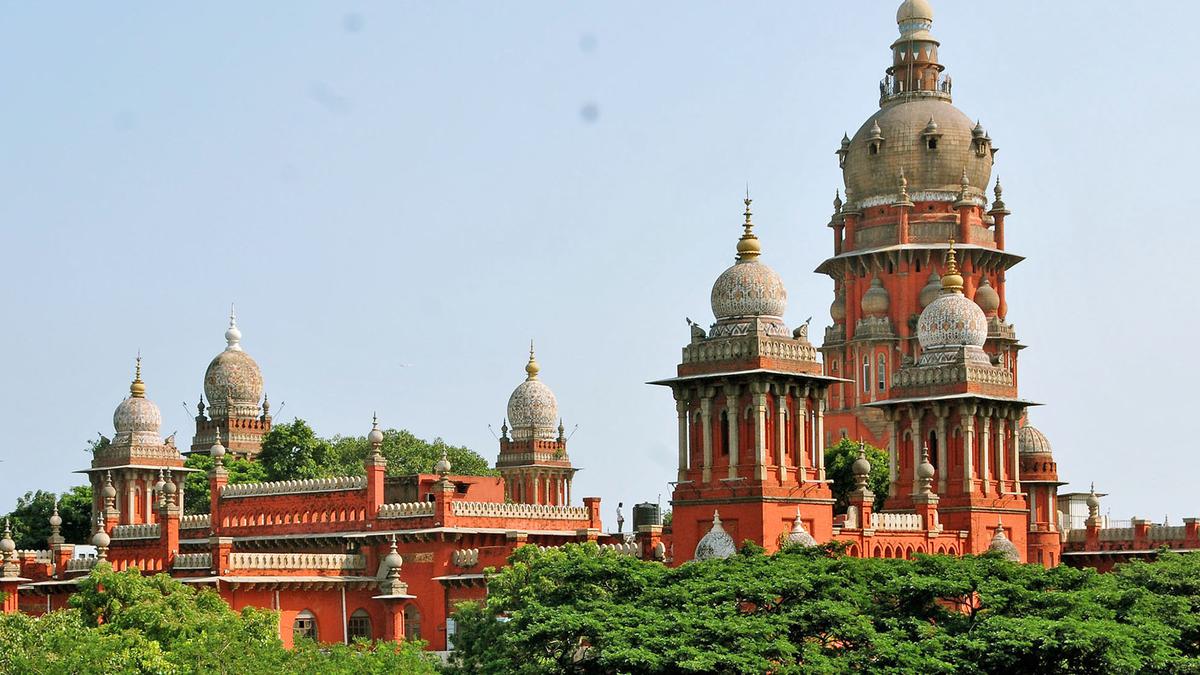
DMK moves Madras High Court questioning the design of third generation EVMs
The Hindu
DMK files petition in Madras High Court seeking direct connection between EVM units, transparency in election procedures.
The DMK has filed a writ petition in the Madras High Court seeking a direction to the Election Commission of India (EC) to ensure that the balloting units in Electronic Voting Machines (EVMs) are connected directly with the control units without placing the VVPAT printers in between the two units, as was done in third generation M3 EVMs.
The party also sought a direction to the EC to lay down procedures for approval of the EVMs. It also called for a direction to formulate the guidelines to be followed by Returning Officers while dealing with applications made by election agents to count the paper slips collected as part of the Voter Verified Paper Audit Trail (VVPAT) system.
Filing an affidavit on behalf of the party, its organisation secretary R.S. Bharathi said that elections were conducted only through the conventional paper ballot system between 1950 and 1990. The Representation of the People Act, 1951, was amended only in 1989 to insert Section 61A, which permits the use of voting machines in elections, and the amendment came into force from March 15, 1989.
Accordingly, the Conduct of Election Rules, 1961, were also amended, and as per those statutory rules, an EVM should have only a balloting unit and a control unit. It was only in 2013 that the Supreme Court permitted the EC to introduce VVPAT, the party said, adding that recently, a lot of concerns had been raised by all sections of society over the use of EVMs and VVPAT printers.
“These concerns are most justified and the possibilities highlighted therein are technically feasible. India being a democracy, a discrepancy of even one vote between the votes cast and votes counted is unacceptable,” the party said, and claimed that the configuration of the EVMs and VVPAT printers in the third generation M3 machines was completely in contravention of the 1961 statutory rules.
The party claimed that second generation M2 machines were fully in compliance with the rules, since VVPAT printers with drop boxes were attached separately to the balloting units without disturbing the direct connection between the balloting units and the control units. However, in the M3 machines, VVPAT printers had been sandwiched between the balloting units and control units, it said.
“This paves the way for the output of the printer to flow to the control unit. It opens a myriad of technical possibilities to corrupt the integrity of the data that is fed to the control unit from the balloting unit. Further, a process involving a fourth unit, namely the Symbol Loading Unit that feeds the election symbols of candidates to the VVPAT printer, paves the way for other possibilities,” the affidavit said.


Maharashtra SEC extends voters' list publication deadline to January 3 ahead of municipal elections on January 15.

A new irradiation center near Hyderabad airport will reduce transportation costs and damage for fruit farmers, boosting exports.

CBI challenges Delhi HC's suspension of Kuldeep Sengar's life sentence in the Unnao rape case at the Supreme Court.

Ramanathapuram farmers seek timely preservation of water bodies

BJP leaders claim town panchayat results reflect Congress government's failure amid ongoing leadership struggles and unmet promises.

Water level in Mullaperiyar dam on Thursday stood at 132.95 feet (the maximum permissible level is 142 ft.) with an inflow of 199 cusecs and a discharge of 1,000 cusecs.

Suvendu Adhikari urges Bangladesh to end attacks on Hindus, promising continued protests if violence persists against the community.

New Mayor V.K. Minimol prioritizes anti-corruption and a comprehensive mobility plan for Kochi's urban development and efficiency.

O. Sadasivan elected Mayor of Kozhikode, emphasizing collaborative city development and prioritizing waste management and agricultural projects.

The procedure of endoscopic removal of stone and blockage from the bile duct, followed by placement of Common Bile Duct (CBD) stent, widely practised in leading medical institutions and private hospitals, was performed for the first time at Government Thoothukudi Medical College and Hospital on a 10-year-old girl.

Andhra Pradesh CM Chandrababu Naidu emphasizes political decorum and warns against crime and character assassination in politics.

Prashant Jagtap joins Congress, citing ideological differences with NCP and criticizing BJP ahead of Pune civic elections.

Mirwaiz Umar Farooq removes 'Hurriyat chairman' title amid pressure from authorities, sparking varied reactions across Kashmir's political landscape.