Did Trump cross the line on Kashmir issue? | Explained Premium
The Hindu
Trump's false claims on India-Pakistan ceasefire and Kashmir dispute raise concerns about bilateral ties and foreign policy red lines.
The story so far: U.S. President Donald Trump’s repeated claims that the U.S. mediated the May 10 India-Pakistan ceasefire has been sternly denied by the Ministry of External Affairs, including by External Affairs Minister S. Jaishankar, and has raised questions about the impact of the comments on India-U.S. bilateral ties. However, far more than Mr. Trump’s incredible assertions that he threatened Delhi and Islamabad with cutting trade in order to talk them back from a “nuclear conflict”, his references to the Kashmir dispute have been a cause for worry.
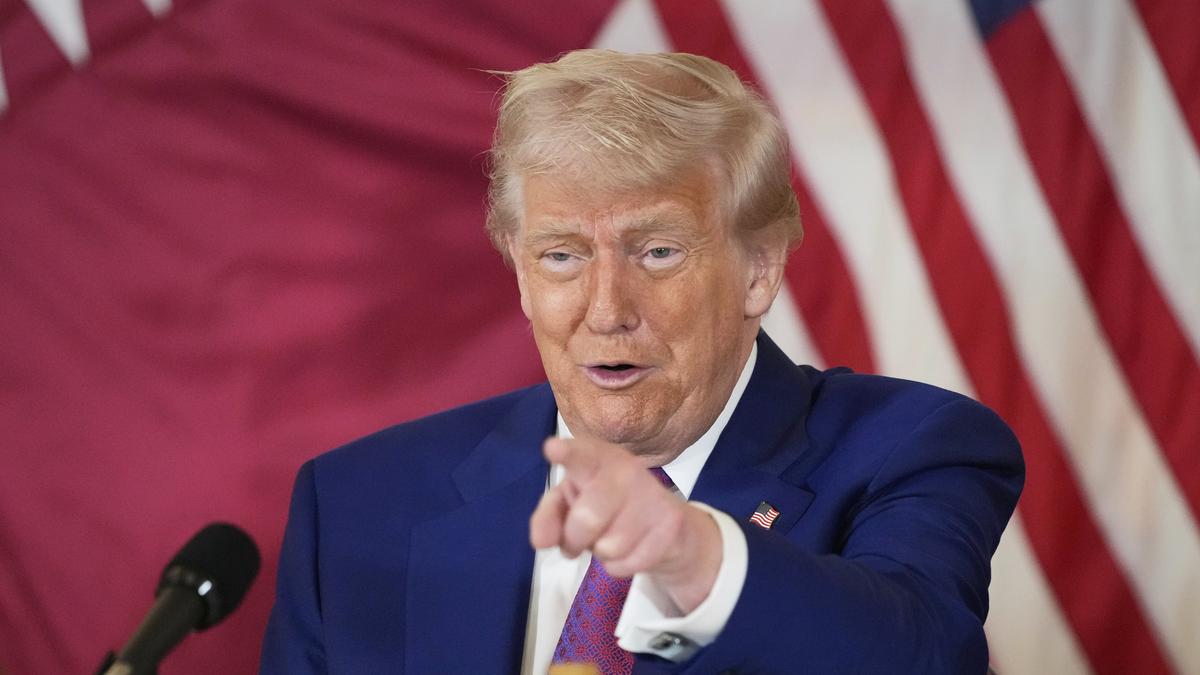
The U.S. President was among the first leaders to call Prime Minister Narendra Modi to condemn the Pahalgam terror attack. Yet, once Indian airstrikes on terrorist infrastructure in Operation Sindoor intensified into an India-Pakistan conflict, Washington joined countries like Saudi Arabia, the UAE and Iran to push for a halt in hostilities. Half an hour before the ceasefire was announced by Foreign Secretary Vikram Misri, Mr. Trump took to his account, claiming credit for a “U.S.-brokered” ceasefire. Later, in media meets, he lavished praise on “both great nations”, promised to increase trade with them, and offered to mediate to resolve the Kashmir issue, erroneously saying it was “a thousand years old” dispute (it dates back to 1947). With his statement, elements of which he repeated in remarks at the White House; at an investors conference in Riyadh; speaking to U.S. troops in Doha; and in an interview, Mr. Trump crossed all the red lines of Indian foreign policy when it comes to Pakistan and Jammu & Kashmir. These can be summed up as no third-party mediation, no hyphenation with Pakistan, no internationalisation of the Kashmir issue and focussing on terrorism as the core concern.
India’s first Prime Minister Jawaharlal Nehru is accused of the original internationalisation of the Kashmir dispute after India went to the United Nations Security Council against Pakistan’s illegal acquisition of Pakistan-Occupied Kashmir (PoK) in December 1947. An offer by Nehru to hold a plebiscite for the Kashmir Valley was contingent on Pakistan vacating PoK, and was shelved thereafter. However, as diplomat Rajiv Dogra points out in his book India’s World: How Prime Ministers Shaped Foreign Policy, Nehru made it clear in Parliament that he had only asked to end Pakistan’s aggression, not to seek arbitration or “adjudge the validity of Kashmir’s accession or to determine where the sovereignty lay,” but the UN broadened its scope of enquiry.
Trumpeting claims: On the U.S. President’s claims, India and Pakistan
Since then, India and Pakistan have fought wars, and held talks over the issue, with no resolution. In 1972, after Pakistan suffered a humiliating defeat with the liberation of Bangladesh in 1971, Pakistan PM Zulfikar Bhutto is understood to have assured Prime Minister Indira Gandhi that the Simla accord they signed would lead to a bilateral resolution of Kashmir along the Line of Control, but then never kept the promise. In 1994, in the wake of the insurgency in J&K backed by Pakistan, Parliament passed a resolution taking a firm line: it called the State an “integral part of India”, and said Pakistan must vacate the areas of the Indian State of J&K.
After the 2019 re-organisation of J&K following the amendment of Article 370, Pakistan tried to internationalise the issue again. While it was largely unsuccessful, Pakistan, with China’s support managed to hold a UNSC closed-door meeting on “the volatile situation surrounding Kashmir”, for the first time in 50 years.
However, post 2019, the Narendra Modi government, which did negotiate with the Imran Khan government for the Kartarpur corridor and the 2021 LoC ceasefire, drew another line: that the only India-Pakistan talks on Kashmir henceforth would be for the return of PoK. While the position seemed maximalist, it was the outcome of decades of frustration at Pakistan’s refusal to keep its commitments on the LoC and cross-border terrorism.


Denmark's recent election results leave Prime Minister Mette Frederiksen's future uncertain amid a fragmented parliamentary landscape.

An explosion at Valero's Port Arthur refinery caused a temporary shutdown but resulted in no reported injuries.

Anduril and Palantir Technologies are working together to develop software for U.S. President Donald Trump’s Golden Dome antimissile shield initiative, a source familiar with the matter said

A federal judge weighing the merits of the Pentagon’s designation of rising Silicon Valley star Anthropic as a security threat repeatedly questioned the government’s reasons for vilifying the company

When the conflict in West Asia, which began with the U.S. and Israel’s attack on Iran on February 28, escalated into a regional war, analysts said that the war would last as long as Iran had missiles or until the Gulf nations ran out of interceptors. However, with “emergency” military sales, piling monetary costs and a strained supply chain, is the U.S. becoming too constrained in its effort to keep the war going — both militarily and monetarily?

U.S.-Israel war on Iran LIVE: Follow The Hindu for updates on the West Asia conflict on March 25, 2026

Jair Bolsonaro to serve his sentence at home due to health issues, monitored by police, with a review in 90 days.

A New Mexico jury finds Meta liable for harming children's mental health, marking a significant shift in accountability for tech companies.

Modi and Dissanayake discuss energy cooperation, West Asia conflict, and global supply chain disruptions in a recent phone call.

Russia launches a massive drone and missile attack on Ukraine, signaling the potential beginning of a spring offensive.

U.S. official Elbridge Colby emphasizes India's vital role in the Indo-Pacific, highlighting mutual benefits despite existing differences.

Philippine President Marcos declares national energy emergency amid Middle East conflict, ensuring fuel and essential goods supply stability.

Mohammad Baqer Zolqadr appointed as Iran's new security chief, succeeding Ali Larijani after his assassination.