Diamonds pose a quantum block to India’s research ambition
The Hindu
Customs restrictions on diamond imports hinder India's quantum technology research, impacting the National Quantum Mission's progress.
Customs Department’s decision on who can and cannot import diamonds is taking some of the lustre off the National Quantum Mission (NQM), a ₹6,000-crore initiative, which may allow India take the lead in the emerging field of quantum technologies.
Quantum technology is a broad term, much like ‘Artificial Intelligence,’ or ‘nano-technology’, and applicable to multiple avenues of research. It hinges on being able to exploit the ‘quantum-mechanical’ properties of matter inside the atom and develop entirely new kinds of computers, sensors and encryption systems that – proponents say – will make our existing devices primitive in comparison.
However, this also means that much knowledge on harnessing quantum technology is still being unearthed and requires highly trained scientists conducting intricate experiments on many things, including diamonds.
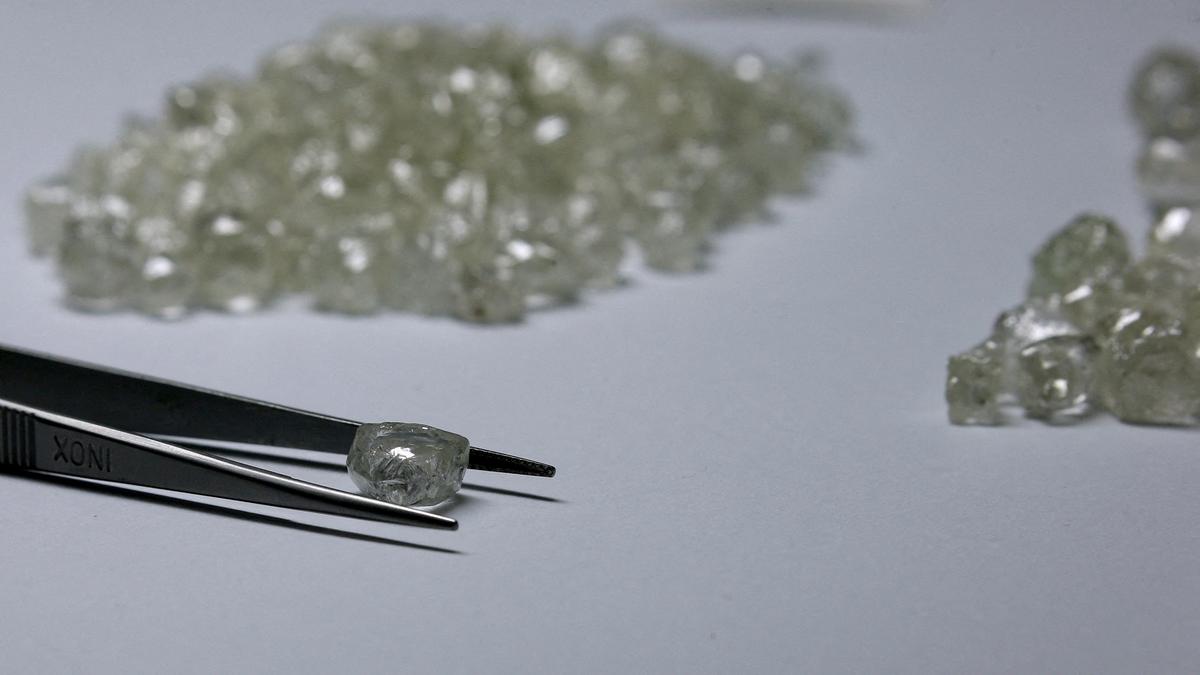
While the gemologist may be concerned with the cut, clarity, colour and karats of diamonds, quantum researchers are interested in their ‘defects.’ It is the unique arrangement of carbon atoms in a diamond which gives it the properties of hardness, electrical conductivity and manipulation of light. However, the atomic structure of some diamonds sometimes have two missing carbon atoms. They are substituted by a nitrogen atom as well as a ‘hole’ or what is called a ‘nitrogen-vacancy’ centre.
These “centres’ are very sensitive to the slightest variations in magnetic fields and thereby open vistas of investigation. An electron at such a centre can be individually tweaked and made to behave like a qubit. Qubits –analogous to the bits and bytes of classical computers – are the logic states of quantum computers and in theory allow calculations, beyond the capacity of existing supercomputers, to be done in a trice.
Researchers can also use lasers at room temperatures to manipulate these centres – a property that is not very common in other elements and materials. However, unlike the diamonds in jewellery shops, scientists prefer their diamonds grown in a lab and customised with ‘defects’ of their choice.
In the Union Budget 2023, Finance Minister Nirmala Sitharaman announced a scheme to promote research and development of lab-grown diamonds in India. Indistinguishable from natural diamonds, they are said to be environmentally and ethically more benign. Much like culturing microbes, lab-diamonds are grown after being ‘seeded’ with natural diamonds. India, despite being a formidable industry in cutting and polishing diamonds, has only just begun manufacturing diamonds in a few places. Indian diamantaires aren’t yet equipped to make diamonds with quantum-research-ready ‘defects.’ And this is a problem for scientists.


Parliamentary panel criticizes Ministry of Planning and Niti Aayog for persistent underutilization and poor financial management practices.

LPG consumption in India dropped 17.7% in March due to war-related supply disruptions, impacting household cooking gas availability.

LPG eKYC is required only for unauthenticated customers, clarifies the Ministry of Petroleum and Natural Gas.

India's second LPG carrier, 'Nanda Devi', arrives at Gujarat's Vadinar port, carrying 46,500 metric tonnes of gas.

European publishers, tech firms and startups have urged EU antitrust regulators to wrap up a near two-year probe into Alphabet unit Google’s alleged favouring of its own services in online searches and impose a fine on the tech giant.

OpenAI is in advanced talks with private equity firms including TPG, Advent International, Bain Capital and Brookfield Asset Management to form a joint venture

Shares of Samsung Electronics rose as much as 5% on Tuesday after Nvidia CEO Jensen Huang said the South Korean company was producing Nvidia’s new artificial intelligence chips.

Stock markets rebound after early losses, with Sensex and Nifty rising amid global bullish trends despite notable laggards.

The rupee declines 14 paise to 92.42 against the dollar amid rising crude prices and foreign fund withdrawals.

Dell’s total workforce declined by about 10%, or 11,000 employees, in fiscal 2026, it said on Monday

Nvidia chief Jensen Huang on Monday said the leading artificial intelligence chip maker is heading for space with a goal of powering orbiting data centres.

Meta Platforms shares rose nearly 3% on Monday after a Reuters report that the social media giant plans to lay off 20% or more of its workforce to offset heavy spending

Wholesale price inflation hits 11-month high at 2.13%, driven by rising crude prices and increased costs across various sectors.