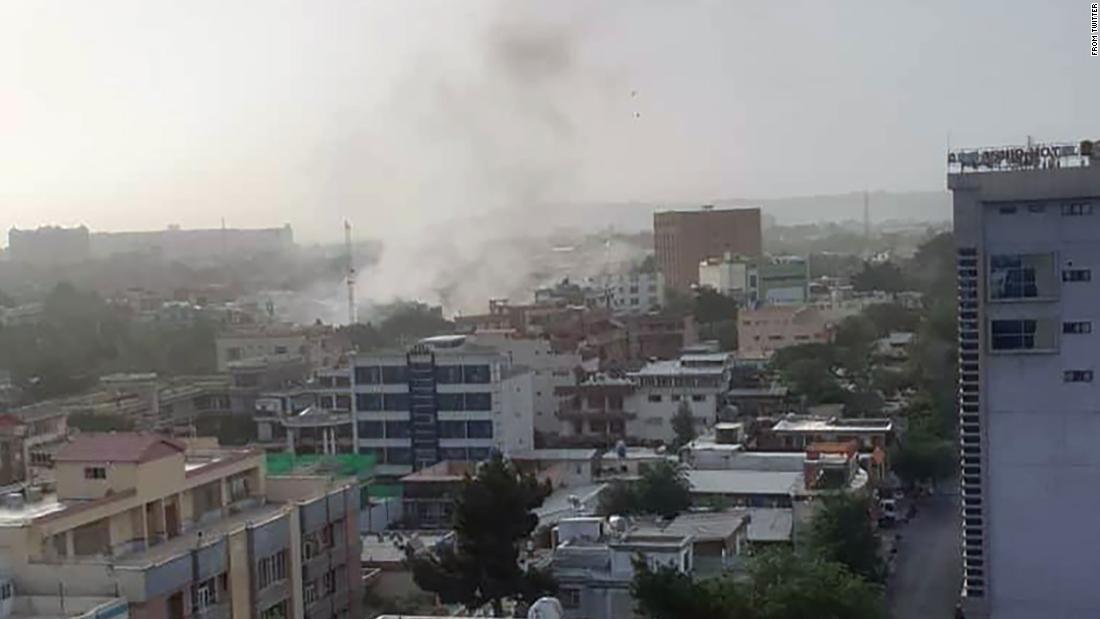
Despite al-Zawahiri strike, US officials are concerned about terrorism threats in Afghanistan
CNN
Shortly before the US withdrawal from Afghanistan, the Defense Department created a task force responsible for handling counterterrorism strikes inside the country after American troops had left -- a so-called "over the horizon" strategy that officials promised would keep Afghanistan from once again becoming a safe haven for terror groups like al Qaeda and ISIS to flourish.
More than a year after the creation of that task force, sources say it hasn't sent a single proposed target to the Pentagon for approval -- largely because without a presence on the ground, it hasn't been able to build enough intelligence on targets to meet the administration's standards for avoiding civilian casualties.
The White House has hailed the CIA operation that killed al Qaeda leader Ayman al-Zawahiri in Kabul on Saturday as evidence that using over the horizon counterterrorism capabilities in Afghanistan has been effective. Current and former officials say the successful Zawahiri strike certainly proves that with the right intelligence, the US is perfectly capable of tackling a specific target from afar -- but those same sources also said that Zawahiri, a single, high-value target long in the CIA's crosshairs, was a special case that doesn't alone prove the effectiveness of the strategy.


Three-quarters of Americans say they oppose the US attempting to take control of Greenland, according to a new CNN poll conducted by SSRS, indicating that President Donald Trump’s push to expand America’s territory faces stiff headwinds with the public.

As millions of Venezuelans wait to see what will become of their economically and politically ravaged country, a battle has emerged between two female leaders for control over the nation’s future – and for the American president’s favor.

The Trump administration is preparing to use private military contractors to protect oil and energy assets in Venezuela rather than deploying US troops, according to two sources familiar with the plans, setting up a potential boon for security firms with experience in the region and ties to the administration.

Senate Republicans blocked an effort to curb the Trump administration’s military action in Venezuela, a victory for the president who was incensed that some Republicans tried to tie his hands on a key foreign policy.

A federal three-judge panel on Wednesday allowed California to use a new voter-approved US House map that is designed to boost Democrats in the 2026 midterms.

Maria Corina Machado, the Venezuelan opposition leader and 2025 Nobel Peace Prize winner, arrives in Washington this week for high-stakes talks with US President Donald Trump on the future of Venezuela following the ouster of Nicolás Maduro. The meeting comes after Trump surprised many by allowing Maduro’s vice president, Delcy Rodríguez, to assume control, dashing opposition hopes for a new democratic era.

A judge decided not to issue a temporary restraining order after Minnesota and the Twin Cities sued federal officials, claiming their immigration enforcement operation involves warrantless arrests and excessive force.

After an Immigration and Customs Enforcement (ICE) agent shot and killed Renee Nicole Good in Minneapolis one week ago, reactions on social media and among politicians and political influencers rapidly polarized.

Most Americans see an immigration officer’s fatal shooting of Minneapolis resident Renee Good as an inappropriate use of force, a new CNN poll conducted by SSRS finds. Roughly half view it as a sign of broader issues with the way US Immigration and Customs Enforcement is operating, with less than one-third saying that ICE operations have made cities safer.

The United States is indefinitely suspending immigrant visa processing from 75 countries in another expansion of the Trump administration’s crackdown on immigration.

The US announced the start of the next phase of the Gaza ceasefire plan on Wednesday as a new committee was formed to run the battered enclave.

Michigan Democratic Sen. Elissa Slotkin said Wednesday that US Attorney Jeanine Pirro wants a formal interview with her following her involvement in a controversial video urging service members and intelligence officials to disobey illegal orders.

Venezuelan opposition leader María Corina Machado, the 2025 Nobel Peace Prize winner, is scheduled to meet with US President Donald Trump on Thursday, a senior White House official told CNN. CNN’s Stefano Pozzebon reports from Bogota.