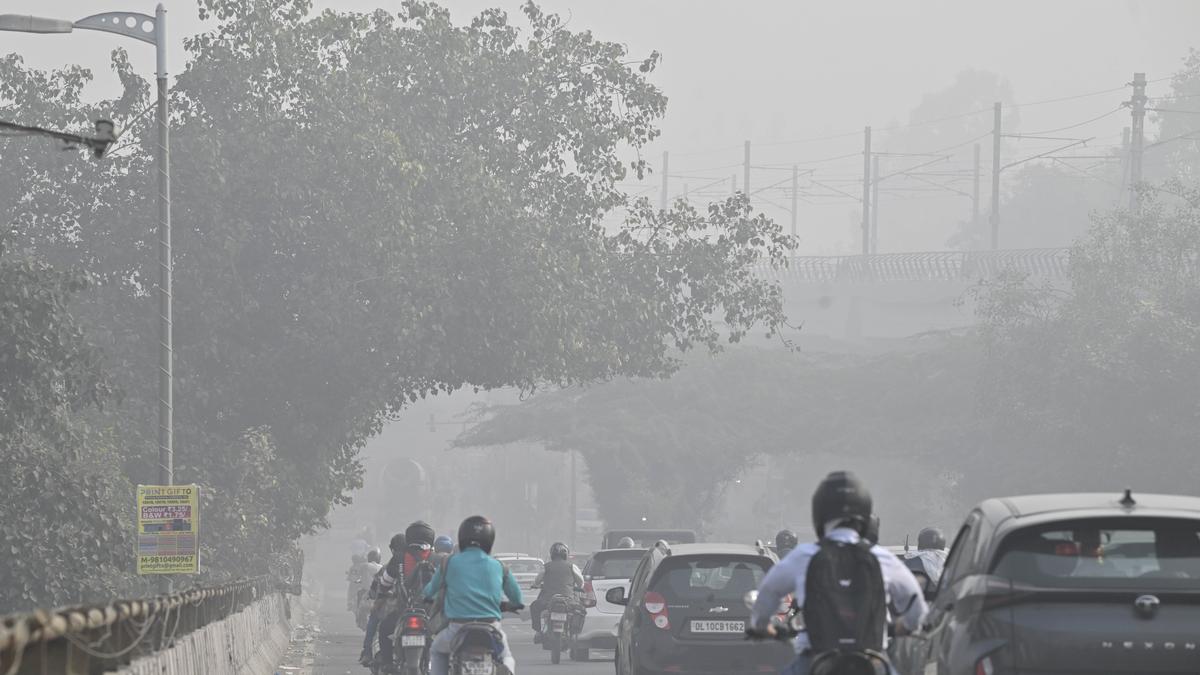
Delhi air pollution: Delhi wakes up to thick smog, air quality remains in 'severe' category
The Hindu
Delhi engulfed in severe smog crisis, triggering health risks and poor visibility, prompting government action and public concern.
Delhi woke up to a thick blanket of smog on Sunday (November 17, 2024) morning, with air quality levels plunging to severe levels, leaving residents grappling with poor visibility and health risks.
The dense haze, caused by a mix of local pollution and the seasonal crop burning in neighbouring states, choked the city's skies, triggering widespread concerns over Delhi's ongoing battle with air pollution.
According to the Central Pollution Control Board (CPCB), the national capital recorded an Air Quality Index (AQI) at 428 as of 8 a.m., placing it in the 'severe' category. Visuals from around the New Delhi Railway Station show a thick layer of smog blanketing the entire area.
Likewise, drone visuals from the AIIMS area at 7.10 a.m. show high-rise buildings in the area covered with smog, reducing visibility to the bare eyes. Drone shots from Mayur Vihar at 7.30 a.m. show a smog-filled atmosphere engulfing the area as pollution levels continue to remain high.
In Patparganj, the AQI was recorded at 439, categorized as 'severe' by the CPCB. Meanwhile, the Delhi airport took to its official handle to inform the flyers that low-visibility procedures are currently underway. "Low-visibility procedures are in progress at the Delhi airport. All flight operations are presently normal. Passengers are to contact the airline concerned for updated information," posted the handle on X.
As the pollution level continues to remain high, a thick froth of toxic foam primarily caused by untreated industrial effluents, sewage discharge, and high phosphate levels from detergents, was observed in sections of the river near Kalindi Kunj and Okhla Barrage.
The residents of Delhi continue to raise alarms as air quality levels in many areas remain in the "severe" category in multiple areas. The AQI for Anand Vihar was recorded at 457, Bawana at 471, CRRI Mathura Road at 471, DTU at 386, Dwarka Sector-8 at 445, ITO at 411, Jahangirpuri at 466, Lodhi Road at 374, Mundka at 463, Narela 444, North Campus at 427, Punjabi bagh at 447, RK Puram at 434, Shadipur at 457 and Wazipur at 463, according to SAFAR-India (System of Air Quality and Weather Forecasting and Research).


Hyderabad faces traffic challenges due to rising vehicle numbers; government appoints international consultant for effective infrastructure solutions.

Discover the Delhi Capitals' IPL 2026 player roster, schedule, and support staff as they pursue their first championship.

Sanya Malhotra and Aditya Rawal have started shooting for their upcoming romantic-thriller, Sundar Poonam.

Telangana Government plans a ₹940 crore double-decker elevated corridor from Panama Godowns to Hayatnagar on the Vijayawada highway.

PM Modi emphasizes India's pursuit of diverse gas and crude oil sources amid the global energy crisis due to West Asia conflict.

Kerala BJP chief Rajeev Chandrasekhar challenges Congress to prove undisclosed assets allegations in court, dismissing them as distractions.

As per information by Minister of State for Civil Aviation Murlidhar Mohol to a question in the Rajya Sabha, ₹146.89 crore has been utilised under the UDAN scheme till October 31, 2025.

Supreme Court rules women officers in Armed Forces deserve equal opportunities, upholding their right to permanent commission and pension benefits.

Telangana government assures no fuel shortage; Hyderabad police commissioner urges citizens to avoid panic buying

Telangana government employees will receive 10-20% discounts on electric vehicles to promote eco-friendly transportation, announces Transport Minister.

Discover the engaging teaser of 'Pallichattambi,' a period drama starring Tovino Thomas, releasing on April 10.

SP P. Jagadeesh reviews night patrols in Anantapur to enhance security and public safety during Operation Night Safety.

DMK announces candidates for 13 seats in Puducherry elections, reserving one seat for ally VCK amid strategic alliances.