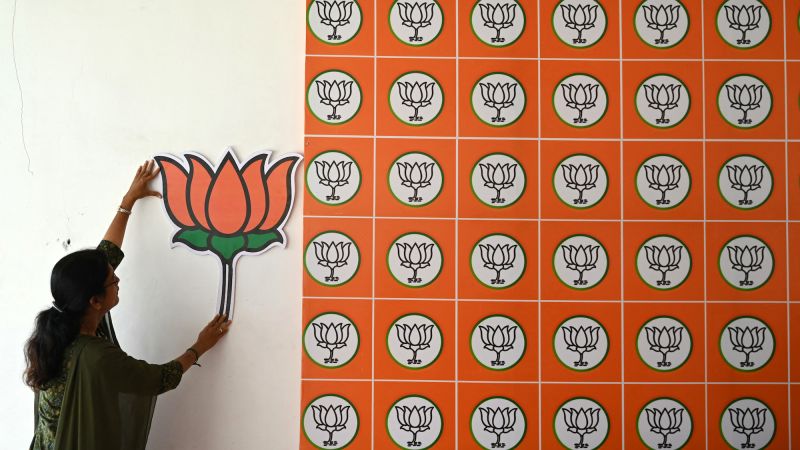
Date set for largest democratic election in human history
CNN
Polls in the world’s largest democracy India will open on April 19, the country’s election commissioner announced on Saturday, setting the stage for a nationwide election expected to see Prime Minister Narendra Modi clinch a rare third consecutive term.
Polls in the world’s largest democracy India will open on April 19, the country’s election commissioner announced on Saturday, setting the stage for a nationwide election expected to see Prime Minister Narendra Modi clinch a rare third consecutive term. An estimated 960 million people in a country of 1.4 billion are eligible to vote in the widely anticipated polls that will take a month to complete. Modi’s Bharatiya Janata Party (BJP) is expected to secure another five years in power, ruling an India that has become increasingly polarized along religious lines. Polling will unfold over seven phases around the country ending on June 1. Indians will be voting for 543 seats in the 545-seat lower house of parliament, called the Lok Sabha, and the other two seats in the house are nominated by the president. All the votes – from the country’s 28 states and eight union territories – will be counted on June 4, the commission said at a press conference in New Delhi.


Lt. Gov. Juliana Stratton’s win in the Senate Democratic primary was also a win for Gov. JB Pritzker, while big-spending groups like AIPAC got mixed results in Tuesday’s contests.

United Farm Workers is not participating in annual celebratory events this month of its co-founder Cesar Chavez over what it calls serious allegations the union did not specify

Illinois Lt. Gov. Juliana Stratton will win the Democratic primary for an open Senate seat, CNN projects, a stunning rise for a little-known state officer now on a glide path to Washington.

President Donald Trump promised his endorsement was forthcoming in the GOP Texas Senate runoff and said he wanted whoever he didn’t pick to drop out. But now — preoccupied with the Iran war and a doomed voting bill — he’s missed a critical deadline.

The Senate has kicked off extended debate on the “SAVE America Act” — one of President Donald Trump’s top legislative priorities.

Organized crime in Latin America is proving difficult to defeat with the kind of decapitation strategy apparently favored by US President Donald Trump.

The conservative movement’s internal debate over the Iran war entered a new phase on Tuesday, with the first resignation of a prominent Trump appointee who criticized the war.

Arizona’s attorney general has filed the first-ever criminal charges in the US against a major prediction market company, accusing Kalshi of running an illegal gambling operation in violation of state law.

President Donald Trump’s brief and aggressive attempt to corral an international coalition to police the Strait of Hormuz concluded in disappointment on Tuesday.

House Oversight Chair James Comer on Tuesday issued a subpoena to Attorney General Pam Bondi to appear for a deposition on April 14 as part of the panel’s Jeffrey Epstein probe.

President Trump’s latest comments about the Iran war make him look out of the loop and unprepared.

Travelers are experiencing long security lines at a number of airports as TSA workers continue to work without pay. Follow for live updates.

A senior US intelligence official appointed by President Donald Trump abruptly announced he is stepping down from his post on Tuesday, citing misgivings about the administration’s war with Iran.