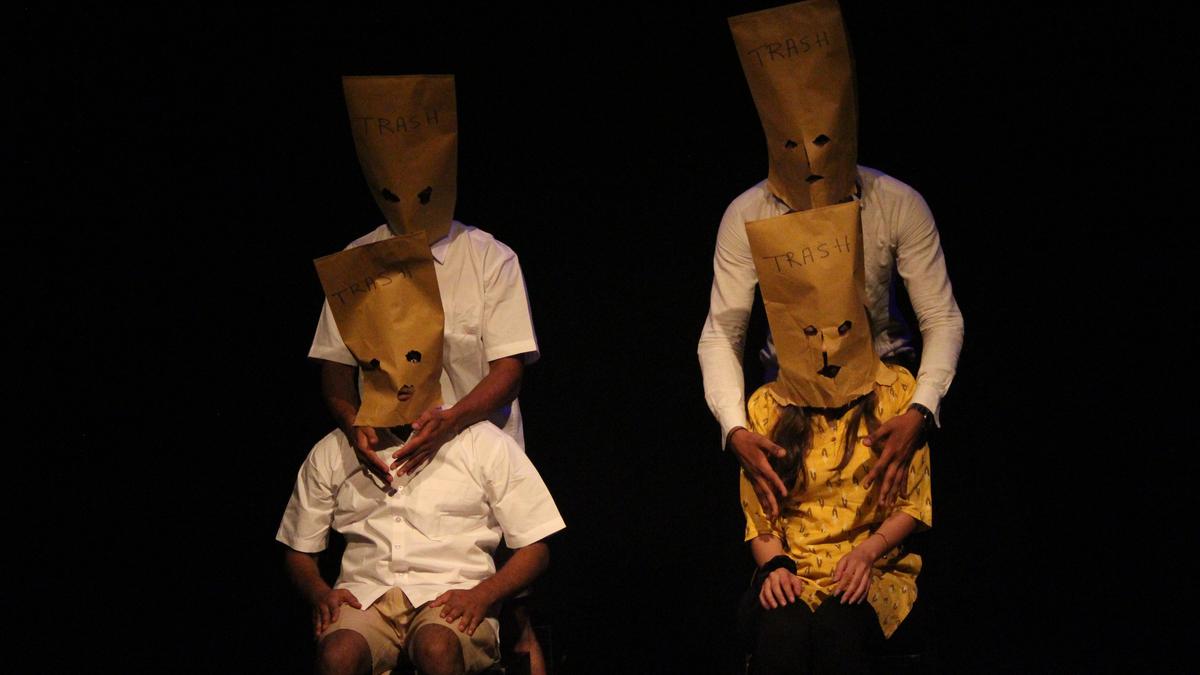
‘Dark People’ play preview: When a clowning group devises a play about honour killing
The Hindu
Bhandutva’s Dark People sheds light on suppressed love stories in South India, challenging societal norms and prompting reflection. Through its narrative, it urges us to reevaluate acceptance, compassion, and the need for change. It incorporates elements of clowning to make the violence depicted on stage feel real, leaving a lasting impact on viewers. #Bhandutva #DarkPeople #TherapeuticClowning #HonourKilling #Caste #Acceptance #Compassion #Change
Members of Bhandutva, a Bengaluru-based theatre group, are into therapeutic clowning. They are known for their heartwarming performances that bring comfort and joy to patients battling chronic diseases, hospital staff, and children in orphanages. When the arts management collective, Chennai Art Theatre, invited them to perform in April, they devised a play about a subject far from clowning: honour killing.
Dark People sheds light on the suppressed love stories from South India, where caste and honour constrain relationships. Based on six true stories, the play challenges societal norms, making the audience uncomfortable and prompting reflection. It exposes the paradox of the public intimacy taboo while other transgressions are normalised. Through its narrative, the play urges us to reevaluate acceptance, compassion, and the need for change.
Why did a clowning group choose a subject this serious? Pritesh Bhandary, a co-founder of the group and the director of Dark People, says clowning helped them in the play. “People don’t get that clowning isn’t just about being funny. A clown is someone who is deeply connected to their emotions. They can be sad or angry. They stay true to their feelings. A clown doesn’t hold back their emotions; they let them out.”
This understanding is what they are trying to convey, Bhandary says. “There’s an aspect of clowning in violence too, which many people fail to comprehend. We have incorporated this aspect into our training and actions.”
In the play, Bhandutva strives to create a thought-provoking experience for the audience by presenting true stories. Through careful choreography and the incorporation of specific elements, they aim to make the violence depicted on stage feel real, leaving a lasting impact on viewers. The overarching objective is to shed light on the grim reality of honour killings, inviting a strong emotional response.
One of the narratives portrayed in the play revolves around a queer couple victimised by their families. Addressing the societal unease surrounding queer relationships, Pritesh chose to depict their intimacy on stage to challenge prevailing preconceptions and further contribute to the discomfort experienced by the audience. Through this discomfort, Bhandutva hopes to emphasise the need for greater openness and acceptance in society.
Due to the sensitive and intense nature of the play, it is not for ages below 15.


South African naturalist Steve Boyes speaks on ghost elephants, ancestral tracking, and Werner Herzog’s documentary exploring Angola’s elusive highland giants

Actor-director Amol Palekar will receive META's Lifetime Achievement award for 2026 on March 25 in New Delhi.

India's artists unite against rising censorship, advocating for creative freedom and support for marginalized voices in the arts.

Written and directed by Kunal, the film also stars Sparsh Shrivastava and Vanshika Dhir

This year, Bharatnatyam artistes will present the Tyagaraja Aradhane as a dance performance

This year, Bharatnatyam artistes will present the Tyagaraja Aradhane as a dance performance

The actor, along with director Sushant Shah, speak about their upcoming series ‘Chiraiya’, Divya’s process of working on the dialect, Sushant’s approach to telling a story about women, and more

An independent video, ‘Feel the Spark’ by Raleigh Rajan with vocals by Ciera Dumas that celebrates Tamil literary giants, garnered 1.4 million views in less than 36 hours.

In ‘Jack Ryan: Ghost War’, John Krasinski is back as the savvy CIA analyst, diving headfirst into a high-stakes mission that unravels a deadly conspiracy and pits him against a rogue black-ops unit

Shriram Bharatiya Kala Kendra’s Shankarlal festival showcased rare ragas, radiant artistry, and inclusive performances, from Pt Madhup Mudgal’s serene morning ragas to Ramana Balachandran’s Saraswati veena.

Explore "Threads that Bind: The Kantha Project," an exhibition in Delhi reimagining kantha as a medium of repair and renewal.

Sean Penn skips the Oscars to meet Ukraine's Zelenskyy, who praises him as a "true friend" amid the war.

The teaser of Tamil star Suriya’s much-awaited film with director Venky Atluri, titled Vishwanath and Sons, was unveiled by the makers on Monday