Dakshina Kannada has no area suitable for seaweed cultivation, Karnataka tells Union government
The Hindu
Karnataka government states Dakshina Kannada unsuitable for seaweed cultivation, focusing on seaweed projects in other areas.
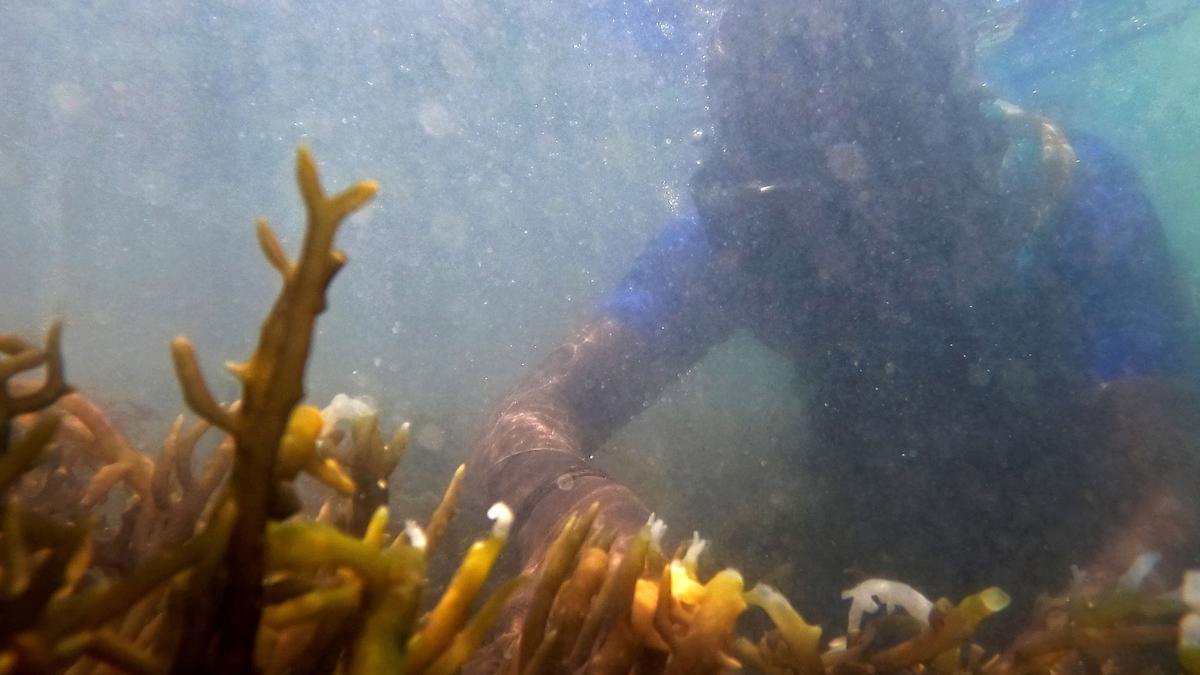
The Karnataka government has informed the Union government that Dakshina Kannada has no area suitable for seaweed cultivation.
Replying to an unstarred question by Captain Brijesh Chowta, Dakshina Kannada MP in Lok Sabha on December 17, the Union Minister for Fisheries, Animal Husbandry and Dairying Rajiv Ranjan Singh said that according to the Indian Council of Agricultural Research (ICAR) 1,579 hectares in Karnataka covering 14 locations have been identified for seaweed farming.
“...Government of Karnataka has informed that most of the area identified by ICAR for seaweed cultivation are in Uttara Kannada and no such area are suitable for seaweed cultivation in Dakshina Kannada...,” the minister said.
He said that the ICAR has identified a total of 24,000 hectares as suitable area for seaweed farming along the Indian coast.
The minister said that the Union Department of Fisheries, under Pradhan Mantri Matsya Sampada Yojana (PMMSY) has approved various seaweed projects consisting of seaweed cultivation through rafts, monoline, establishment of seaweed aquapark, seaweed banks and Research & Development projects of various State/Union Territories and research institutes. This also includes 10,000 seaweed rafts and 21,000 monoline/tube nets approved for seaweed cultivation in Karnataka.
He said that during last four years (2020-21 to 2023-24) and current financial year (2024-25) under PMMSY, the Union Department of Fisheries has accorded approval to the fisheries developmental proposals of Government of Karnataka amounting to ₹ 1,056.34 crore.
The activities approved under PMMSY inter alia included promotion of marine and inland fisheries activities for welfare of fishers and fish farmers in Karnataka, including Dakshina Kannada, namely assistance for acquisition of deep sea fishing vessels, upgradation of existing fishing vessels for export competency, safety kits to fishers, livelihood and nutritional support to fishers during fish ban, communication devices onboard the fishing vessels and installation of artificial reefs along the coast towards conservation.


Eight TSPC Maoists arrested in Hazaribag, Jharkhand, with weapons and ammunition seized during a police operation.

Four ambulances of a Jewish community service in London were set ablaze in a suspected antisemitic hate crime.

Gautham Manohar hopes his photographs serve as reminders of the Earth’s delicate beauty

Thousand Lights faces parking chaos and traffic congestion despite its political significance and ongoing development efforts.

Generic semaglutide increases accessibility, but doctors caution against misuse and quality concerns

Haryana Police removes 857 links to Badshah's 'Tateeree' for objectionable content, ensuring a safer digital environment.

Congress criticises Modi for not leveraging the upcoming BRICS+ Summit to address the West Asia crisis amid U.S. tensions.

Nagapattinam faces underdevelopment and resource challenges, impacting its rich heritage and the livelihoods of its fishing community.

One of the best games of 2025 makes it over to the PC, with a harder mode and bristling with new graphic tech

Air Force employee arrested for espionage, allegedly sharing sensitive information with Pakistani handlers since 2023 for money.

Four killed and several injured in a Bengaluru–Mysuru Expressway crash; driver arrested for alleged negligence.

Four injured in SUV collision with a stranded goods carrier on Narsingi ORR, causing significant traffic congestion.

Parliament Budget Session LIVE: Follow The Hindu's latest updates on the Parliament Budget Session on March 23, 2026.