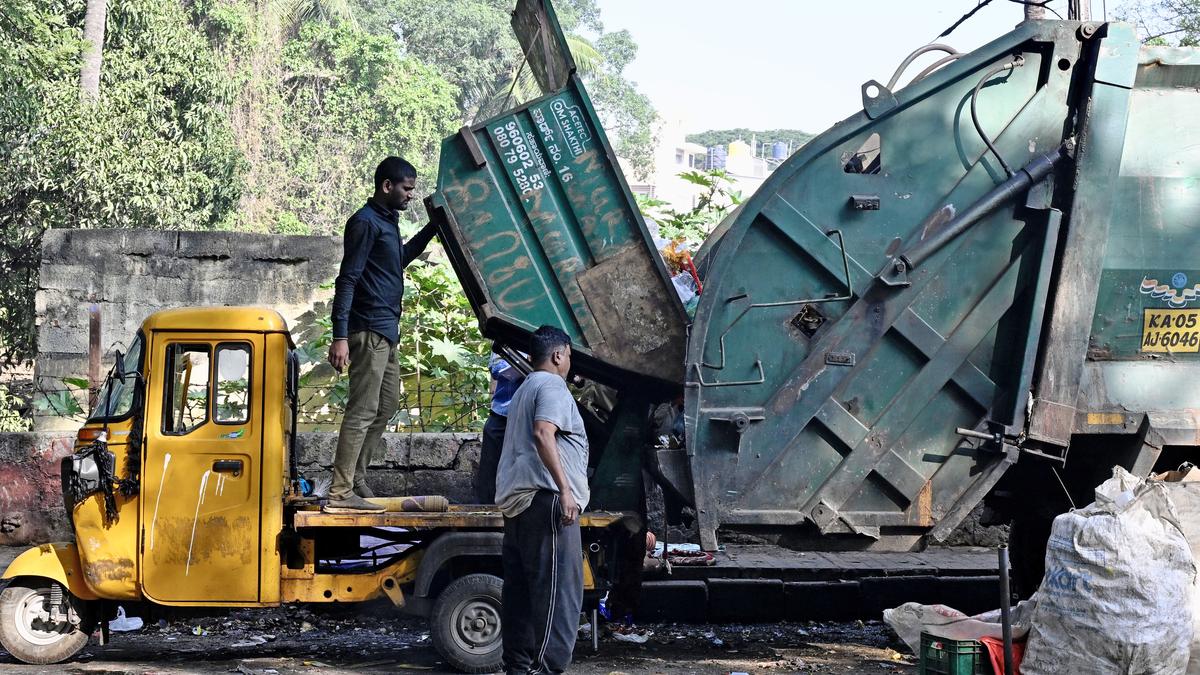
Daily battles of Bengaluru’s waste collectors Premium
The Hindu
Although the BBMP, which has given contracts for door-to-door waste collection from homes, has directed the contractors to pay salaries promptly, this is hardly ever adhered to.
31-year-old Harikumar’s family of seven is crammed into a single room-and-a-kitchen house at Siddharth Colony near Vidya Peetha in Bengaluru. Married at an early age, he has three children, wife, mother, and father to feed. Harikumar works as a waste collector. About a year ago, he was forced to sell his passenger auto to meet emergency medical expenses. As doctors advised C-section for his wife to arrange money, he was left with no choice but to sell his autorickshaw and borrow money. His debt is mounting as his employer has not paid him for the past four months.
Every morning, waste collectors diligently collect waste from homes in Bengaluru. Yet, they carry an invisible burden, one that goes unnoticed by the millions they serve. The silent suffering of thousands of waste collectors in Bengaluru remains ignored, their struggles hidden from the world around them. Left in the lurch by the Bruhat Bengaluru Mahanagara Palike (BBMP) and at the mercy of the contractors, the civic workers’ pleas have remained unaddressed for decades.
Peddamma, the mother of Harikumar, burst into tears describing the daily suffering the family is undergoing. “To make ends meet, in my old age, I have to work. I am employed as a housekeeper in a college. I earn ₹8,000 per month, of which ₹6,000 is spent on rent, power and television cable bills. The remaining is utilised for food and miscellaneous things. Every month, we have to borrow money for the children’s needs. My son’s salary, which is credited once in four or five months, is used to repay loans to local money lenders. Besides local money lenders, we owe at least ₹50,000 to our neighbours,” she sobbed.
Pointing to his wailing one-year-old son, Harikumar says he cannot afford to feed his child the way a middle-class family does. He cannot afford toys for his two daughters, who are enrolled in a government school. “Some days, I feel numb watching them playing imaginary games with pencils. Pencil is a tool for both play and study.”
Yet, every day, he turns up for work at 7 a.m. to collect waste from the homes assigned to him.
In January 2023, the vehicle in which M. Vijayakumar, who drives a vehicle collection vehicle, was travelling overturned in Andhra Pradesh. He was travelling to attend a local fair at his village in Anantapur district of Andhra Pradesh. Due to the impact, he sustained bone fractures near his chest and back, for which he had to shell out ₹1.5 lakh. He and his wife Nirmala have now sent their two children to their hometown as they both have to toil in the city.
In the absence of a regular salary, Nirmala has to cover the monthly expenses. Vijyakumar said Nirmala walks a total of 9 km to and fro, as she has taken up a job as a helper at a printing press. “As I am not paid monthly, I also work as a bathroom cleaner at two nearby bars. But the money they give is not sufficient,” he rued.


Hyderabad officials assure sufficient fuel supply for 60 days, warn against misinformation and illegal sales amid panic buying.

Telangana MP urges Centre to expedite ₹1,270 crore dues transfer from Andhra Pradesh for financial fairness and development.

A Karnataka man was detained with ₹62.5 lakh in cash during election checks on NH 544, claiming it was from a property sale.

Telangana Government issued 16 notifications to fill 31,798 vacancies, with 67,763 total recruitments since Congress took power.

Supreme Court directs Tarun Butolia's family to seek safety assessment from Delhi Police after fatal Uttam Nagar clash.

CM Stalin asserts unity in the DMK-led alliance, dismissing division attempts and emphasizing collaborative efforts for the upcoming elections.

Rahul Gandhi to skip Kerala rally due to Sonia Gandhi’s ill health; Kharge to attend Kozhikode event
Rahul Gandhi will miss the Kerala rally due to Sonia Gandhi's health; Congress president Kharge to attend instead.

Thunderstorms with lightning and gusty winds forecasted for 20 Telangana districts on March 26

TGSRTC reduces Metro AC and Deluxe bus fares by 30% in Hyderabad to encourage public transport amid the fuel crisis.

Supreme Court criticises Haryana Police for mishandling a four-year-old rape case, mandates swift action and oversight with a Special Investigation Team.

On World Theatre Day 2026, artists in Hyderabad call for affordable venues as rising costs and infrastructure gaps challenge the city’s theatre ecosystem.

Madhapur police seize 31 illegally transported commercial gas cylinders, ensuring public safety and compliance with regulatory norms.

Punjab AAP MLA Harmeet Singh Pathanmajra arrested in Gwalior after evading police in a rape case for over six months.