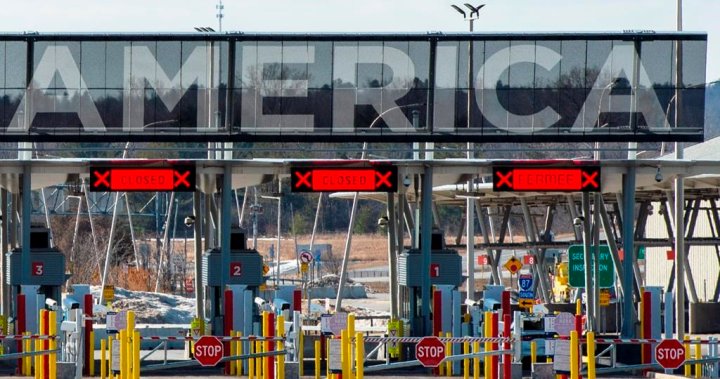
Customs dispute at U.S.-Canada border threatens fish stick, filet supply
Global News
A customs dispute at the U.S.-Canada border is threatening America's supply of a key fish used for popular products such as fish sticks and fast food sandwiches.
A customs dispute at the U.S.-Canada border is threatening America’s supply of a key fish used for popular products such as fish sticks and fast food sandwiches.
The Alaska pollock has a complicated supply chain. After being caught as part of the largest commercial fishery in the U.S., the fish are transported by ship to New Brunswick, Canada, near the border with Maine. They are then loaded onto rail cars for a brief trip down 100 feet (30 meters) of track in Canada, before being put on trucks and crossing the border into the U.S.
U.S. Customs and Border Protection has alleged that shippers are violating the Jones Act, which requires that goods shipped between U.S. ports be transported on U.S.-owned ships.
The agency has assessed more than $350 million in penalties to the shippers, records state. Two of the shipping companies have sued in federal court to stop the enforcement, which they characterized as heavy-handed, unexpected and unfair.
The dispute left 26 million pounds of fish in cold storage in Canada until a federal court judge issued an injunction on Sunday to let the seafood be shipped into the U.S. Members of the industry said they’re concerned about permanent disruption to the seafood supply chain if the disagreement continues.
“We’re talking about feeding and employing Americans, right now,” said Gavin Gibbons, spokesperson for the Virginia-based National Fisheries Institute.
Gibbons said it was unlikely the fish in cold storage would start moving on Monday because it was a holiday in both countries.
U.S. Customs filed court papers in early October that stated the agency agrees with the shippers in desiring a quick resolution to the case. However, the schedule it has proposed in court for resolving the case would still take several weeks.


Gas prices in Canada have been climbing sharply since the Iran war began, but how much higher they could go is unclear as consumers struggle with the higher cost of living.

The Oscar-winning actor has denied all allegations against him and maintains that the incidents raised in the lawsuits either did not happen or were consensual.

European leaders have deflected entreaties from U.S. President Donald Trump to send military assets to secure the Strait of Hormuz.

All six crew members of a KC-135 Air Force refueling aircraft were killed last week in a plane crash over friendly territory in western Iraq, supporting operations against Iran.

U.S. Director of National Intelligence Tulsi Gabbard testified that the regime remains intact and Tehran and its proxies remain capable of attacking U.S. and allies' interests.

James 'Jimmy' Gracey was reported missing after he didn't return to the short-term rental where he was staying with friends during spring break.

The U.K. Health Security Agency described the event as 'rapidly evolving' and warned of the potential for further cases.

U.S. benchmark crude fell US$1.24 to US$94.53 per barrel. Brent crude, the international standard, rose to US$104.17 per barrel. That's down from more than US$106 on Monday.

Volodymyr Zelenskyy urged Ukraine's allies not to forget about his country, and suggested the U.S. and others should make use of Ukraine's anti-drone technology during the war.

Trump’s visit to China is seen as an opportunity to build on a fragile trade truce, but it has become tangled in his effort to find an endgame to the war in Iran.

White House economic adviser Kevin Hassett said oil tanker traffic in the Strait of Hormuz starting to move is "a sign of how little Iran has left."

The secretary of Iran’s Supreme National Security Council, and the head of the Revolutionary Guard’s all-volunteer Basij force, were “eliminated last night," Israel said.

Explosions were heard in Maiduguri, the Borno state capital, where Nigeria’s homegrown jihadi Boko Haram extremists have waged an insurgency for more than a decade.