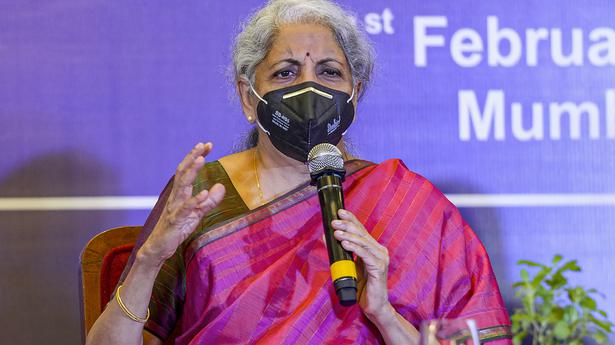
Crude oil poses a key risk to financial stability: Finance Minister
The Hindu
‘Keeping an eye on volatility in markets, but no plans to defer LIC IPO’
The government and the financial sector regulators are keeping close tabs on the evolving Russia-Ukraine situation, high crude oil prices and the extreme volatility in financial markets, Finance Minister Nirmala Sitharaman said on Tuesday, ruling out any extraordinary or special measures to cope with the implications of these headwinds.
Ms. Sitharaman said she is studying the facts of the governance fiasco at the National Stock Exchange (NSE) to assess whether adequate regulatory action was taken by the stock market regulator in the case. She was unfazed about the volatility in equity markets affecting the prospects for the listing of the Life Insurance Corporation of India (LIC) shares before the end of the current financial year in March.
India was hoping for a diplomatic resolution of the Ukraine crisis and the External Affairs Ministry was in touch with all countries in the region so that Indian trade was not affected, Ms. Sitharaman said after steering the 25 th meeting of the Financial Stability and Development Council in Mumbai with the chiefs of financial sector regulators overseeing banking, capital markets, insurance and pensions.
Runaway crude oil prices were identified as one of the major challenges for India’s financial stability by the Council, which also deliberated extensively on “the extreme volatility’ in markets, ‘headwinds’ from the tightening of monetary policy by the U.S. Federal Reserve and other central banks and the “worrisome international situation” in Ukraine, she indicated.
“It is very difficult to say on crude prices, [but] it is obviously an important consideration… It’s not just the rise in global prices that is a problem, but there’s a supply challenge as well,” she pointed out.
On the prospects for local retail fuel price increases, which are expected to rise in tandem with global prices after the ongoing Assembly polls conclude in March, Ms. Sitharaman said it was a decision for oil marketing companies to make.
“But about why oil marketing companies, who actually play at a price… meaning they buy at some cost, they use a 15-day average based on which they put out a pump-level price; what the OMCs will have to do, why they have not done it for the last 7 days, 17 days, 27 days, I cannot answer,” she asserted.


The Thane police have arrested two co-founders of cryptocurrency exchange platform CoinDCX in connection with an alleged fraud of Rs 71.6 lakh, officials said

Meta Chief Executive Mark Zuckerberg is building a CEO agent to help him do his job, the Wall Street Journal reported

Insurance penetration and density are often misunderstood and do not reveal how many families are insured or whether they would be financially secure if the main earning member were to die. The real issue is not reach but adequacy, as households may have life insurance but not enough cover to replace lost income, leaving them financially vulnerable.

Five top firms lose ₹1 lakh crore in market value, with HDFC Bank experiencing the largest decline of ₹56,124.48 crore.

L&T confirms 95% of its West Asia project sites are safe, while addressing logistics challenges amid ongoing regional conflicts.

Mines Ministry to auction 19 critical mineral blocks on March 23, expanding strategic resources for clean energy and technology sectors.

Mines Ministry to auction 19 critical mineral blocks on March 23, expanding strategic resources for clean energy and technology sectors.

Five top firms lose ₹1 lakh crore in market value, with HDFC Bank experiencing the largest decline of ₹56,124.48 crore.

HDFC Bank terminates three senior officials over client onboarding issues at its DIFC branch amid ethical concerns following chairman's resignation.

Air India CEO warns of potential flight cuts and reduced travel demand due to rising fuel costs amid ongoing Gulf conflict.

Options are widely used by retail traders to speculate on the value of the stock for immediate gains and such behaviour in large scale can distort the market

India achieves 1 billion tonne coal production for the second consecutive year, ensuring stable energy supply and economic growth.

Generic drugmakers in India launch affordable Semaglutide versions, targeting a $1 billion diabetes and weight loss market.