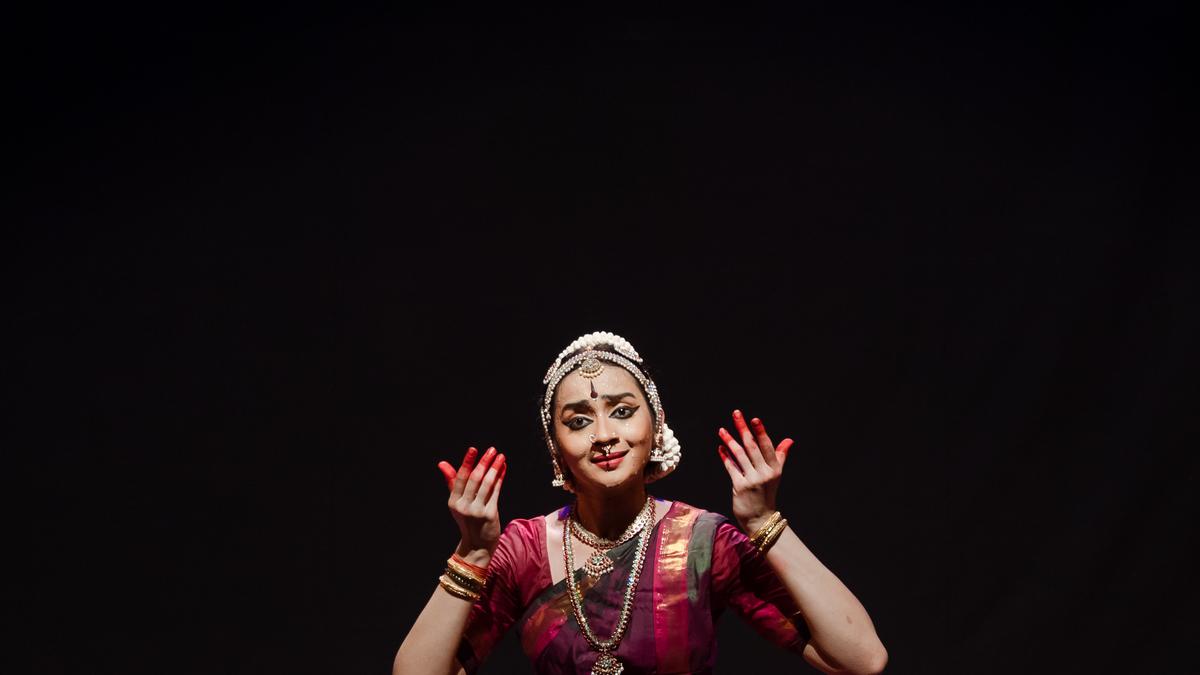
Crisp footwork and poignant depiction marked the performances by Navyashree and Radhika Shetty
The Hindu
The performances by Navyashree and Radhika Shetty were steeped in bhakti
Nrityaangan, Mangaluru, had recently organised two Bharatanatyam performances with the support of the Karnataka Government’s Department of Kannada and Culture. One was an exquisite recital by Navyashree K N, disciple of P. Praveen Kumar, and the other, an endearing emotional journey ‘Manushi – on a quest’, by Radhika Shetty, founder-director of Nrityaangan.
Navyashree made an instant appeal with her crisp adavus, nimble footwork and fleeting facial expressions. The tasteful costume and jewellery enhanced the effect. She began with T.S. Kalyana Sundaram Pillai’s varnam in Kamboji, ‘Naadhanai azhaiththu vaa sakhiyae’ ( My friend, go and bring my Lord). The love-lorn nayika is unable to bear the separation from Lord Muruga and wonders whether her lord’s heart has turned into stone. Though she is angry, she can’t help taking pride in the greatness of her Lord.
Navyashree’s depiction of the nayika’s passionate love, her longing and the pride she felt when she enumerated the great feats of her Lord, were visually appealing. The interesting jathis, presented through graceful steps and facial expressions, spoke highly of the choreography.
‘Jagadhodhaarana aadisidhalu yashodhe’, the eternal favourite of Purandaradasa, gave Navyashree immense scope for emoting, and the young dancer transformed herself into the quintessential mother, exhibiting love, mirth, playfulness, adoration and amazement.
For her thematic presentation ‘Manushi - A quest’, Radhika Shetty, depicted the eternal search of four women (one of them is a river), born out of their unfulfilled desires and longings, but consistently backed by a strong will.
Radhika began with the journey of River Saraswati, once known as the cradle of Vedic culture, which mysteriously dried up and came to be called ‘Gupta Gamini’ (the one who moves secretly, without being seen by anyone). Radhika depicted with great feeling an alive Saraswati in her halcyon days and her present, insignificant status. She concluded the episode wondering whether Saraswati is alive or not? One could feel a lump in the throat as the tale of the vibrant river ended in a question mark. Arjun Bharadwaj’s lyrics, enlivened by rhythmic inputs by DV Prasanna Kumar, were given life by Rohith Bhat Uppoor, who sang it appropriately in the raga Saraswati.
Next, Radhika portrayed Meerabai’s unquenchable desire for Krishna through three bhajans. Meera begins praising the virtues of Hari, ‘Hari gun gaavat naachoongi’, but when Hari does not appear in spite of a long wait, she becomes frustrated and starts wondering why she loved Him at all (Tum sang kaahe peeth lagaayee). But, she cannot be angry and indifferent for long. Finally, she surrenders to Him (Mhe Tho Charan Lagee Gopal). Did Meerabai find solace? Only she can tell. Radhika transformed herself into Meerabai, in her devotion, frustration and total submission.


Sean Penn skips the Oscars to meet Ukraine's Zelenskyy, who praises him as a "true friend" amid the war.

The teaser of Tamil star Suriya’s much-awaited film with director Venky Atluri, titled Vishwanath and Sons, was unveiled by the makers on Monday

A 'Golden' moment for a K-pop track at the Oscars.

Parvathi Nayar’s new exhibition, The Primordial, in Mumbai, traces oceans, pepper and climate change
Opened on March 12, the exhibition marks the artist’s first solo show in Mumbai in nearly two decades. Known for her intricate graphite drawings and multidisciplinary practice spanning installation, photography, video, and climate change, her artistic journey has long engaged with the themes of ecology, climate change and the natural world. In this ongoing exhibition, these strands converge through a series of works centred on water, salt, and pepper — materials that carry natural and historic weight across centuries.

Explore the highlights and key winners of the 98th Academy Awards, featuring memorable moments and historic achievements from Oscars 2026.

Spring season celebrated at Ramakrishna Mission Institute, Kolkata, with ‘Evening of Basant’

The Spirit of the Land, a solo show by artist Shivakumar Sunagar, is a vista of Nature-inspired emotions

Tal Fry is all set for an exciting new performance season

Netflix is making a bold move by snagging InterPositive, the AI filmmaking company founded by Ben Affleck, in a deal that could hit $600 million

Watch the eerie trailer for 'Hokum,' where Adam Scott faces a witch haunting in a mysterious Irish inn.

Oscars 2026 security heightened amid FBI warnings of a potential Iranian drone threat ahead of the Hollywood ceremony.

Directed by Rahul Pandey, the series also stars Naila Grewal, Nidhi Bisht, Anant Joshi, Anjum Batra and Kusha Kapila

A tribute to the versatile actor and comedian V.K. Ramasamy in his birth centenary year.