Could tardigrades have colonised the Moon? Premium
The Hindu
Given the tardigrades remarkable abilities to survive situations that would kill pretty much any other animal, could they have contaminated the Moon?
Just over five years ago, on 22 February 2019, an unmanned space probe was placed in orbit around the Moon. Named Beresheet and built by SpaceIL and Israel Aerospace Industries, it was intended to be the first private spacecraft to perform a soft landing. Among the probe’s payload were tardigrades, renowed for their ability to survive in even the harshest climates.
The mission ran into trouble from the start, with the failure of “star tracker” cameras intended to determine the spacecraft’s orientation and thus properly control its motors. Budgetary limitations had imposed a pared-down design, and while the command center was able to work around some problems, things got even trickier on 11 April, the day of the landing.
On the way to the Moon the spacecraft had been travelling at high speed, and it needed to be slowed way down to make a soft landing. Unfortunately during the braking manoeuvre a gyroscope failed, blocking the primary engine. At an altitude of 150 m, Beresheet was still moving at 500 km/h, far too fast to be stopped in time. The impact was violent – the probe shattered and its remains were scattered over a distance of around a hundred metres. We know this because the site was photographed by NASA’s LRO (Lunar Reconnaissance Orbiter) satellite on 22 April.
So what happened to the tardigrades that were travelling on the probe? Given their remarkable abilities to survive situations that would kill pretty much any other animal, could they have contaminated the Moon? Worse, might they be able to reproduce and colonize it?
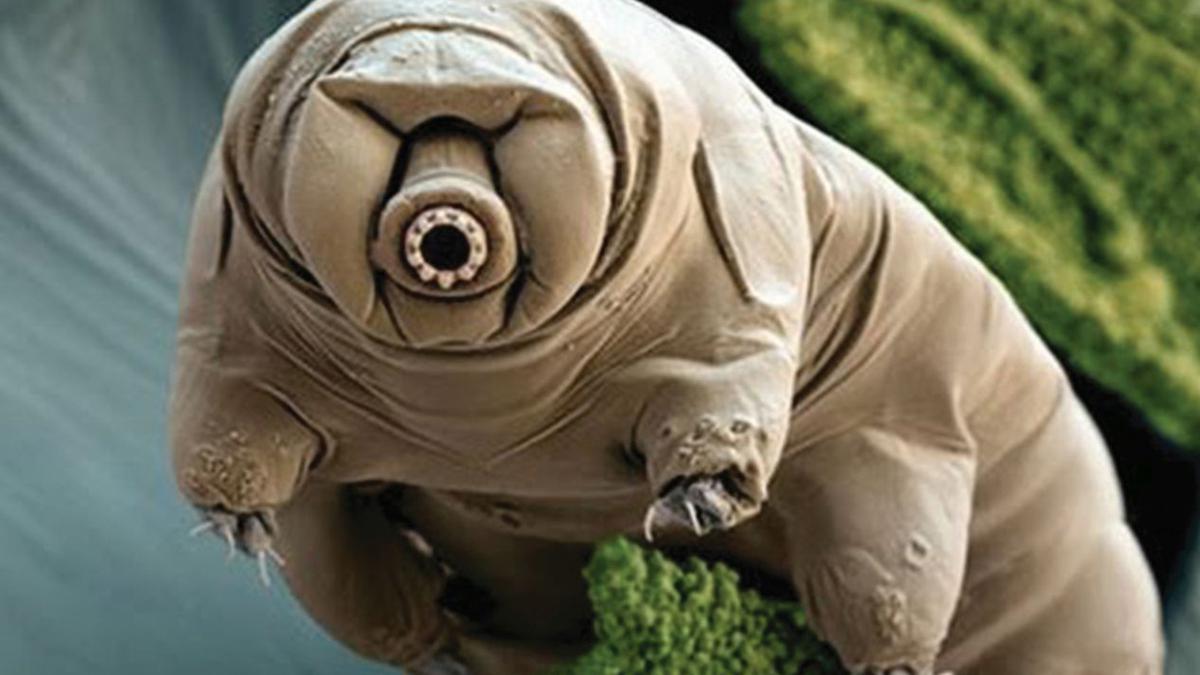
Tardigrades are microscopic animals that measure less than a millimetre in length. All have neurons, a mouth opening at the end of a retractable proboscis, an intestine containing a microbiota and four pairs of non-articulated legs ending in claws, and most have two eyes. As small as they are, they share a common ancestor with arthropods such as insects and arachnids.
Most tardigrades live in aquatic environments, but they can be found in any environment, even urban ones. Emmanuelle Delagoutte, a researcher at the CNRS, collects them in the mosses and lichens of the Jardin des Plantes in Paris. To be active, feed on microalgae such as chlorella, and move, grow and reproduce, tardigrades need to be surrounded by a film of water. They reproduce sexually or asexually via parthenogenesis (from an unfertilised egg) or even hermaphroditism, when an individual (which possesses both male and female gametes) self-fertilises. Once the egg has hatched, the active life of a tardigrade lasts from 3 to 30 months. A total of 1,265 species have been described, including two fossils.
Also Read | How water bears survive lethal UV radiation


Vibha Batra’s latest book, Spotless (Hachette India) is a novel in verse for young adults

In its first edition, the Madras Art Salon spotlights the works of journalist and artist Narayan Lakshman at The Botanical Club, a social space in the British Deputy High Commission, Chennai

Cholesterol enhances melanoma cell invasion by making nuclei squishier, revealing a potential treatment target in cancer progression.

The designers reinterpret the Swedish artist’s symbolic forms and colour energy through contemporary resortwear silhouettes

Discover the inspiring legacy of Bibha Chowdhuri, a pioneering woman in physics and a trailblazer in STEM history.

Discover the inspiring legacy of Bibha Chowdhuri, a pioneering woman in physics and a trailblazer in STEM history.

Ashdeen’s Spring 2026 collection features saris inspired by the designer’s Parsi gara archive

Red ochre burials, ritual markings and myths across cultures show that red repeatedly marks liminal thresholds such as puberty, sacrifice and death; anthropologists argue that the colour functions as a technology of collective ritual and value, binding communities through shared symbolic acts

India approves 23 institutions for quantum labs under the National Quantum Mission, aiming to advance quantum technology and research.

India approves 23 institutions for quantum labs under the National Quantum Mission, aiming to advance quantum technology and research.

The Gaza conflict exacerbates environmental damage, emitting millions of tonnes of CO2 and threatening climate stability in West Asia.

Chefs and cookery experts share smart kitchen hacks, hybrid cooking methods and appliance tips to help households reduce LPG use without compromising on food

Discover groundbreaking research on Titan's lakes, bat vaccinations, and the unique aroma of ripening bananas in just one minute.