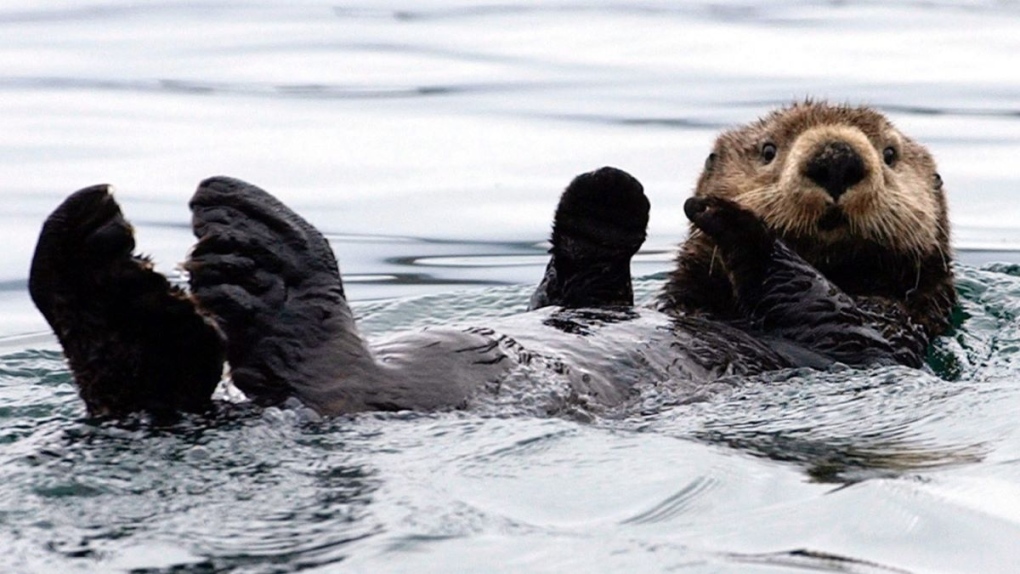
Could sea otters save kelp forests off Northern California coast?
CTV
The health of the ocean off the Northern California coast is in trouble, as biologists have seen a massive die-off of the kelp forests that are essential to a healthy ecosystem. Scientists think bringing back sea otters may be one solution.
The health of the ocean off the Northern California coast is in trouble, as biologists have seen a massive die-off of the kelp forests that are essential to a healthy ecosystem. Scientists think bringing back sea otters may be one solution.
Sea otters may be adorable to look at and fun to watch, but what and how much they eat has put them at the centre of a debate.
Last summer, the U.S. Fish and Wildlife Service began floating the idea of reintroducing sea otters to Northern California and Oregon. The agency is now holding public open houses, including one that took place Wednesday morning in Sausalito.
The problem is the kelp forests that have been dying off, thanks to an explosion of sea urchins. That's happening because sea stars, the urchin's primary natural predators, are being killed by rising water temperatures.
But the urchins' only other natural predator—sea otters—were hunted nearly to extinction in the 1800s for their fur. The idea is to bring them back to try to save the kelp.
"They eat a lot of sea urchins," said Southern Sea Otter Recovery Coordinator Lillian Carswell. "And by eating a lot of sea urchins, they help to defend the kelp from overgrazing. And when the kelp is protected, it tends to expand and create resilient kelp beds. Kelp beds support a really huge diversity of species in the marine environment."
In many places the ocean floor looks desolate, carpeted with nearly-dead urchins and not much else. They call them "urchin barrens."


Officials in Dresden evacuated 18,000 people Wednesday after the discovery of an unexploded World War II bomb, the largest such operation yet in the eastern German city, emergency services said.

At least six people have been killed and three others hospitalized with severe injures after a bus caught fire in a town west of the Swiss capital, police said Tuesday.

A U.S. judge has rejected a request for a new trial for a Venezuelan man convicted of killing Georgia nursing student Laken Riley, a case that became a flashpoint in the national debate over immigration.

Without warning, the sleepy Cuban farm town of San Antonio de los Baños burst into protest one morning nearly five years ago, triggering a series of copycat demonstrations across the country that shook the Communist government unlike any event in decades.

Three wealthy brothers, including two of New York’s top real estate brokers, were found guilty on Monday at a closely watched sex trafficking trial over allegations they lured women and girls to exclusive parties where they drugged and raped them.

Lawyers for a man accused of carrying out a deadly shooting on Sydney’s Bondi Beach sought a court order on Monday to stop media naming his family, saying their safety was at risk.

A fire at a building near Scotland’s Glasgow Central Station has caused major disruptions to train services.

A U.S. federal judge ruled Saturday that Kari Lake, U.S. President Donald Trump’s choice to lead the U.S. Agency for Global Media, did not have legal authority to take the actions she’s done to largely dismantle the Voice of America. The decision’s effect on VOA operations was not immediately clear.

Visitors to the Capitol will now have a visible reminder of the violent attack against the building on Jan. 6, 2021, and the officers who fought and were injured that day.

U.S. President Donald Trump is set to gather with Latin American leaders on Saturday at his Miami-area golf club as his administration looks to demonstrate it’s still committed to sharpening U.S. foreign policy focus on the Western Hemisphere even as it deals with five-alarm crises around the globe.

The calls to 911 poured in from staff at Camp East Montana in Texas, the nation’s largest U.S. Immigration and Customs Enforcement detention facility, at a rate of nearly one a day for five months, each its own tale of pain and despair.

Some two dozen states challenged President Donald Trump’s new global tariffs on Thursday, filing a lawsuit over import taxes he imposed after a stinging loss at the Supreme Court.

A Florida handyman who was sentenced on Thursday to life in prison for molesting two children had been convicted of storming the Capitol on Jan. 6, 2021, but was pardoned by U.S. President Donald Trump.