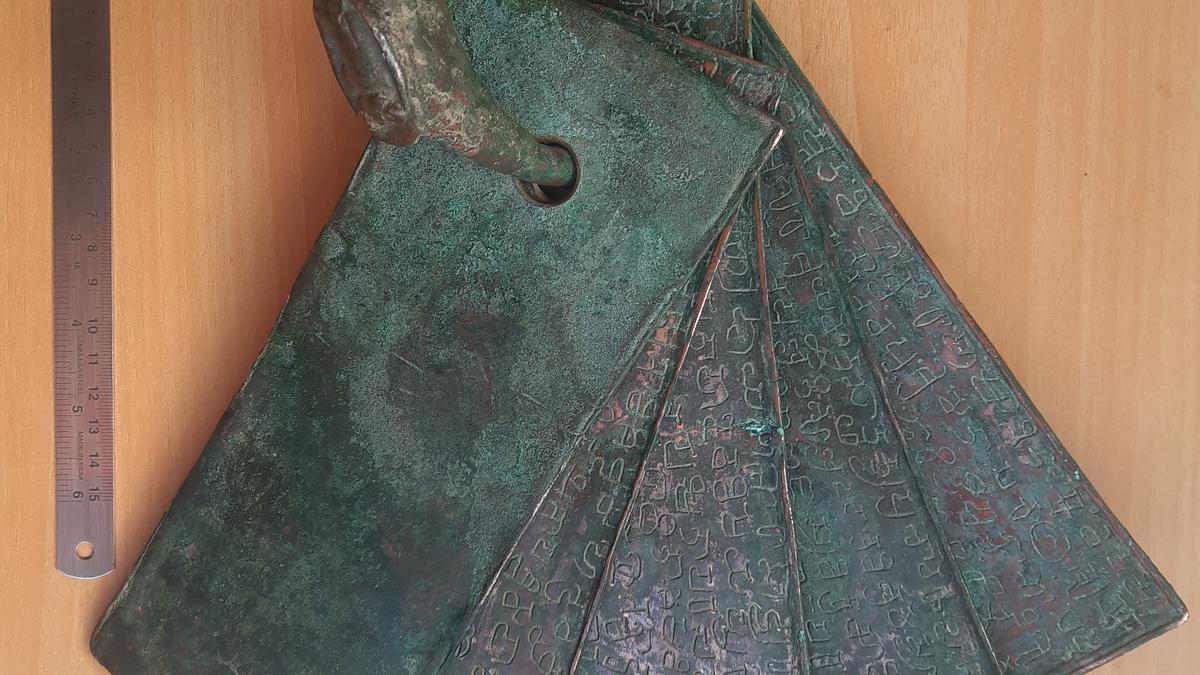
Copper plates decoded by Pune-based Bhandarkar Institute sheds light on celebrated ancient Sanskrit poetess Shilabhattarika
The Hindu
Following the decoding of inscriptions on copper plates earlier this month, noted Sanskrit scholar Dr. Shreenand Bapat, said it was now reasonably certain that Shilabhattarika was a Chalukyan princess, possibly the daughter of Pulakeshin II, who ruled from 610-642 CE and had famously defeated Harshavardhan of Kanauj in a battle near the banks of the Narmada River in 618 CE.
The reconstruction of History, particularly that of the Ancient World where sources are few and far, is often likened to detective work.
Researchers at the Pune-based Bhandarkar Oriental Research Institute (BORI), which houses South Asia’s largest collection of manuscripts and rare texts, recently embarked on a grand adventure in detection after which they claim to have shed new light on Shilabhattarika— the celebrated Sanskrit poetess of Ancient India by establishing her as a daughter of the famed Chalukyan Emperor, Pulakeshin II of Badami (in modern Karnataka).
Following the decoding of inscriptions on copper plates earlier this month, noted Sanskrit scholar Dr. Shreenand Bapat, registrar and curator at BORI, said it was now reasonably certain that Shilabhattarika was a Chalukyan princess, possibly the daughter of Pulakeshin II, who ruled from 610-642 CE and had famously defeated Harshavardhan of Kanauj in a battle near the banks of the Narmada River in 618 CE.
Speaking to The Hindu, Dr. Bapat said that the importance of this decipherment shed a revelatory new light on Shilabhattarika, who stood out as a poetess in the ancient Indian world in the heavily male-dominated field of classical Sanskrit literature.
The Sanskrit poet-critic Rajashekhara (who lived in the 9th-10th century CE) and was the court poet of the Gurjara-Pratiharas, has praised Shilabhattarika for her elegant and beautiful compositions.
Noted Marathi poetess, Shanta Shelke, too, has drawn inspiration from Shilabhattarika’s verse to compose one of her most iconic songs— toch chandrama nabhat (translated as ‘it is the same moon in the sky’).
The decoding of the copper plates also marks a notable shift in the historiography of Badami Chalukyas by placing Shilabhattarika as having lived in the 7th century CE rather than the current theory which has her as a wife of the 8th century Rashtrakuta ruler, Dhruva.


Ramanathapuram identifies 145 polling stations as sensitive, ensuring security with paramilitary forces ahead of assembly elections, says DEO.

BJP Puducherry president V. P Ramalingam files nomination for Raj Bhavan, joined by Union Minister Mandaviya and Khushbu Sundar.

History-sheeter 'Thoppai' Ganesh shot dead by police in Chennai after attacking officers during attempted escape.

The government plans to amend the FCRA, introducing new regulations for NGO asset management and accountability for key functionaries.

The draft policy for “Responsible Digital Use Among Students”, released on Monday by the Department of Health and Family Welfare, has recommended that parents set structured routines with clear screen-time rules and prioritise privacy, safety, and open conversation with children on digital well-being.

Police Observer Sushant Kumar Saxena conducts surprise inspection at Shencottai police station, reviewing warrants and security arrangements ahead of elections.

Andhra Pradesh government to launch key projects in April, focusing on industrial growth and infrastructure development, says Nara Lokesh.

Lok Sabha refers the Corporate Laws (Amendment) Bill to a JPC amid opposition concerns over CSR provisions dilution.

SHG members in Kanniyakumari use snakes and ladders to raise election awareness and boost voter turnout.

Government accelerates consultations for early implementation of the Women’s Reservation Act to ensure women’s representation in 2029 elections.

CM A. Revanth Reddy distributes ₹1 crore insurance cheques to families of deceased Electricity department employees, enhancing financial security for workers.

The Bengaluru Traffic Police (BTP) registered 634 cases of drunk driving during a week-long special enforcement drive conducted across the city between March 16 and March 22.

GHMC intensifies action against property tax defaulters, seizing properties and offering a One Time Settlement scheme for payments.